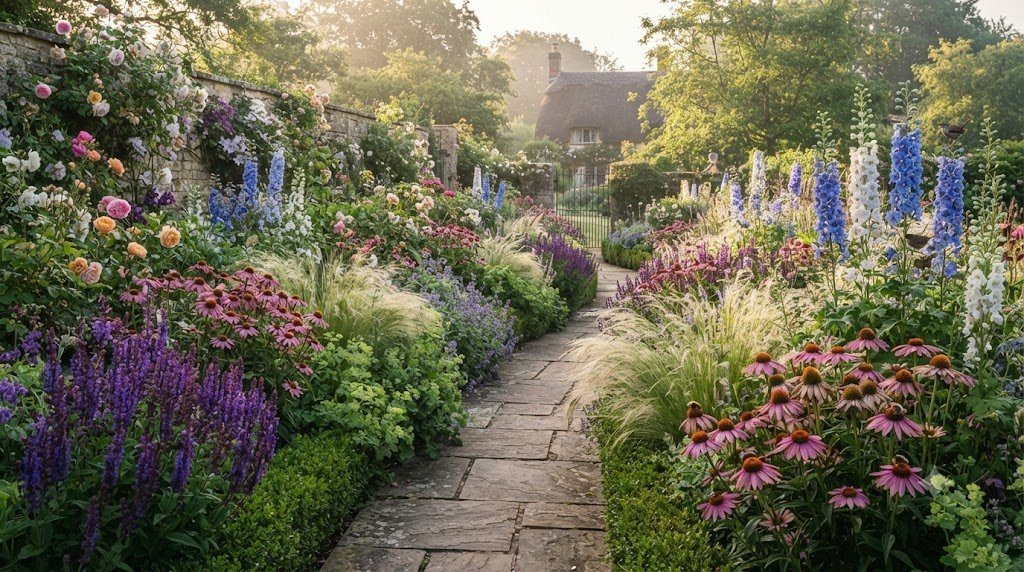
The English herbaceous perennial border represents one of the most sophisticated achievements in ornamental landscape architecture. Unlike seasonal annual beds that provide uniform, static color throughout the summer before perishing in autumn, a dynamic perennial border is a living, evolving four-dimensional tapestry. Designing an exceptional perennial border requires an integrated mastery of botanical succession blooming calendars, vertical canopy stratification, structural foliar contrasts, and precise soil chemistry calibrated to sustain long-lived woody root crowns and taproots across multiple decades.
Vertical Stratification and Spatial Depth Geometry
The foundational principle of perennial border architecture is vertical stratification—organizing plants by mature height, crown spread, and structural habit to create visual depth, maximize photosynthetic interception, and prevent aggressive specimens from shading out delicate understory companions. A classical mixed border is organized into three distinct spatial planes:
The Foreground (Edge Matrix: 6 to 18 Inches)
Foreground plantings anchor the boundary between lawn or stone walkway and the garden bed. These species must possess dense, compact mounding habits and pristine foliar presence throughout the entire season, even when not in active bloom. Ideal structural candidates include Alchemilla mollis (Lady’s Mantle) with its hydrophobic dew-trapping leaves, mounding Geranium cultivars (‘Rozanne’), creeping campanulas, and broad-leaved heucheras that conceal bare lower stems of mid-border perennials.
The Mid-Ground (Core Tapestry: 2 to 4 Feet)
The mid-ground comprises the primary visual body of the border, where succession color interplay unfolds. This layer relies on architectural floral forms—such as the vertical spires of Salvia nemorosa (‘Caradonna’) and Veronica, the broad flat umbels of Achillea millefolium (Yarrow), and the textural globes of Echinacea purpurea (Purple Coneflower) and Monarda didyma (Bee Balm).
The Background (Architectural Spire Anchor: 5 to 8+ Feet)
The background establishes the vertical backdrop and visual boundary of the bed. It requires towering structural perennials that maintain rigid, wind-resistant stems without requiring unsightly staking cords. Exemplary architectural species include Delphinium elatum, Thalictrum rochebruneanum (Lavender Mist Meadow Rue), Eupatorium maculatum (Joe Pye Weed), and giant ornamental grasses like Calamagrostis x acutiflora (‘Karl Foerster’).
Succession Blooming Matrices: Chronological Color Choreography
A common pitfall in perennial garden design is the ‘June peak collapse’—where a garden explodes into spectacular color in early summer, only to degenerate into a dull, monotonous expanse of green seed heads by mid-July. Preventing this requires engineering continuous succession blooming across four distinct seasonal phases:
| Seasonal Bloom Phase | Key Architectural Perennial Species | Foliar Form & Texture | Peak Chromatic Palette | Care Protocol |
|---|---|---|---|---|
| Early Spring Awakening (April – May) | Helleborus, Pulmonaria, Brunnera macrophylla | Bold, leathery, silver-variegated | Pastel rose, sky blue, cream | Cut back winter-damaged foliage early |
| Early Summer Surge (June – July) | Salvia, Paeonia, Delphinium, Geranium | Fine spires, dense mounds, heavy blooms | Indigo, magenta, pure white | Deadhead spent flower spikes immediately |
| Mid-to-Late Summer Zenith (July – August) | Echinacea, Rudbeckia, Monarda, Helenium | Coarse daisy rays, prominent cones | Fiery copper, golden amber, ruby | Deep drip irrigation; check powdery mildew |
| Autumn Finale & Winter Seedheads (Sept – Nov) | Symphyotrichum (Asters), Sedum, Ornamental Grasses | Feathery plumes, rigid russet discs | Deep purple, bronze, rich gold | Leave structural seed heads for winter birds |
Soil Chemistry, Crown Aeration, and Drainage Mechanics
Unlike annuals that flourish in loose, fluffy, highly fertilized potting blends, woody perennial root crowns demand structurally stable, well-aggregated soil with exceptional internal drainage. The single greatest killer of prized perennials—including lavender (Lavandula), cone-flowers (Echinacea), and Russian sage (Salvia yangii)—is winter crown rot caused by saturated, anaerobic clay soil.
Cation Balancing and Soil pH for Perennial Longevity
Most temperate herbaceous perennials thrive in circumneutral to slightly acidic soils with a pH between 6.2 and 6.8. In this range, beneficial soil bacteria and mycorrhizal fungi actively release phosphorus and micronutrients without chemical lockup. Incorporating coarse horticultural grit, expanded shale, and composted pine bark into heavy soils creates permanent macroscopic pores that drain excess gravity water rapidly while retaining capillary film moisture around fine feeder root hairs.
Pruning Mechanics: The Chelsea Chop and Deadheading Science
Active canopy management dramatically extends the blooming window and structural stability of tall late-season perennials:
- The Chelsea Chop Technique: Practiced in late spring (around late May), this procedure involves cutting back selected late-summer bloomers (such as Helenium, Phlox paniculata, Echinacea, and Sedum) by one-third to one-half. This temporary shock stimulates lateral branching, creates compact, bushy plants that never require staking, and delays flowering by two to three weeks. Cutting half the plants in a drift while leaving the other half untouched doubles the overall bloom duration!
- Deadheading to Prevent Seed Synthesis: Producing seeds consumes immense biochemical energy. Removing spent flowers before seeds mature halts the plant’s hormonal shutdown signals, prompting auxiliary flower buds along the stem to burst into a vibrant second flush of late-season blooms.
Dividing Perennials: Rejuvenation and Clonal Propagation
After three to five years of vigorous growth, many clump-forming perennials (such as hostas, daylilies, and Siberian irises) develop hollow, dead centers as outer root crowns exhaust central soil nutrients. Dividing these crowns in early spring or early autumn rejuvenates plant vigor, restores profuse flowering, and yields dozens of identical cloned specimens to expand existing beds or share with fellow gardeners.
Color Theory Biophysics: Chromatic Temperature and Complementary Harmony
Designing world-class perennial borders requires applying classic visual color theory to the botanical spectrum. Light reflection from plant petals interacts dynamically with human visual perception and the fluctuating quality of sunlight from dawn to dusk:
- Warm Chromatic Spectra (Reds, Oranges, Saturated Yellows): Warm colors possess longer wavelengths that advance visually toward the viewer. Positioning warm drifts (such as Helenium ‘Moerheim Beauty’ or orange Echinacea) at the near end of a border makes spaces feel vibrant, intimate, and energetic. In bright, harsh midday sun, warm colors retain intense visual impact without washing out.
- Cool Chromatic Spectra (Blues, Purples, Violets, Silvers): Cool colors possess shorter wavelengths that recede visually. Planting deep violet spires (Salvia ‘Caradonna’) and soft blue bells (Campanula) at the far end of a border creates an optical illusion that stretches spatial perspective, making small gardens appear significantly longer and more expansive. Furthermore, cool blues and lavenders glow with luminous intensity during twilight and overcast cloudy days.
- Complementary Contrast Harmonies: Pairing direct chromatic opposites on the 12-hue color wheel—such as royal purple salvias alongside golden-yellow coreopsis, or magenta echinacea beside chartreuse Alchemilla mollis—creates intense, high-energy visual resonance where each hue enhances the brilliance of the other.
| Color Harmony Style | Dominant Floral Genera | Accent Foliage Companion | Psychological Mood | Optimal Sunlight Exposure |
|---|---|---|---|---|
| Monochromatic White (‘Moon Garden’) | Phlox paniculata ‘David’, Echinacea ‘Virgin’ | Silver Stachys byzantina, Artemisia | Serene, luminous, architectural | Evening twilight / Moonlit gardens |
| Harmonious Analogy (Warm Surge) | Crocosmia ‘Lucifer’, Helenium, Rudbeckia | Bronze-leaved Heuchera, Purple Grasses | Dynamic, fiery, celebratory | Full direct afternoon sun |
| Complementary Contrast (High Energy) | Purple Salvia, Golden Achillea ‘Moonshine’ | Blue-green Hosta sieboldiana | Vibrant, high-contrast, bold | All-day open sun |
| Cool Pastel Serenity | Pale pink Paeonia, Blue Delphinium, Geranium | Chartreuse Alchemilla mollis | Calm, classical English romantic | Gentle morning sun / dappled light |
Soil Microbiology for Long-Lived Perennial Root Systems
Unlike annual vegetable beds that thrive on bacterial-dominated soils (Fungal-to-Bacterial ratio < 0.5:1), mature perennial borders demand a fungal-dominated soil ecology (F:B ratio between 2:1 and 5:1). Long-lived woody root crowns form extensive perennial networks with ecto- and endomycorrhizal fungi that break down complex woody lignin. Mulch perennial beds exclusively with shredded arborist wood chips, composted pine bark, or deciduous leaf mold rather than fine green grass clippings. Fungal mycelial mats thread through woody mulch, synthesizing glomalin that permanently glues soil minerals into stable, water-permeable aggregates.
Winter Silhouette Architecture: The New Perennial Movement
Pioneered by Dutch master plantsman Piet Oudolf, the contemporary ‘New Perennial Movement’ mandates that a perennial must look just as structurally magnificent when dead in winter as it does in full June flower. Instead of cutting back the entire garden into bare dirt in October, leave the dark architectural seed heads of Echinacea, the sculptural russet discs of Sedum ‘Autumn Joy’, and the feathery bleached plumes of ornamental grasses (Miscanthus, Panicum) standing through winter. Frost and snow transform these silhouettes into breathtaking botanical ice sculptures while providing crucial winter seed calories for resident songbirds.
Soil Drainage Percolation Testing and Macro-Pore Engineering
Before investing substantial capital in a multi-thousand-dollar perennial border, landscape architects must evaluate the soil’s internal Hydraulic Conductivity ($K_{sat}$) using a standardized field percolation test. Perennial root crowns drown in soils with sluggish drainage, while drought-intolerant species desiccate in excessively porous sands.
The Field Percolation Test Protocol
Excavate a test hole 12 inches in diameter and 12 inches deep in the proposed border bed. Fill the hole with water and allow it to saturate the surrounding soil profile completely for 4 hours. Refill the hole to the top with water and measure the rate of water descent in inches per hour using a ruler:
- Optimal Percolation (1.0 to 2.5 inches per hour): The ideal drainage velocity for temperate mixed perennial borders. Excess gravity water drains away within 6 to 8 hours, while capillary films remain available to feeder roots.
- Deficient Drainage (< 0.5 inches per hour): Indicates dense clay or hardpan compaction. Requires raising the border 8 to 12 inches above native grade and amending with expanded shale and coarse horticultural grit.
- Excessive Drainage (> 4.0 inches per hour): Indicates coarse sand or gravel. Water drains too rapidly to sustain broad-leaved perennials. Requires incorporating generous quantities of cured deciduous leaf compost to boost water-holding micropores.
| Percolation Rate (in/hr) | Drainage Classification | Root Crown Rot Risk | Recommended Perennial Genera | Soil Engineering Remedy |
|---|---|---|---|---|
| < 0.5 Inches / Hour | Severe Drainage Restriction | Extremely High (Fatal in winter) | Iris sibirica, Ligularia, Astilbe | Install French drains or raised berms |
| 1.0 – 2.5 Inches / Hour | Optimal Loam Drainage | Very Low (Healthy root crowns) | Echinacea, Salvia, Paeonia, Phlox | Standard organic compost mulching |
| > 4.0 Inches / Hour | Excessive Porosity (Drought) | Zero (Extreme dehydration risk) | Lavandula, Achillea, Sedum, Stachys | Heavy application of humified compost |
Clonal Division Schedules: Preserving Crown Vigor Over Time
Different perennial families exhibit contrasting lifespans and division requirements. While taprooted species like False Indigo (Baptisia) and Peonies (Paeonia) resent root disturbance and should remain undivided for decades, fibrous-rooted clump formers—such as Salvia nemorosa, Helenium, and Coreopsis—require division every 3 to 4 years to prevent central crown senescence and maintain vigorous, floriferous border displays.
Structural Root Crown Management and Winter Mulch Removal
In early spring, timing the removal of protective winter mulch is a critical management operation. Leaving thick winter mulch blankets over perennial crowns as spring soil temperatures warm encourages premature, etiolated (bleached) shoot growth and creates ideal conditions for crown rot (Sclerotium rolfsii).
Rake back heavy winter straw and leaf mulches away from crowns in early spring as crocuses bloom, allowing warm sunlight and fresh air to reach dormant perennial crowns. Re-apply a light, breathable 2-inch layer of shredded hardwood mulch only after soil temperatures consistently exceed 55°F (13°C), keeping mulch strictly two inches away from plant stems.
Underplanting Geophytes in Perennial Borders
Transform perennial borders into year-round ecological tapestries through stratified geophyte underplanting. Plant early spring botanical bulbs (such as Galanthus, Crocus, and Narcissus) directly beneath late-emerging architectural perennials (such as Hosta sieboldiana and Paeonia). The bulbs emerge, flower, and begin photosynthesizing in early spring sunlight before perennial crowns break dormancy. As the bulb foliage senesces in May, expanding perennial leaves naturally conceal the dying yellow bulb leaves without requiring human cleanup.