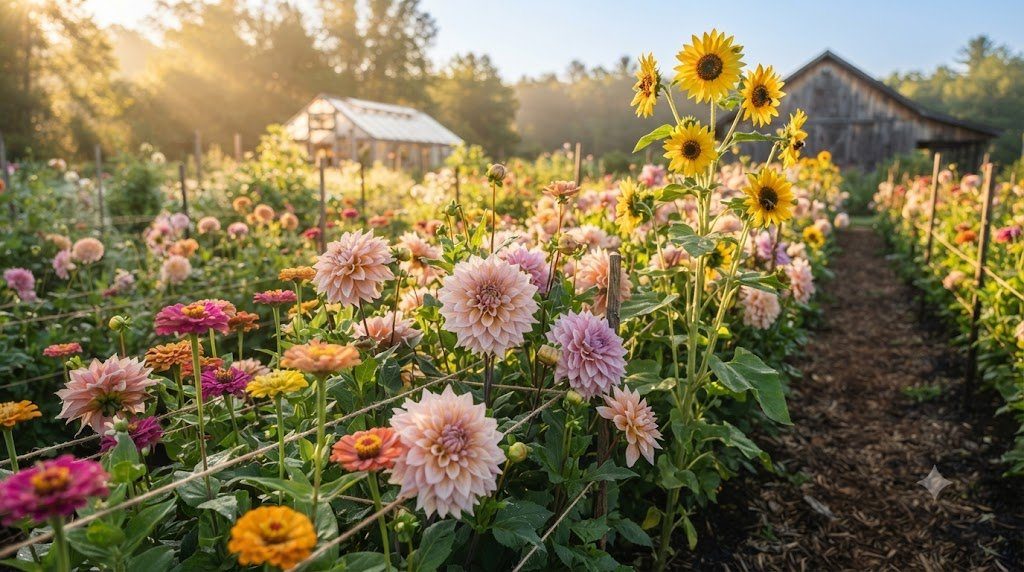
Commercial-grade ornamental cut flower production requires a radically different agronomic mindset than casual garden bed display. While landscape flowers are cultivated for compact bushy growth and prolonged on-the-plant color, cut flowers are engineered for exceptional stem length, caliper thickness, vase life longevity, petal rigidity, and symmetrical blossom geometry. Mastering high-yield production of the ‘Big Three’ summer cut flower staples—Dahlias (Dahlia pinnata), Zinnias (Zinnia elegans), and Branching Sunflowers (Helianthus annuus)—requires precise apical pinching, specialized support netting, mineral-balanced fertigation, and post-harvest vascular hydration science.
Dahlia Tuber Agronomy: Eyes, Tubers, and Crown Anatomy
Dahlias are tender tuberous perennials originating from the high-altitude volcanic plateaus of Mexico and Central America. Unlike true potatoes where ‘eyes’ (buds) emerge randomly across the tuber surface, dahlia tubers are biologically incapable of producing shoots on the tuber body itself. New vegetative growth arises strictly from the crown—the narrow neck collar connecting the tuber to the previous year’s stalk.
Tuber Dividing and Sanitation Protocol
When dividing overwintered tuber clumps in early spring, every viable division must contain three distinct anatomical structures: a sound, undamaged storage tuber; an intact neck; and at least one clearly visible eye on the central crown collar. Use a sanitized scalpel or surgical grafting knife, dipping blades in 70% isopropyl alcohol between cuts to prevent mechanical transmission of Dahlia Mosaic Virus (DMV).
Structural Support Engineering: Hortonova Netting Systems
Heavy-blooming dahlia cultivars (such as giant ‘Café au Lait’ dinnerplates) and tall branching zinnias develop top-heavy floral canopies that readily snap under sudden summer thunderstorms or gusting winds. Installing horizontal Hortonova crop support netting is essential:
| Support System | Mesh Size | Tensioning Hardware | Stem Straightness Rating | Harvest Efficiency |
|---|---|---|---|---|
| Double-Layer Hortonova Netting | 6″ x 6″ Polypropylene | T-posts at 10-ft intervals with conduit | Exceptional (98% arrow-straight) | High (Clean vertical stem pulls) |
| Single Lower Support Net | 6″ x 6″ Mesh at 18 inches | Rebar corner posts with turnbuckles | Moderate (Late-season wind sway) | High |
| Individual Bamboo Stakes & Twine | Single stem ties | Manual bamboo stakes per plant | Fair (Labor-intensive maintenance) | Very Slow (Constant untying) |
| Unsupported Free Growth | None | None | Disastrous (Over 60% bent/lodged stems) | Extremely Poor (Damaged petals) |
Zinnia Cultivation: Apical Management, Alternaria, and Powdery Mildew
Zinnias (Zinnia elegans)—exemplified by long-stemmed benchmark varieties like the ‘Benary’s Giant’ and ‘Queen Lime’ series—are warm-season annual workhorses that produce copious florist-grade blooms under high solar radiation. However, zinnias are acutely prone to two devastating fungal pathogens: Alternaria leaf spot (Alternaria zinniae) and Powdery Mildew (Golovinomyces cichoracearum).
Drip Irrigation and Cultural Disease Suppression
Never irrigate zinnias with overhead sprinklers. Wetting zinnia foliage triggers rapid germination of airborne fungal spores within 4 to 6 hours of surface moisture. Always utilize sub-surface or surface drip irrigation tape operating under 10–12 psi with emitters spaced 8 inches apart. Ensure broad row spacing (12 inches between plants, 18 inches between rows) to maintain rapid laminar airflow through lower canopies.
Branching and Pollenless Sunflowers: Stem Geometry and Photoperiod
Professional cut flower sunflowers differ fundamentally from garden birdseed types. Commercial cut cultivars—such as the ‘ProCut’ and ‘Sunrich’ series—are bred to be strictly pollenless single-stem hybrids. Pollenless flowers eliminate messy yellow pollen drops that stain table linens and irritate allergy sufferers, while extending vase life by 5 to 7 days because unfertilized female ray florets do not trigger senescence hormones.
High-Density Sowing for Caliper Control
In a standard garden setting, sunflowers spaced 24 inches apart produce massive, tree-trunk stems with 12-inch flower heads that are entirely unmanageable in table vase arrangements. Cut flower growers deliberately plant pollenless sunflowers at ultra-high densities (4 to 6 inches apart in grid patterns). High-density root competition restricts individual stem diameter to an elegant 0.5-inch caliper and constrains blossom diameter to an ideal 4 to 5 inches.
Post-Harvest Physiology and Vascular Hydration Chemistry
Maximizing vase life begins the moment stems are harvested from the field:
- Harvesting Chronology: Cut flowers exclusively during early morning hours before transpirational water stress occurs, or late in the evening after photosynthetic carbohydrate accumulation peaks. Never harvest in midday sun.
- Harvest Stage Diagnostics: Harvest dahlias when blooms are 75% open (dahlias do not open significantly in water after cutting). Harvest zinnias when stems pass the ‘wiggle test’—holding the stem 8 inches below the flower; if the neck wobbles, it is too immature; if rigid, it is ready. Harvest sunflowers when the first ray petal begins lifting off the central disc.
- Hydration and Water Conditioning: Strip all foliage from the bottom two-thirds of the stem. Place immediately into sanitized harvest buckets filled with cool water treated with a commercial flower holding solution containing a citric acid acidifier (lowering water pH to 3.5–4.5 to inhibit bacterial vascular occlusion) and a broad-spectrum microbicide.
Vascular Occlusion Dynamics and Post-Harvest Flower Food Chemistry
The premature wilting of freshly cut flowers—commonly observed as ‘bent neck’ in dahlias and zinnias—is almost never caused by lack of water in the vase. It is caused by vascular xylem occlusion: the physical blockage of the microscopic water-conducting tubes inside the cut stem. Vascular occlusion occurs through three distinct mechanisms:
- Bacterial and Fungal Proliferation: Within 12 hours of placing cut stems in plain tap water, bacteria feed on sugars leaking from the severed stem cells, multiplying into billions of cells that physically plug xylem vessels like a cork.
- Embolism and Air Cavitation: When a stem is severed, transpirational tension pulls air bubbles into the open xylem vessels. These air pockets (embolisms) break the continuous hydrogen-bonded water column, preventing water uptake.
- Physiological Wound Response (Callose Deposition): The plant recognizes the cut as an injury and deposits wound-healing callose and gummy pectin over the severed surface, sealing off water transport channels.
Formulating Professional Cut Flower Holding Solutions
Commercial flower food formulas are mathematically engineered to neutralize all three occlusion pathways:
| Chemical Constituent | Standard Concentration | Biochemical Mechanism | Agronomic Impact on Vase Life |
|---|---|---|---|
| Acidifier (Citric Acid / Aluminum Sulfate) | Adjusts water pH to 3.5 – 4.2 | Reduces water surface tension; optimizes xylem flow | Accelerates rapid water uptake into drooping petals |
| Biocide (Chlorine Dichloroisocyanurate / 8-HQC) | 50 – 100 ppm active chlorine | Sterilizes vase water; prevents bacterial biofilms | Eliminates stem slime and foul odors completely |
| Metabolic Carbohydrate (Sucrose / Glucose) | 1.0% – 2.5% sugar solution | Provides respiratory energy for petal cell expansion | Ensures tight buds open fully with rich pigmentation |
| Ethylene Inhibitor (Aminoethoxyvinylglycine / STS) | Trace micronutrient chelate | Blocks ethylene hormone synthesis receptors | Extends vase life of sensitive blooms by 4-8 days |
Dahlia Tuber Storage Physiology and Winter Overwintering
In USDA hardiness zones 7 and colder, dahlia tubers cannot survive freezing winter soils and must be lifted and stored. Dig tubers two weeks after the first killing frost has turned foliage black, which signals tubers to enter dormant storage. Wash away native soil, allow tubers to cure in a dry, ventilated room at 60°F for 48 hours until skin is dry to the touch, and pack in slightly damp vermiculite or peat moss inside ventilated cardboard boxes. Maintain storage temperatures between 40°F and 48°F (5°C to 9°C). If temperatures drop below 32°F, tubers freeze and turn to mush; if temperatures exceed 55°F, tubers sprout prematurely and desiccate.
Branching Cut Sunflowers: Sequential Succession Planting Math
Single-stem cut sunflowers produce exactly one marketable stem per plant before dying. To maintain a continuous weekly supply of florist-grade sunflowers throughout the summer, growers must plant sequential successions every 7 to 10 days from early spring through mid-summer. Utilizing high-density planting grids (6×6-inch spacing) in raised beds ensures continuous stem caliper control and yields up to 36 premium stems per square yard of bed space every single week.
Cold Room Storage Biophysics and Post-Harvest Cooling Protocols
The biological longevity of commercial cut flowers is governed by temperature. Every hour a freshly harvested stem remains in ambient 75°F (24°C) field heat consumes stored carbohydrate reserves at triple the rate of a stem cooled to 38°F (3°C), slashing potential vase life by multiple days. Professional cut flower growers deploy immediate post-harvest cold chain management:
The Floral Cold Cooler Regimes
Immediately after field harvesting, conditioned stems are transferred into a dedicated walk-in floral cooler. Cooler temperature and humidity parameters must be tailored to species tolerances:
- Temperate Cut Flowers (Zinnias, Sunflowers, Peonies): Stored at 34°F to 38°F (1°C to 3°C) with 85% to 90% relative humidity. Near-freezing temperatures suppress cellular respiration to near zero, arresting petal aging while preventing fungal sporulation.
- Cold-Sensitive Flowers (Dahlias, Tropical Blooms): Stored at 42°F to 48°F (6°C to 9°C). Storing dahlias below 40°F causes irreversible chilling injury, manifested as petal browning and premature leaf collapse.
| Cut Flower Species | Optimal Harvest Stage | Post-Harvest Cooler Temp | Expected Vase Life (Days) | Key Physiological Challenge |
|---|---|---|---|---|
| Dahlia (Dahlia pinnata) | 75% – 85% Open (Petals firm) | 42°F – 48°F (Sensitive to cold) | 5 – 7 Days | Bacterial vascular stem clogging |
| Zinnia (Zinnia elegans) | Rigid stem (‘Wiggle test’ pass) | 36°F – 40°F | 7 – 10 Days | Foliar bacterial rot in dirty water |
| Sunflower (Pollenless ProCut) | First ray petal lifting off disc | 34°F – 38°F | 10 – 14 Days | High water consumption; vascular wilt |
| Sweet Pea (Lathyrus odoratus) | 2 Flowers open on stem | 34°F – 36°F | 4 – 6 Days | Extreme sensitivity to ethylene gas |
Sanitation Chemistry: Eliminating Biofilms in Harvest Buckets
The primary vector of vascular occlusion in cut flowers is bacterial biofilm accumulating on the walls of harvest buckets. Washing buckets with plain water does not eliminate bacterial colonies. Implement a commercial floral sanitation protocol: scrub all harvest buckets between uses with a quaternary ammonium compound or a 10% sodium hypochlorite bleach solution, and air-dry in direct sunlight to destroy persistent bacterial pathogens.
Field Trellising Tensioning Math and Cable Turnbuckle Hardware
Installing multi-layer Hortonova crop support netting over 100-foot commercial cut flower rows requires proper mechanical tensioning. Under heavy autumn crop canopies, wind loads exert hundreds of pounds of lateral force against end posts:
- Heavy-Gauge Steel T-Posts: Install 8-foot heavy-duty steel T-posts at row ends, driven a minimum of 24 inches into subsoil and angled backward at 15 degrees.
- Cable Gripples and Turnbuckles: Run 1/8-inch galvanized aircraft cable along row perimeters through the edges of the netting. Tighten cables using heavy-duty galvanized turnbuckles or Gripple tensioners to eliminate mid-row sag, ensuring horizontal netting remains flat and taut.
Post-Harvest Floral Waxing and Stem Sear Treatments
Certain hollow-stemmed cut flowers (such as giant dahlias) benefit from stem sear treatment: briefly dipping the bottom half-inch of severed stems in boiling water for 15 seconds to sterilize cut ends and expel air bubbles, followed immediately by transfer into deep, chilled floral holding solutions treated with citric acid.
Ethylene Scrubbing in Floral Coolers
Flowers are exquisitely sensitive to ambient ethylene gas ($C_2H_4$), a gaseous phytohormone produced by ripening fruit and decaying foliage. Ethylene accelerates petal abscission, bud blasting, and sleepiness in sensitive cuts (sweet peas, carnations, dahlias). Ensure floral cold rooms feature activated potassium permanganate ($KMnO_4$) ethylene scrubbing filters, and never store harvested flowers in the same cooler with apples, tomatoes, or ripening produce.
Master Floriculture Principles and Seasonal Border Action Checklist
Establishing a world-class floral landscape requires transitioning from reactive gardening to proactive ecological stewardship. A thriving flower garden balances aesthetic chromatic harmony with enduring botanical vigor, providing endless beauty for the gardener while serving as a vital sanctuary for regional wildlife.
The Floriculture Seasonal Maintenance Matrix
Adhere to this comprehensive four-season management routine to ensure continuous floral displays:
- Early Spring Awakening (March – April): Carefully clear winter protective duff away from emerging perennial crowns. Perform initial division of vigorous clump-forming species before shoots reach four inches in height. Broadcast a light dressing of balanced organic compost and rock minerals across border beds.
- Early Summer Floral Surge (May – June): Execute the Chelsea Chop on selected late-season bloomers to double bloom duration and eliminate staking requirements. Install horizontal support netting over vigorous cut flower rows before stems exceed 12 inches tall.
- Mid-Summer Maintenance (July – August): Deadhead spent blossoms twice weekly to prevent energy diversion into seed synthesis. Irrigate deeply at ground level using drip lines during hot, dry spells, avoiding wetting petals and foliage.
- Autumn Preparation & Winter Architecture (September – November): Plant hardy spring geophytes (daffodils, species tulips, alliums) at proper depth. Leave sculptural perennial seed heads and ornamental grasses standing through winter to provide cold-season architectural interest and vital avian forage.
Observing these floricultural principles guarantees that your flower garden remains a dynamic, ever-changing masterpiece of color, fragrance, and ecological harmony throughout every season.