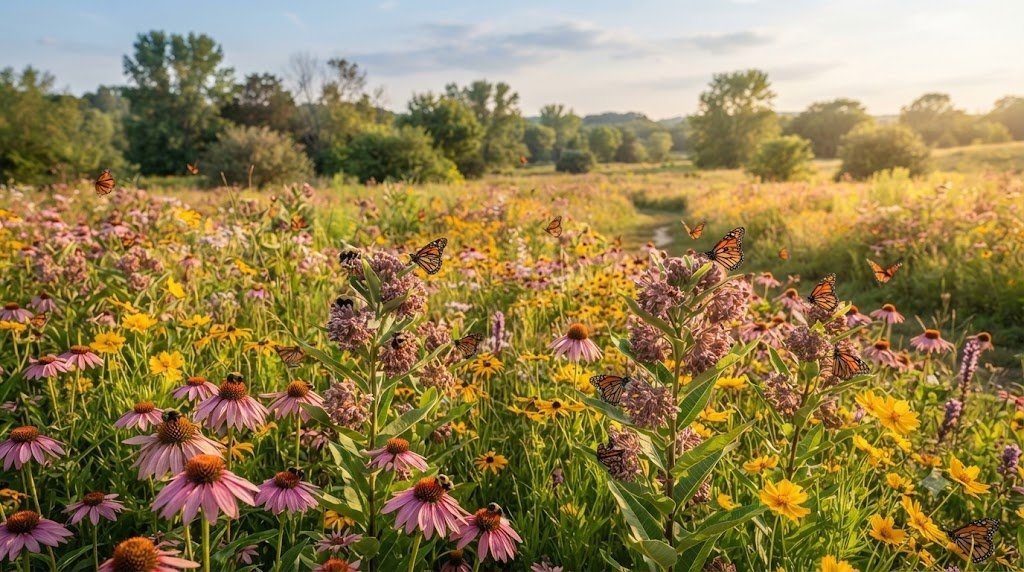
In an era of accelerating global habitat fragmentation, suburban biodiversity loss, and pesticide pressures, establishing a pollinator-friendly native wildflower garden is among the most ecologically impactful projects a horticulturist can undertake. Unlike sterile ornamental turf lawns or exotic bedding annuals bred for sterile double blossoms that produce zero pollen or nectar, a thoughtfully designed native plant community restores co-evolved ecological relationships. A truly resilient pollinator habitat functions as an integrated food web—providing continuous floral resources for native solitary bees, bumblebees, syrphid flies, and butterflies while offering larval host foliage, structural nesting cavities, and overwintering shelter.
Co-Evolutionary Mutualism: Specialized vs. Generalist Pollinators
The biological value of native flora lies in millions of years of evolutionary co-adaptation between indigenous plants and local insect communities. While non-native European honeybees (Apis mellifera) are dietary generalists capable of foraging across diverse exotic blossoms, the vast majority of North America’s 4,000 native bee species—including sweat bees (Halictidae), mining bees (Andrenidae), and leafcutter bees (Megachilidae)—are highly specialized.
Oligolectic Bees and Host Specificity
Many native bees are oligolectic, meaning their reproductive biology is strictly tethered to the pollen of a single botanical plant genus or family. For instance, the squash bee (Peponapis pruinosa) specializes exclusively on the flowers of Cucurbita species, while mining bees such as Andrena erigeniae depend entirely on early-blooming Spring Beauties (Claytonia virginica). Introducing exotic horticultural ornamentals fails to support these crucial specialist pollinators, breaking essential links in regional ecosystems.
Floral Morphology and Nectar Reward Architecture
To attract and sustain a diverse pollinator guild, a wildflower garden must feature diverse floral morphologies that accommodate distinct insect mouthpart architectures:
| Floral Architecture Type | Representative Native Species | Flower Color & Scent | Target Pollinator Guild | Primary Reward |
|---|---|---|---|---|
| Tubular / Zygomorphic Spire | Penstemon digitalis, Monarda fistulosa | Lavender / Purple; aromatic | Long-tongued Bumblebees, Hummingbirds | Deep nectar reserves & concealed pollen |
| Composite / Flat Disc Florets | Echinacea purpurea, Rudbeckia hirta | Yellow, orange, purple; light scent | Butterflies, Halictid sweat bees | Abundant shallow pollen & landing platforms |
| Open Umbel / Flat Clustered | Zizia aurea (Golden Alexanders), Asclepias | Bright yellow, white, rose; sweet | Syrphid flies, solitary predatory wasps | Easily accessible surface nectar droplets |
| Dense Composite Button | Liatris spicata (Blazing Star), Vernonia | Brilliant violet magenta; subtle | Skippers, Swallowtails, Monarchs | High-sucrose late-season nectar |
Soil Preparation for Native Meadows: The Low-Nutrient Advantage
A critical and counterintuitive rule of native meadow gardening is: never enrich native wildflower soil with high-nitrogen fertilizers or rich compost. Native prairie and meadow wildflowers evolved across millennia in lean, mineral-dense soils with minimal nitrogen availability.
Weed Competition and Nutrient Inversion
When garden soil is enriched with nitrogen, invasive agricultural weeds—such as crabgrass, lamb’s quarters, pigweed, and thistle—grow with explosive speed, rapidly outcompeting, over-topping, and suffocating slow-growing native perennial seedlings. Lean, unamended soils restrict weed vigor while native perennials invest energy into extensive taproots (often penetrating 6 to 15 feet deep into subsoil layers) that access subterranean moisture reserves.
Habitat Engineering: Nesting Substrates and Structural Complexity
Providing nectar and pollen satisfies only half of pollinator habitat requirements. Reproduction demands secure nesting and overwintering infrastructure:
- Bare Ground for Ground-Nesting Bees: Approximately 70% of native solitary bee species nest underground, excavating delicate subterranean brood chambers in bare, undisturbed soil. Mulching every square inch of garden beds with thick wood chips locks out ground-nesting bees! Leave sunny, well-drained patches of bare, un-mulched soil along garden margins.
- Pithy and Hollow Stems for Cavity Nesters: Leafcutter and mason bees nest in abandoned beetle bores and hollow plant stems. In late winter, prune back native perennial stems to a height of 12 to 18 inches above ground level. Female bees will utilize these upright hollow stalks as nesting cavities throughout the spring and summer.
- Leaf Litter and Overwintering Duff: Many butterfly species (such as swallowtails and fritillaries) overwinter as chrysalises or caterpillars hidden in fallen autumn leaves. Queen bumblebees hibernate just two inches beneath leaf litter. ‘Leave the leaves’ to preserve dormant pollinator life cycles.
Seasonal Phenology and the Late-Season Nectar Bridge
While summer typically delivers an abundance of garden blooms, early spring and late autumn represent critical starvation bottlenecks for pollinators. Emerging bumblebee queens in April rely on early native ephemerals and blooming pussy willows (Salvia discolor) to build initial energy reserves. In autumn, migrating Monarchs and overwintering insect queens require late-blooming native asters (Symphyotrichum novae-angliae) and goldenrods (Solidago speciosa) to build vital lipid reserves before freezing winter weather sets in.
Cold Stratification Biophysics: Breaking Native Seed Embryonic Dormancy
One of the most frequent reasons novice gardeners fail when attempting to start native wildflowers from seed is sowing unstratified seed in spring. Native perennial seeds (such as Echinacea, Asclepias, Liatris, and Baptisia) possess deep evolutionary physiological dormancies that prevent them from germinating during a temporary warm autumn spell, which would lead to fatal winter freezing of fragile seedlings.
Artificial Cold-Moist Stratification Protocol
In their native habitat, seeds overwinter beneath damp snow and freezing soil. To replicate this artificially, mix native seeds with a small handful of damp (not soaking) clean sand or vermiculite inside a sealed zip-top bag. Label with the species name and date, and store in a household refrigerator at 34°F to 38°F (1°C to 3°C) for 30 to 60 days (depending on species requirements). During this cold-moist chilling, endogenous abscisic acid breaks down, and embryonic gibberellins surge, priming the seeds to germinate with 90%+ emergence within 7 days of spring sowing.
| Native Wildflower Species | Common Name | Stratification Requirement | Emergence Velocity Post-Chill | Larval Host / Specialist Insect Value |
|---|---|---|---|---|
| Asclepias tuberosa | Butterfly Weed | 30 Days Cold-Moist (35°F) | 10 – 14 Days | Obligate larval host for Monarch Butterfly |
| Echinacea purpurea | Purple Coneflower | 30 – 60 Days Cold-Moist | 7 – 10 Days | High nectar reward; winter seed for Goldfinches |
| Liatris spicata | Dense Blazing Star | 60 Days Cold-Moist | 12 – 18 Days | Major autumn nectar fuel for migrating Lepidoptera |
| Baptisia australis | Blue False Indigo | 10 Days Chill + Seed Scarification | 14 – 21 Days | Wild Indigo Duskywing Butterfly larval host |
| Penstemon digitalis | Foxglove Beardtongue | 30 Days Cold-Moist | 8 – 12 Days | Essential pollen for long-tongued native bumblebees |
Mechanical Seed Scarification: Breaking Hard Seed Coats
Certain native leguminous wildflowers—such as Baptisia australis (Blue False Indigo) and Lupinus perennis (Wild Lupine)—possess rock-hard, water-impermeable seed coats (botanically termed physical dormancy or hardseededness). Water cannot penetrate the embryo even if the seed is soaked for weeks. Propagators must perform mechanical scarification: rub seeds gently between two sheets of fine-grit sandpaper, or use a nail clipper to make a tiny nick in the outer seed coat opposite the embryonic hilum. This rupture allows water imbibition to initiate cell division.
Ecological Maintenance: The Rotational Spring Cutback
Never perform autumn ‘clean-ups’ in a native wildflower meadow. The dead stalks, seed heads, and leaf litter provide indispensable winter shelter for hibernating queen bumblebees, dormant butterflies, and beneficial predatory ground beetles. Delay meadow cutbacks until late spring, when ambient daytime temperatures consistently exceed 50°F (10°C) for a full week, signaling that dormant native pollinators have safely emerged from their winter cavities.
Genetic Provenance and Local Ecotypic Sourcing
In ecological restoration and native pollinator gardening, the geographic and genetic origin of planting material is paramount—a concept known in botany as local ecotypic provenance. A Purple Coneflower (Echinacea purpurea) seed sourced from a commercial nursery in Oregon possesses distinct epigenetic adaptations that differ fundamentally from a wild native ecotype adapted to Wisconsin winters:
- Phenological Synchronization: Local ecotypes break dormancy, flower, and set seed in precise synchronization with the emergence of local specialist pollinator insects. Sourcing non-local cultivars often results in plants blooming two weeks before native bees emerge, causing mutual starvation.
- Winter Hardiness and Disease Resistance: Indigenous ecotypes carry genetic adaptations to regional soil mineral profiles, winter minimum temperatures, and local fungal pathogens that mass-produced commercial cultivars lack. Always purchase native seeds and plants from regional native plant nurseries that certify wild-collected local genetic provenance.
| Planting Material Source | Genetic Diversity Index | Phenological Match with Native Bees | Regional Hardiness Resilience | Ecological Restoration Value |
|---|---|---|---|---|
| Local Wild Ecotypic Seed | Exceptional (Broad genetic base) | 100% Synchronized with local insects | Maximum (Adapted to regional climate) | Highest Tier Ecological Value |
| Open-Pollinated Native Species (General) | Moderate to High | Fair to Good | High | Very Good (Acceptable for home gardens) |
| Named ‘Nativar’ Cultivars (e.g. Double Blooms) | Extremely Low (Cloned selections) | Poor (Often produce zero nectar/pollen) | Moderate (Bred for human visual appeal) | Poor to Negative (Ecological sink) |
The Nativar Controversy: Why Double Blossoms Fail Pollinators
Commercial plant breeders frequently select wild native plants for unusual traits, marketing them as ‘nativars’ (native cultivars). A common breeding mutation is selecting for ‘double flowers’—where reproductive stamens (pollen-producing organs) are genetically converted into extra decorative petals. While visually spectacular to humans, double flowers are ecologically sterile: pollinators cannot physically penetrate the dense petal mass, and even if they do, the flowers produce zero pollen and nectar, rendering them useless to foraging bees.
Soil Seed Bank Dynamics and Solarization Site Preparation
The single greatest cause of native wildflower seeding failure is the pre-existing weed seed bank lurking in uncultivated soil. A single square foot of lawn or old garden soil contains thousands of dormant weed seeds (crabgrass, thistle, foxtail) waiting for light and water to germinate.
The Clear Plastic Solarization Protocol
To eradicate the weed seed bank organically without synthetic herbicides, conduct soil solarization during mid-summer. Moisten the soil thoroughly, level the grade, and stretch clear UV-stabilized polyethylene plastic (not black plastic!) tightly across the ground, burying all edges with dirt. Clear plastic creates a greenhouse effect that traps incoming solar radiation, elevating soil temperatures in the top 2 inches to 140°F (60°C). Six to eight weeks of summer solarization pasteurizes the soil, killing weed seeds and fungal pathogens while leaving beneficial heat-tolerant thermophilic bacteria unharmed.
Long-Term Prairie Disturbance Cycles: Rotational Scything
Native wildflower meadows evolved with natural disturbance regimes, historically provided by periodic prairie fires and grazing herds of bison. In residential landscapes where prescribed fire is legally prohibited, mimic natural disturbance by rotational scything or high-deck mowing once every two to three years in late winter. Mowing with a brush cutter set at 6 to 8 inches chops coarse woody brush while stimulating vigorous crown sprouting from perennial native root systems.
Native Seed Drilling Calibration and Depth Regulation
When sowing large native meadow areas, calibrate seed drills or broadcast seeders carefully. Unlike large agricultural grains that are buried 1 to 2 inches deep, native wildflower seeds are tiny and require sunlight to trigger germination. Seed must be placed at a depth no greater than 1/8 to 1/4 inch, followed by rolling with a heavy lawn roller to ensure intimate seed-to-soil contact without deep burial.
Master Floriculture Principles and Seasonal Border Action Checklist
Establishing a world-class floral landscape requires transitioning from reactive gardening to proactive ecological stewardship. A thriving flower garden balances aesthetic chromatic harmony with enduring botanical vigor, providing endless beauty for the gardener while serving as a vital sanctuary for regional wildlife.
The Floriculture Seasonal Maintenance Matrix
Adhere to this comprehensive four-season management routine to ensure continuous floral displays:
- Early Spring Awakening (March – April): Carefully clear winter protective duff away from emerging perennial crowns. Perform initial division of vigorous clump-forming species before shoots reach four inches in height. Broadcast a light dressing of balanced organic compost and rock minerals across border beds.
- Early Summer Floral Surge (May – June): Execute the Chelsea Chop on selected late-season bloomers to double bloom duration and eliminate staking requirements. Install horizontal support netting over vigorous cut flower rows before stems exceed 12 inches tall.
- Mid-Summer Maintenance (July – August): Deadhead spent blossoms twice weekly to prevent energy diversion into seed synthesis. Irrigate deeply at ground level using drip lines during hot, dry spells, avoiding wetting petals and foliage.
- Autumn Preparation & Winter Architecture (September – November): Plant hardy spring geophytes (daffodils, species tulips, alliums) at proper depth. Leave sculptural perennial seed heads and ornamental grasses standing through winter to provide cold-season architectural interest and vital avian forage.
Observing these floricultural principles guarantees that your flower garden remains a dynamic, ever-changing masterpiece of color, fragrance, and ecological harmony throughout every season.