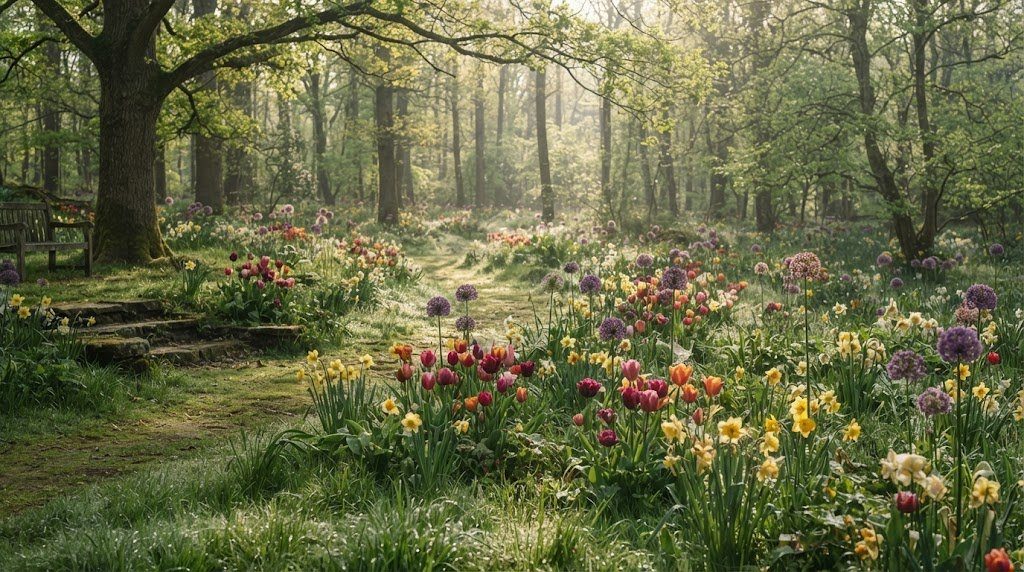
Geophytes—geologically ancient plants possessing specialized underground storage organs such as true bulbs, corms, tubers, and rhizomes—hold a unique and revered position in temperate horticulture. Among these, hardy spring-flowering bulbs, principally Daffodils (Narcissus), Tulips (Tulipa), and Ornamental Alliums (Allium), deliver breathtaking botanical color long before herbaceous perennials emerge from winter dormancy. However, transforming a formal geometric bulb planting into an enduring, self-sustaining, naturally proliferating perennial drift requires an in-depth understanding of physiological chilling requirements (vernalization), basal plate anatomy, daughter bulb propagation, and rodent chemical deterrents.
Underground Anatomy: True Bulbs vs. Corms and Basal Plate Dynamics
To manage and propagate spring bulbs successfully, one must understand their distinct underground morphology. A true bulb (exemplified by daffodils, tulips, and alliums) is botanically a complete, highly compressed subterranean modified shoot containing an entire embryonic flower and future foliage encased in concentric fleshy storage scale leaves (modified leaves swollen with nutrient reserves), all anchored to a flattened, compressed stem base known as the basal plate.
Basal Plate Function and Root Primordia
The basal plate is the vital vascular hub of the bulb. Root primordia differentiate along its lower rim, while the growing tip and flower bud emerge from its apex. Any mechanical injury, fungal pathogen (such as Fusarium oxysporum f. sp. narcissi basal rot), or anaerobic water-logging at the basal plate results in immediate vascular decay and bulb mortality. In contrast, corms (such as Crocus) consist of solid, swollen modified stem tissue without fleshy scales, renewing an entirely new corm on top of the old withered corm each season.
Vernalization: The Cold Requirement and Gibberellin Synthesis
Hardy spring bulbs possess an absolute physiological requirement for vernalization—prolonged exposure to cold subterranean temperatures (between 35°F and 45°F / 2°C and 7°C) for 12 to 16 continuous weeks. This chilling requirement is a genetic survival adaptation that prevents bulbs from producing tender leaves during temporary autumn warm spells, which would be destroyed by subsequent winter freezes.
Hormonal Signaling in Vernalization
During cold exposure, the plant breaks down endogenous abscisic acid (a growth-inhibiting hormone) and stimulates the synthesis of active gibberellins ($GA_1$ and $GA_3$). Gibberellins activate hydrolytic amylase enzymes that convert insoluble storage starches in bulb scales into soluble sucrose, providing the osmotic turgor pressure and energy necessary to drive rapid stem elongation when spring temperatures rise.
| Bulb Genus & Species | Chilling Duration (Weeks) | Optimal Planting Depth | Naturalizing Capacity | Mammalian Pest Resistance |
|---|---|---|---|---|
| Daffodils (Narcissus spp.) | 12 – 15 Weeks at <45°F | 6 – 8 Inches | Exceptional (Multiplies indefinitely) | Complete Immunity (Toxic lycorine alkaloids) |
| Species Tulips (Tulipa clusiana) | 10 – 14 Weeks at <45°F | 4 – 5 Inches | High (Perennializes in dry summer soils) | Poor (Highly palatable to deer & rodents) |
| Hybrid Darwin Tulips | 14 – 16 Weeks at <40°F | 6 – 8 Inches | Low (Tends to split into non-blooming bulblets) | Extremely Poor (Voles, squirrels, deer) |
| Giant Alliums (Allium giganteum) | 12 – 16 Weeks at <45°F | 8 Inches | Moderate (Divides by offset bulbs) | Exceptional (Strong sulfur allicin repels pests) |
Naturalization Agronomy: Selecting True Perennializers
Not all commercially sold bulbs are capable of ‘naturalizing’—the process of surviving, multiplying, and expanding across garden borders or lawns with zero human intervention:
The Indestructible Daffodil (Narcissus)
Daffodils are the undisputed kings of bulb naturalization. Every tissue of the daffodil plant contains lethal concentrations of bitter phenanthridine alkaloids, predominantly lycorine and calcium oxalate crystals. As a result, neither subterranean rodents (voles, mice, gophers) nor above-ground browsers (deer, rabbits) will consume daffodil bulbs, stems, or blossoms. Over time, parent bulbs divide into multiple daughter offsets, forming massive, self-expanding flowering colonies that persist for generations.
The Tulip Conundrum: Hybrid Split vs. Wild Species
Modern Dutch hybrid tulips (such as Triumph and Single Late hybrids) rarely naturalize in residential gardens. Bred primarily for single-season display, parent bulbs naturally split into several tiny, immature bulblets after flowering that take three to four years of intensive nursery culture to reach blooming size. To achieve true naturalizing tulips, gardeners must plant historic botanical species tulips (e.g., Tulipa turkestanica, Tulipa tarda, Tulipa sylvestris). Originating from the dry steppes of Central Asia, species tulips reliably return and self-seed if summer soils remain warm and well-drained.
Post-Bloom Foliage Photosynthesis and Nutrient Translocation
The most consequential management decision for spring bulbs occurs after the petals drop. As flowers fade, the developing seed capsule must be snapped off (deadheaded) to prevent the plant from wasting metabolic energy on seed synthesis. However, the green foliage must never be braided, tied, or cut back until it turns completely yellow and senesces naturally (typically 6 to 8 weeks post-bloom).
During this post-bloom window, active photosynthesis in leaves synthesizes vast quantities of carbohydrates that are translocated downward through vascular tissues to recharge the storage scales of the developing daughter bulbs for next spring’s embryonic flower bud formation. Premature mowing or cutting of green bulb foliage starves the underground bulb, guaranteeing blind (non-blooming) plants the following year.
Rodent and Mammalian Deterrent Strategies
For vulnerable bulbs like tulips, crocuses, and lilies that lack toxic alkaloids, proactive pest defenses are essential:
- Hardware Cloth Wire Cages: Construct planting baskets from 0.5-inch galvanized wire mesh (hardware cloth) sunken into the garden bed. Place bulbs inside and cover with a mesh lid before backfilling with soil to create an impenetrable barrier against burrowing voles and digging squirrels.
- Sharp Crushed Gravel (Grit Barrier): Backfill the planting trench with sharp, crushed angular gravel or expanded shale (Permatill). Burrowing rodents cannot tunnel through abrasive stone particles without severe pain.
- Interplanting with Deterrent Genera: Mix vulnerable tulip bulbs intimately with pungent, unpalatable bulbs—such as Narcissus, Allium, and Crown Imperial (Fritillaria imperialis). The intense allicin sulfur scent disorients and repels foraging rodents.
Bulb Topography and Soil Moisture Hydraulics: The Summer Baking Niche
A crucial yet frequently misunderstood factor in long-term bulb naturalization is the summer dormancy moisture requirement. Most prized spring-flowering geophytes originate from the Mediterranean basin, the Levant, or the mountain steppes of Central Asia (the historical origin of tulips). In these ecosystems, wet, cool winters and springs are followed by bone-dry, scorching summer droughts.
The Peril of Summer Irrigation Over Bulbs
When gardeners plant tulips or specialty alliums beneath a lush lawn or thirsty summer annual bed that receives overhead sprinkler irrigation every other day from June through August, the dormant bulbs suffocate in warm, wet soil. Fungal pathogens (such as Botrytis tulipae or ‘tulip fire’, and Fusarium basal rot) proliferate rapidly, liquifying the dormant bulb scales into foul-smelling mush. For long-term naturalization, plant bulbs beneath deciduous tree canopies: the trees absorb massive soil moisture in summer, creating the warm, dry soil dormancy bulbs crave, while shedding leaves in autumn to allow bright sunlight through during spring bloom.
| Bulb Genus / Species | Summer Moisture Tolerance | Dividing Interval | Naturalizing Multiplication Ratio | Toxicity to Domestic Pets |
|---|---|---|---|---|
| Narcissus (Daffodils) | High (Tolerates moderate summer moisture) | Every 5 – 7 Years | 1:3 Daughter offsets every 2 seasons | Highly Toxic (All parts contain lycorine) |
| Allium (Ornamental Onions) | Moderate to High | Every 4 – 5 Years | 1:2 Bulb divisions; self-seeds | Toxic to Cats & Dogs (Thiosulfates) |
| Tulipa (Species / Botanical) | Extremely Low (Demands dry summer bake) | Every 3 – 4 Years | 1:2 Multiplies by underground stolons | Mildly Toxic (Tulipalin A & B alkaloids) |
| Galanthus nivalis (Snowdrops) | High (Thrives in moist woodland duff) | Every 3 Years (Divide ‘in the green’) | 1:4 Multiplies rapidly into carpets | Mildly Toxic |
Dividing Bulbs ‘In the Green’: The Snowdrop and Daffodil Method
While commercial bulbs are sold as dry, dormant brown units in autumn, the most successful propagation technique for naturalizing woodland bulbs (such as Snowdrops, Winter Aconites, and English Bluebells) is dividing them ‘in the green’. This operation is performed immediately after blooming finishes, while leaves are still fully green, lush, and actively photosynthesizing. Lift entire clumps using a garden fork, gently separate daughter bulbs by hand while preserving living white root systems, and replant immediately into moist shade. This eliminates the severe root desiccation that occurs during summer dry storage.
Soil Mineral Nutrition: The Phosphorus and Potassium Formula
Historic gardening books frequently recommended adding a handful of bone meal beneath every bulb at planting. However, modern soil tests reveal that bone meal attracts foraging dogs, skunks, and raccoons that dig up newly planted bulbs looking for bones! Furthermore, phosphorus ($P$) is largely immobile in soil; placing it at the bottom of a hole does not aid lateral root hairs. Modern bulb fertility relies on a low-nitrogen, high-potassium organic fertilizer (such as a 3-5-8 blend) broadcast over the soil surface in autumn, allowing winter rain and snowmelt to carry soluble potassium down into the expanding root zone.
Basal Plate Fungal Prophylaxis: Mitigating Fusarium and Botrytis
The subterranean lifespan of naturalized geophytes is threatened primarily by soil-borne fungal pathogens that target the carbohydrate-rich basal plate. Fusarium basal rot (Fusarium oxysporum) penetrates root primordia during warm autumn soil conditions (temperatures above 60°F / 15°C), decomposing internal bulb scales into dry, brown rot.
Biological Pre-Planting Inoculation
To establish permanent, disease-free bulb colonies, dip dormant bulbs in an aqueous solution of beneficial Trichoderma harzianum or Bacillus subtilis before planting. These beneficial fungi and bacteria aggressively colonize the basal plate and outer tunic, exuding antifungal lipopeptides that physically outcompete pathogenic Fusarium spores throughout the winter chilling period.
| Geophyte Pathogen | Causal Organism | Primary Symptom | Environmental Trigger | Agronomic Mitigation Protocol |
|---|---|---|---|---|
| Basal Rot of Narcissus & Tulips | Fusarium oxysporum | Decay of basal plate; soft brown scales | Warm, wet soils at autumn planting | Plant late when soil drops below 50°F; bio-dip |
| Tulip Fire (Foliar Blight) | Botrytis tulipae | Spotted flowers, distorted leaves, grey mold | Cool, wet, humid spring weather | Destroy infected bulbs; avoid overhead irrigation |
| Blue Mold Storage Rot | Penicillium spp. | Blue-green powdery fungal spores on bulbs | High humidity and poor ventilation in storage | Store in dry, well-ventilated mesh bags at 45°F-55°F |
| Stem and Bulb Nematode | Ditylenchus dipsaci | Swollen, distorted foliage; brown ring in bulb | Infected planting stock and water splash | Use hot-water treated certified disease-free bulbs |
Naturalizing in Lawns: Grass Mowing Schedules and Vernal Phenology
Naturalizing early-spring bulbs—such as Crocuses, Snowdrops, and Siberian Squill (Scilla siberica)—directly within turfgrass lawns creates breathtaking spring meadow carpets. However, success depends on one non-negotiable rule: delay the first lawn mowing of the season until bulb foliage has completely yellowed and died down (typically late May). Mowing green bulb foliage with a lawnmower in early spring starves the subterranean bulbs, causing the display to fade away within two seasons.
Rodent Exclusion Metallurgy: Hardware Cloth Box Construction
In gardens plagued by heavy subterranean vole or gopher populations, planting vulnerable hybrid tulips or lilies requires constructing subterranean hardware cloth planting boxes. Bend 0.5-inch hot-dipped galvanized wire mesh into rectangular open-topped boxes 8 inches deep, 12 inches wide, and 24 inches long. Sink the mesh boxes into garden trenches, place bulbs inside at proper spacing, backfill with soil, and install a mesh lid wired to the box rim. The wire prevents rodent teeth from reaching bulbs while allowing roots to grow freely through mesh openings into subsoil.
Naturalizing in Lawns: Grass Mowing Schedules and Vernal Phenology
Naturalizing early-spring bulbs—such as Crocuses, Snowdrops, and Siberian Squill (Scilla siberica)—directly within turfgrass lawns creates breathtaking spring meadow carpets. However, success depends on one non-negotiable rule: delay the first lawn mowing of the season until bulb foliage has completely yellowed and died down (typically late May). Mowing green bulb foliage with a lawnmower in early spring starves the subterranean bulbs, causing the display to fade away within two seasons.
Master Floriculture Principles and Seasonal Border Action Checklist
Establishing a world-class floral landscape requires transitioning from reactive gardening to proactive ecological stewardship. A thriving flower garden balances aesthetic chromatic harmony with enduring botanical vigor, providing endless beauty for the gardener while serving as a vital sanctuary for regional wildlife.
The Floriculture Seasonal Maintenance Matrix
Adhere to this comprehensive four-season management routine to ensure continuous floral displays:
- Early Spring Awakening (March – April): Carefully clear winter protective duff away from emerging perennial crowns. Perform initial division of vigorous clump-forming species before shoots reach four inches in height. Broadcast a light dressing of balanced organic compost and rock minerals across border beds.
- Early Summer Floral Surge (May – June): Execute the Chelsea Chop on selected late-season bloomers to double bloom duration and eliminate staking requirements. Install horizontal support netting over vigorous cut flower rows before stems exceed 12 inches tall.
- Mid-Summer Maintenance (July – August): Deadhead spent blossoms twice weekly to prevent energy diversion into seed synthesis. Irrigate deeply at ground level using drip lines during hot, dry spells, avoiding wetting petals and foliage.
- Autumn Preparation & Winter Architecture (September – November): Plant hardy spring geophytes (daffodils, species tulips, alliums) at proper depth. Leave sculptural perennial seed heads and ornamental grasses standing through winter to provide cold-season architectural interest and vital avian forage.
Observing these floricultural principles guarantees that your flower garden remains a dynamic, ever-changing masterpiece of color, fragrance, and ecological harmony throughout every season.