The hallmark of an amateur vegetable garden is the mid-summer feast followed by an autumn famine. Novice gardeners fill all available bed space during a single frenzy of spring planting, harvest a massive glut of produce in July and August that overwhelms the kitchen, and then abandon beds to autumn weeds. Conversely, high-performance agronomy treats the garden bed as a continuous agricultural conveyor belt. By mastering the mathematical mechanics of Days to Maturity (DTM), seasonal frost date scheduling, staggered interval sowings, relay interplanting, and four-family crop rotations, a home grower can harvest fresh, nutrient-dense vegetables throughout all fifty-two weeks of the year.
The Mathematics of Sowing Calendars: Spring and Autumn Frost Anchors
All professional vegetable scheduling is anchored mathematically to two localized climatological data points: your region’s Average Last Spring Frost Date and Average First Autumn Frost Date.
Calculating Autumn Sowing Deadlines: The Fall Math Equation
Scheduling autumn and winter harvest crops is counterintuitive: you must sow seeds during the blazing heat of mid-summer (July and August) so that plants reach full vegetative maturity before the late autumn ‘Persephone Period’ arrives. Calculate your latest outdoor sowing date using this exact formula:
Latest Sowing Date = First Frost Date – (Days to Maturity + 14 Days Fall Factor + Germination Window)
The ‘Fall Factor’ (+14 days) accounts for the astronomical reality that solar day-length shrinks and ambient temperatures decline in autumn, slowing plant metabolic growth rates by approximately 30% compared to summer catalog estimates.
The Four Succession Planting Methodologies
Continuous harvesting relies on deploying four distinct temporal scheduling models:
| Succession Methodology | Operational Mechanics | Ideal Candidate Crops | Harvest Benefit | Management Complexity |
|---|---|---|---|---|
| Staggered Interval Sowings | Sow small batches of seeds every 10 to 14 days | Radishes, Lettuces, Cilantro, Bush Beans | Steady, manageable weekly harvest; zero glut | Low |
| Same-Day Varietal Staggering | Sow early, mid, and late DTM cultivars on Day 1 | Broccoli (‘Packman’ 55d, ‘Belstar’ 70d, ‘Waltham’ 85d) | Single planting session; extended 6-week harvest | Very Low |
| Relay Interplanting (Overlap) | Transplant next crop between rows of mature crop | Tuck autumn kale between maturing spring onions | Zero wasted bed downtime; doubles square-foot yield | Moderate |
| Seasonal Bed Turnover (Two-Season) | Clear entire spring crop; replant 100% for autumn | Spring peas cleared July 15 -> Sowed to autumn carrots | Full seasonal reset; maximum cold-hardy harvest | High |
Four-Family Crop Rotation Agronomy: Breaking Pathogen Cycles
Continuously planting crops from the same botanical family in the same garden bed year after year leads to catastrophic soil-borne pathogen accumulation (such as Verticillium, Fusarium, and Rhizoctonia) and severely depletes specific soil mineral horizons. Implementing a disciplined Four-Family Crop Rotation Matrix breaks disease cycles and restores soil balance:
- Year 1: Solanaceae (Heavy Feeders – High N & P): Tomatoes, peppers, eggplants, potatoes. Consume vast nitrogen and phosphorus reserves; susceptible to blights and root nematodes.
- Year 2: Fabaceae / Legumes (Soil Restorers – Nitrogen Fixers): Peas, pole beans, bush beans, fava beans. Form symbiotic root nodules that replenish soil nitrogen levels naturally.
- Year 3: Brassicaceae & Leafy Greens (Heavy Feeders – High N & S): Cabbage, broccoli, kale, cauliflower, swiss chard. Utilize residual legume nitrogen; require sulfur for glucosinolate synthesis.
- Year 4: Apiaceae & Root Crops (Light Feeders – Scavengers): Carrots, parsnips, beets, onions, garlic. Deep taproots scavenge potassium and trace minerals from deep subsoil layers without requiring heavy nitrogen inputs.
Season Extension Infrastructure: Cold Frames and Low Tunnels
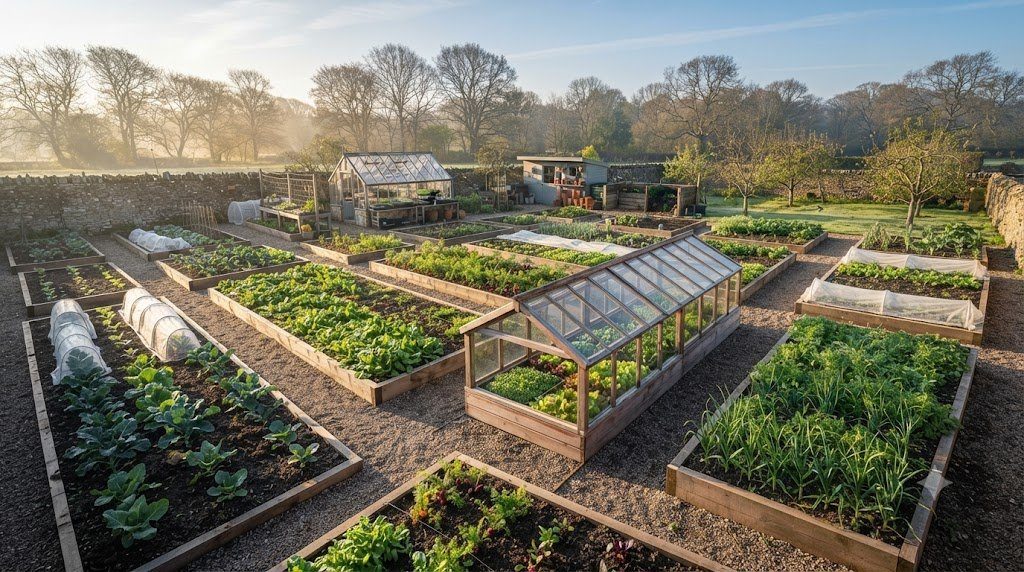
Harvesting fresh greens and root vegetables throughout sub-zero winters does not require an expensive heated commercial greenhouse. A simple unheated low tunnel constructed from 0.5-inch electrical conduit hoops covered with 6-mil greenhouse-grade polyethylene film creates an artificial USDA hardiness microclimate buffer equal to moving your garden 500 miles south (providing an 8°F to 12°F thermal lift). Adding a floating spun-bond row cover inside the plastic tunnel protects spinach, carrots, and mache down to 0°F (-18°C)!
Digital and Physical Record Keeping: The Master Garden Journal
Successful succession planning is impossible without systematic documentation. Maintain a permanent garden log recording exact varietal names, sowing dates, emergence times, first harvest dates, pest outbreaks, and first autumn frost dates. Over three to five seasons, this personalized agronomic empirical record becomes your most valuable gardening asset, fine-tuning your succession calendar to match your unique backyard microclimate with mathematical precision.
Thermal Time Models: Calculating Growing Degree Days (GDD)
Traditional seed packets list ‘Days to Maturity’ (DTM) as a fixed calendar number (e.g., ’65 Days’). However, plant biochemical development is governed by temperature, not the rotation of the Earth. A tomato plant sown in cool 55°F May weather may take 85 days to ripen, while that same variety sown in 80°F July weather ripens in 55 days. Professional agronomists eliminate calendar guesswork by calculating Growing Degree Days (GDD):
GDD = ((T_max + T_min) / 2) – T_base
Where $T_{max}$ is daily maximum temperature, $T_{min}$ is daily minimum temperature, and $T_{base}$ is the minimum physiological threshold temperature below which plant growth ceases (typically 50°F / 10°C for warm-season crops like tomatoes and corn, and 40°F / 4°C for cool-season crops like peas and brassicas). Tracking accumulated GDD enables growers to predict exact harvest and succession dates regardless of erratic seasonal weather swings.
| Vegetable Crop | Base Temp ($T_{base}$) | GDD Required to Harvest | Optimal Succession Interval | Fall Planting Cutoff Formula |
|---|---|---|---|---|
| Sweet Corn (Zea mays) | 50°F (10°C) | 1,200 – 1,500 GDD | Sow next batch when previous batch is 2″ tall | 90 Days prior to first fall frost |
| Snap Bush Beans | 50°F (10°C) | 850 – 1,000 GDD | Every 12 to 14 calendar days | 70 Days prior to first fall frost |
| Radishes (Raphanus sativus) | 40°F (4°C) | 350 – 450 GDD | Every 7 to 10 calendar days | 30 Days prior to hard freeze |
| Spinach (Spinacia oleracea) | 35°F (2°C) | 400 – 550 GDD | Every 14 days; winter overwintering | 45 Days prior to Persephone Period |
Soil-Borne Disease Interruption: Nematode and Fungal Starvation
The biological power of a strict four-family crop rotation lies in the starvation of specialized host-specific soil pathogens. Fungal spores of Verticillium dahliae and resting cysts of root-knot nematodes require specific host root exudates to trigger germination. When non-host crops (such as grasses, grains, or alliums) occupy the bed for three consecutive seasons, dormant pathogen populations decline naturally by up to 85% through biological attrition, eliminating the need for hazardous chemical soil fumigation.
Cover Cropping in Succession Cycles: Green Manure Biochemistry
Never leave succession beds bare between planting cycles. An empty bed subjected to summer sun and rain leaches valuable nitrate ions and bakes into a hard crust. Plant rapid green manures: sow Buckwheat (Fagopyrum esculentum) in mid-summer gaps—it reaches bloom in just 30 days, scavenges insoluble soil phosphorus, and smothers weeds. In late autumn, sow Hairy Vetch and Winter Rye to fix nitrogen and protect soil structure throughout winter before spring tilling.
The Photoperiod Cliff: Managing the Persephone Dormancy Threshold
In northern and temperate latitudes (USDA Zones 4 through 7), the limiting factor for autumn and winter vegetable production is not freezing cold—it is day length. When solar day length drops below 10 hours daily (the ‘Persephone Period’), photosynthetic carbohydrate synthesis becomes so low that vegetative cell expansion essentially halts.
Mathematical Harvest Timing Around the Persephone Window
All winter harvest crops—such as cold-hardy spinach, winter carrots, kale, and mache—must reach 95% of full mature harvest size before the Persephone Period begins (typically early November). The winter garden then functions as an unheated outdoor living refrigerator, storing sweet, crisp vegetables fresh in the ground for continuous winter harvesting. Sowing seeds too late in September results in tiny, immature plants that stall and sit dormant until mid-February!
| Winter Harvest Vegetable | Days to Maturity (DTM) | Frost Tolerance Level | Target Sowing Window | Winter Harvesting Protocol |
|---|---|---|---|---|
| Winter Savoy Spinach | 45 Days + 14d Fall Factor | Immune to 0°F (-18°C) under snow | Mid to Late August | Harvest outer leaves continuously all winter |
| Tuscan Lacinato Kale | 60 Days + 14d Fall Factor | Hardy to 10°F (-12°C) | Early to Mid July | Harvest lower leaves; plants sweeten after freeze |
| Winter Storage Carrots | 75 Days + 14d Fall Factor | Hardy to 15°F (-9°C) with mulch | Late June to Early July | Bank 8″ straw over beds; dig roots through snow |
| Claytonia (Miner’s Lettuce) | 40 Days | Hardy to 10°F (-12°C) | Early to Mid September | Exceptional winter salad green; cuts repeatedly |
The Four-Field Crop Rotation Nutrient Balancing Equation
Disciplined crop rotation maintains long-term soil mineral equilibrium. Heavy-feeding nightshades (tomatoes, potatoes) extract vast amounts of nitrogen and potassium. Following them with nitrogen-fixing legumes (peas, beans) restores soil nitrogen naturally via symbiotic Rhizobium root nodules. Next, brassicas utilize residual organic nitrogen while adding glucosinolate residues to the soil that suppress fungal pathogens. Finally, deep taproot root crops scavenge subsoil minerals before the rotation resets, creating a sustainable, closed-loop soil fertility cycle.
Relay Interplanting Geometry and Spatial Overlap Protocols
In traditional farming, one crop is harvested completely and the bed cleared before the next crop is planted, resulting in 2 to 3 weeks of wasted solar downtime. High-yield bio-intensive growers deploy relay interplanting—transplanting the incoming crop directly into the standing bed two to three weeks before the mature crop is harvested:
- Example: Kale Relayed into Maturing Onions: In mid-July, four weeks before spring bulb onions are harvested, transplant autumn kale seedlings directly into the spaces between onion rows. The maturing onions provide slight shade while the kale roots establish. When onions are harvested in August, the kale is already rooted and takes over the bed seamlessly, doubling seasonal yield!
- Example: Bush Beans Relayed into Sweet Corn: Sow bush snap beans along the base of sweet corn stalks three weeks before the corn harvest.
Mastering the Sowing Logbook: Empirical Data Tracking
The ultimate key to succession mastery is continuous empirical data logging. Record exact sowing dates, days to 50% field emergence, first harvest date, total pounds harvested, and first frost damage. Over three growing seasons, this personal agronomic logbook becomes your most valuable gardening asset, allowing you to calibrate sowing dates to your unique microclimate with surgical precision.
Microclimate Sowing Adjustments Across Elevation Gradients
In hilly or undulating terrain, calculate sowing dates based on Hopkins’ Bioclimatic Law: for every 400-foot rise in elevation, spring phenological events (bud break, frost dates) are delayed by approximately 4 calendar days. Factoring localized elevation and cold air drainage into succession calendars ensures autumn plantings reach vegetative maturity before sub-freezing temperatures arrive.
Empirical Garden Architecture Blueprint and Crop Succession Action Steps
A truly productive vegetable and floral garden is born long before the first seed is sown—it is conceived on paper through meticulous spatial mapping, astronomical solar analysis, microclimate engineering, and mathematically sequenced succession calendars. Treating garden design as an applied science unlocks extraordinary multi-season harvests while minimizing labor and frustration.
The Master Planning Implementation Framework
Follow these five strategic phases when designing or expanding your garden infrastructure:
- Phase 1: Solar Insolation and Aspect Audit: Map sun exposure patterns across your property during the summer solstice and autumn equinox. Allocate full-sun south-facing zones to heat-loving crops, reserving partially shaded areas for cool-season greens.
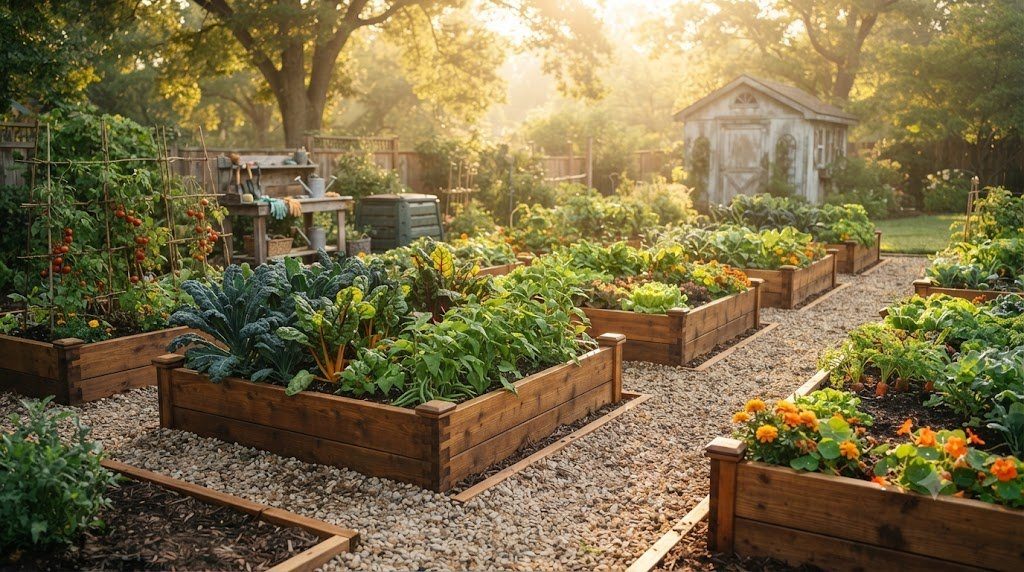
- Phase 2: Raised Bed Ergonomic Construction: Construct beds no wider than 48 inches to prevent soil compaction from foot traffic. Utilize durable, rot-resistant 2-inch timbers, line floors with galvanized hardware cloth against burrowing rodents, and leave minimum 36-inch pathways.
- Phase 3: Four-Season Succession Scheduling: Calculate autumn sowing dates backward from your first expected frost date, adding a 14-day Fall Factor to compensate for declining day-length. Plant successions in 10-to-14-day staggered intervals to maintain steady harvests.
- Phase 4: Four-Family Crop Rotation Alignment: Rotate nightshades, legumes, brassicas, and root crops systematically across four distinct beds to break soil-borne pathogen cycles and balance subterranean nutrient consumption.
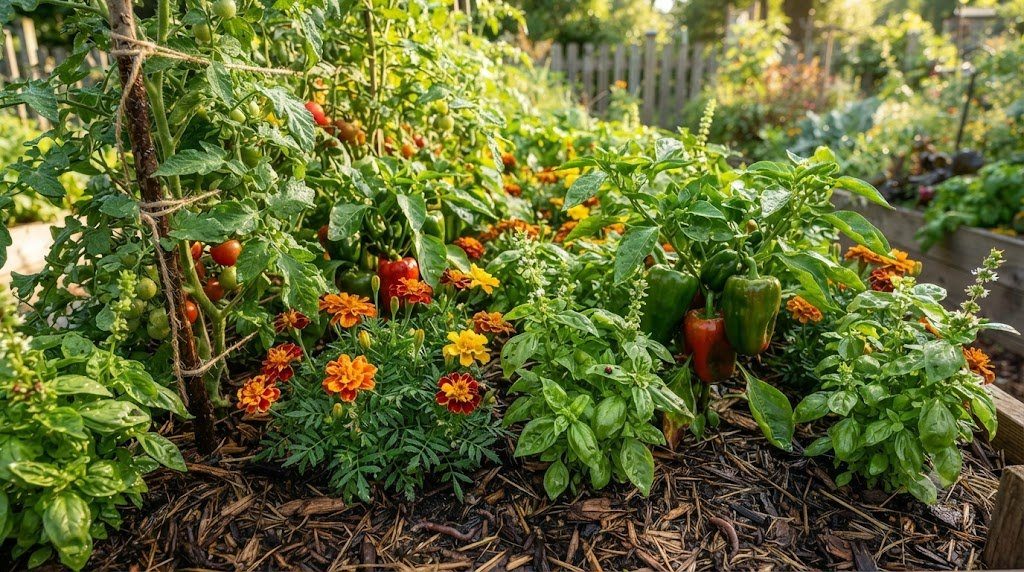
- Phase 5: Polyculture Companion Guild Integration: Interweave aromatic herbs and flowering insectary strips (sweet alyssum, dill, marigolds) throughout crop beds to recruit beneficial predatory insects and disrupt pest migration patterns naturally.
By approaching garden planning with agronomic discipline, empirical data tracking, and ecological harmony, gardeners create enduring, self-sustaining landscapes that provide abundant nourishment and joy for decades to come.