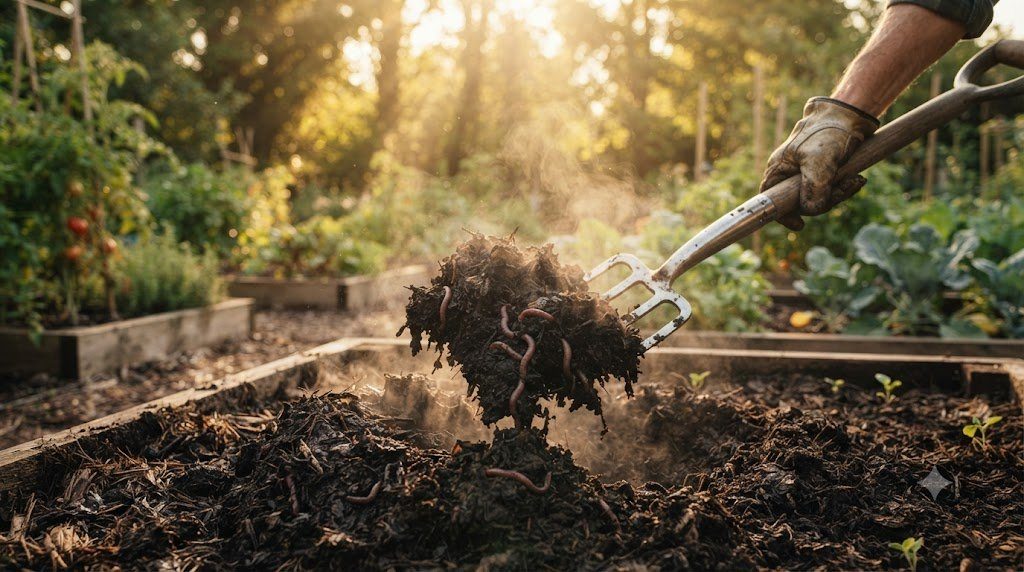
In sustainable agronomy and high-yield vegetable horticulture, the fundamental operational principle is simple yet transformative: feed the soil, not the plant. Synthetic water-soluble fertilizers flood the soil solution with free mineral ions that provide rapid yet transient vegetative flushes, while progressively degrading soil aggregate structure, acidifying the root rhizosphere, and decimating native mycorrhizal fungi. Conversely, empirical organic soil stewardship focuses on biological mineral cycles, humic substance formation, cation-exchange capacity optimization, and aerobic thermophilic composting to establish a self-regulating, disease-suppressive growing medium capable of sustaining intensive continuous vegetable production.
Thermodynamic Biophysics of Aerobic Thermophilic Composting
High-performance hot composting is an active biological engineering process driven by specialized successional microbial communities. Generating pathogen-free, weed-seed-free, finished humus requires strict management of four primary physical parameters: Carbon-to-Nitrogen (C:N) stoichiometry, moisture content, aeration porosity, and pile volume.
The Stoichiometric C:N Ratio (30:1 Equilibrium)
Microbial decomposers require carbon for cellular energy and structural synthesis, and nitrogen for protein, amino acid, and enzyme construction. The stoichiometric equilibrium for optimal thermophilic decomposition is a bulk Carbon-to-Nitrogen ratio between 25:1 and 30:1 by weight:
- Excess Nitrogen (C:N < 20:1): When nitrogen exceeds microbial assimilative capacity, excess nitrogen volatilizes into the atmosphere as pungent ammonia gas ($NH_3$), resulting in foul anaerobic odors, nutrient loss, and rapid pile pH spikes.
- Excess Carbon (C:N > 40:1): When carbonaceous materials (woody chips, straw, sawdust) dominate, microbial reproduction stalls due to nitrogen starvation, causing the pile to remain cool and decomposition to slow to a multi-year crawl.
Microbial Succession and Thermal Phase Dynamics
A properly assembled thermophilic compost pile progresses through three distinct temperature phases:
| Thermal Phase | Temperature Range | Dominant Microbial Consortia | Primary Biochemical Activity |
|---|---|---|---|
| Mesophilic Phase (Initial 24-48 hrs) | 68°F – 104°F (20°C – 40°C) | Mesophilic bacteria & fungi (Pseudomonas) | Rapid breakdown of soluble sugars and starches |
| Thermophilic Phase (Days 3 to 15) | 105°F – 155°F (41°C – 68°C) | Spore-forming bacilli, Thermus, actinobacteria | Lignin/cellulose breakdown; weed seed & pathogen kill |
| Curing / Maturation Phase (Weeks 4 to 12) | Ambient – 90°F | Mesophilic fungi, actinomycetes, earthworms | Humification, humic acid synthesis, nutrient stabilization |
Soil Mineral Chemistry: Balancing the Cation Exchange Complex
The biological performance of vegetable soil is governed by its Cation-Exchange Capacity (CEC)—the measure of how many positively charged mineral ions (cations) the soil colloidal matrix can hold on negatively charged clay and humus surfaces against gravitational leaching. The primary basic cations occupying exchange sites are Calcium ($Ca^{2+}$), Magnesium ($Mg^{2+}$), Potassium ($K^+$), and Sodium ($Na^+$).
Base Saturation Equilibrium and Soil pH
To establish ideal vegetable growing conditions, base saturation ratios should approximate:
- Calcium ($Ca$): 65% to 75% of CEC. Calcium flocculates soil particles, creating granular crumbs and deep aeration porosity.
- Magnesium ($Mg$): 10% to 15% of CEC. Essential for chlorophyll molecular cores; excessive magnesium deflocculates soil, creating tight, sticky clay.
- Potassium ($K$): 3% to 5% of CEC. Critical for fruit development, drought tolerance, and cold hardiness.
- Sodium ($Na$): < 1% of CEC. Toxic to cellular root function at elevated concentrations.
Organic Amendment Selection and Bio-Mineral Balancing
Correcting specific soil mineral deficiencies organically requires targeting amendments with known elemental bioavailability:
- Calcitic Limestone ($CaCO_3$): Raises soil pH in acidic soils while delivering pure calcium without unwanted magnesium.
- Agricultural Gypsum ($CaSO_4 \cdot 2H_2O$): Delivers soluble calcium and sulfur without raising pH, making it ideal for loosening compacted alkaline soils.
- Bone Meal ($Ca_3(PO_4)_2$): Slow-release phosphorus and calcium, promoting vigorous root establishment during transplanting.
- Greensand (Glauconite): Natural marine potassium mineral delivering 5% potash plus over thirty essential trace trace minerals.
- Alfalfa Meal: Mild balanced N-P-K (3-1-2) containing triacontanol, a natural fatty alcohol plant growth stimulant that accelerates root branching.
Mycorrhizal Inoculation and No-Till Soil Stewardship
Arbuscular Mycorrhizal Fungi (AMF) form symbiotic associations with the roots of over 80% of terrestrial plants, extending subterranean hyphal networks thousands of feet beyond the root zone to scavenge immobile phosphorus and trace minerals in exchange for photosynthetic sugars. Mechanical rotary tilling slices these fungal hyphae, destroys delicate earthworm burrows, and oxidizes valuable soil carbon into atmospheric $CO_2$. By transitioning vegetable beds to a permanent no-till mulch protocol, growers preserve living biological networks, minimize weed seed germination, and maintain resilient soil structure.
The Chemistry of Compost Tea: Aerobic Liquid Inoculants
While finished solid compost serves as an exceptional soil amendment, Actively Aerated Compost Tea (AACT) extracts and multiplies beneficial soil biology into an easily applied liquid bio-fertilizer and foliar shield. Producing true AACT is an exact microbiological process requiring continuous dissolved oxygen levels above 6.0 parts per million (ppm) to prevent the proliferation of anaerobic pathogens.
The 24-Hour Fermentation Reactor Protocol
A five-gallon brewing bucket is fitted with a high-output diaphragm air pump connected to fine-bubble air stones. Four cups of premium thermophilic worm castings or cured compost are suspended in a fine mesh brew bag (400-micron mesh). Soluble microbial foods are added: blackstrap molasses (simple carbohydrates to fuel bacterial multiplication), liquid kelp meal (trace minerals and fungal foods), and humic acids. The mixture is aerated continuously for 24 hours at 65°F to 72°F.
| Liquid Amendment Type | Dissolved Oxygen (ppm) | Biological Profile | Primary Application Target | Shelf Life Window |
|---|---|---|---|---|
| Actively Aerated Compost Tea (AACT) | > 6.0 ppm (Continuous bubbler) | Vast aerobic bacteria, fungi, flagellates | Foliar bio-shield & root drench | < 4 Hours post-brew (Perishable) |
| Passive Anaerobic Compost Extract | < 1.5 ppm (Stagnant bucket soak) | Facultative anaerobes; few fungi | Basic mineral fertility drench | Several days |
| Aerated Worm Casting Leachate | > 5.0 ppm | Beneficial microbes & fulvic acids | Seedling root establishment | < 12 Hours |
| Liquid Kelp / Seaweed Ferment | Varies | Phytohormones (cytokinins, auxins) | Stress & drought mitigation | Stable 6-12 months |
Biochar Activation and Soil Carbon Sequestration
Biochar—pure recalcitrant elemental carbon produced through the high-temperature pyrolysis of woody biomass in an oxygen-depleted kiln—represents a generational soil investment. Raw, uncharged biochar is essentially a biological sponge possessing an immense microscopic internal surface area (often exceeding 400 square meters per gram of biochar). However, never add raw biochar directly to garden beds! Raw biochar will pull available nitrogen and soluble moisture directly out of the surrounding soil, severely stunting plants for an entire season.
Biochar must be ‘charged’ or ‘inoculated’ before application: mix biochar with active compost, worm castings, and liquid fish hydrolysate at a 1:4 ratio, allowing it to incubate for 3 to 4 weeks. Once colonized by beneficial mycorrhizal fungi and saturated with mineral cations, inoculated biochar provides permanent water retention and cation-exchange sites that persist in garden soils for hundreds of years without decomposing.
Interpreting Professional Soil Lab Tests: Albrecht Base Cation Saturation
Rather than relying on cheap home test kits that provide vague color strips, serious growers submit soil samples to certified university testing laboratories every two to three years. Look beyond simple total N-P-K numbers and analyze the Albrecht Base Cation Saturation Ratio (BCSR). An ideal Albrecht soil analysis displays a Calcium-to-Magnesium ratio of 7:1 by weight (68% Ca base saturation, 12% Mg). If magnesium levels rise above 20%, soil particles become tightly bonded, restricting root gas exchange. Applying agricultural gypsum ($CaSO_4$) displaces excess magnesium ions with calcium, flocculating tight clay into loose, crumbly, aerated soil.
Humic vs. Fulvic Acids: The Biochemistry of Humified Organic Matter
In advanced soil chemistry, the biological value of finished compost is measured by its concentration of humic substances—stable, complex molecular compounds formed through the secondary humification of decomposed plant matter. Humic substances are classified into three distinct chemical fractions based on molecular weight and solubility:
- Fulvic Acids (Low Molecular Weight): Soluble in water across all pH ranges (acidic, neutral, alkaline). Fulvic acid molecules are small enough to penetrate plant cell membranes, acting as natural chelating agents that bond with trace minerals (iron, zinc, manganese) and transport them directly into plant vascular tissues.
- Humic Acids (Medium Molecular Weight): Soluble only in alkaline conditions; precipitate out in acidic environments. Humic acids remain in the soil matrix, dramatically expanding cation-exchange capacity, binding excess sodium, and flocculating soil particles to improve water-holding capacity.
- Humin (High Molecular Weight): Insoluble across all pH ranges. Humin represents the most durable, recalcitrant fraction of soil organic matter, persisting in soil for centuries to provide permanent aggregate porosity.
| Humic Substance Fraction | Molecular Weight (Daltons) | Aqueous Solubility | Primary Agronomic Function | Persistence in Soil Profile |
|---|---|---|---|---|
| Fulvic Acid | 1,000 – 10,000 Da | Soluble across all pH ranges | Intracellular mineral chelation & transport | 1 – 5 Years (Rapidly utilized) |
| Humic Acid | 10,000 – 100,000+ Da | Soluble in alkaline pH; insoluble in acid | Cation-Exchange Capacity & soil flocculation | 10 – 50+ Years |
| Humin | > 100,000 Da | Completely insoluble in all water | Permanent microscopic soil aggregate structure | Centuries (Recalcitrant carbon) |
| Raw Undecomposed Organic Matter | N/A (Coarse tissues) | Insoluble until digested | Energy source for primary decomposers | Weeks to months |
Remediating Plow-Sole Hardpans and Rotary Tiller Compaction
Repetitive use of mechanical rotary tillers creates an impenetrable subterranean compaction layer known as a ’tiller pan’ or ‘plow sole’ exactly at the depth of the spinning tines (typically 6 to 8 inches deep). Water cannot penetrate this barrier, causing upper soil beds to become waterlogged while deeper subsoils remain bone-dry. Remediating tiller pans organically requires planting deep-rooting bio-drilling cover crops—such as Daikon Forage Radishes (Raphanus sativus var. longipinnatus). Daikon taproots exert over 2.5 MPa of downward hydraulic pressure, drilling 24 to 36 inches straight down through hardpans. In winter, the radishes freeze and decompose, leaving behind vertical drainage channels that aerate subsoils permanently.
Soil Respiration Testing: The Solvita Carbon Dioxide Burst Assay
The biological vitality of living garden soil cannot be determined by static mineral tests alone; it requires measuring soil microbial respiration. The Solvita CO2 burst assay quantifies the microbial respiration of rewetted soil samples over 24 hours. As beneficial aerobic bacteria, actinomycetes, and fungi metabolize organic carbon, they release carbon dioxide ($CO_2$).
High respiration rates (exceeding 80 to 120 ppm $CO_2-C$) indicate an active, disease-suppressive biological soil food web capable of mineralizing 50 to 80 pounds of organic nitrogen per acre annually, reducing the need for purchased fertilizers.
Seasonal Cover Crop Termination: Roller-Crimping vs. Tarping
Terminating cover crops without rotary tilling preserves fragile fungal hyphae and prevents soil erosion:
- Roller-Crimping at Anthesis: Mechanically crimp mature cover crops (such as winter cereal rye and hairy vetch) when plants reach 50% floral anthesis. Crimping snaps vascular stems without cutting them, killing the crop instantly and creating a thick, weed-suppressing in-situ organic mulch mat.
- Silage Tarping (Occultation): Cover dense green cover crops with heavy UV-treated black polyethylene silage tarps for 3 to 4 weeks in early spring. The dark, moist, warm microclimate beneath the tarp accelerates biological earthworm digestion, leaving behind a clean, weed-free seedbed ready for direct transplanting.
Vermiculture Engineering: The Biochemistry of Earthworm Castings
Finished earthworm castings (vermicompost produced by Eisenia fetida) represent the pinnacle of organic biological amendments. As earthworms ingest decomposing compost, their digestive tracts coat mineral particles with mucus, humic acids, and beneficial gut enzymes (including chitinase and phosphatase). Worm castings exhibit five times the available nitrogen, seven times the available phosphorus, and eleven times the available potassium of native topsoil, while delivering chitinase enzymes that dissolve the protective outer shells of root-knot nematode eggs.
Comprehensive Agronomic Summary and Vegetable Bed Maintenance Schedule
Sustaining peak vegetable bed productivity across changing seasons requires executing a disciplined, proactive maintenance regimen. Successful vegetable cultivation is not an isolated set of weekend chores; it is an integrated agronomic system that links soil microbiology, water delivery, canopy airflow, and crop health into an enduring cycle of abundance.
Weekly Field Scouting and Diagnostic Checklist
Implement this 5-point weekly field inspection protocol across all active food beds:
- Under-Leaf Foliar Auditing: Inspect the undersides of lower leaves for early fungal conidia (concentric rings of early blight, powdery mildew pustules) and juvenile piercing-sucking insect colonies. Early physical removal of symptomatic leaves prevents broad-canopy outbreaks.
- Moisture Horizon Verification: Insert a calibrated tensiometer or dig down 4 inches into the root zone. Soil should feel cool and form a loose ball that crumbles under gentle finger pressure. Avoid overhead watering during evening hours to eliminate prolonged leaf wetness.
- Soil Surface Biological Inspection: Verify that organic mulch layers (clean wheat straw, shredded leaves) maintain a depth of 3 to 4 inches. Replenish bare soil patches immediately to prevent sun-baking and soil-borne fungal splash.
- Trellis Load and Fastener Inspection: Check support wires, clips, and stakes for structural stability as developing fruit mass expands. Reinforce weak branches before heavy summer thunderstorms arrive.
- Harvest Maturity Monitoring: Harvest edible crops at peak biological tenderness rather than letting them become overgrown and woody, stimulating plants to continue flowering and setting new produce.
By combining disciplined soil mineral balancing with vigilant preventative cultural practices, home growers transform standard garden plots into resilient, high-yield biological food systems that produce clean, nutrient-dense harvests year after year.