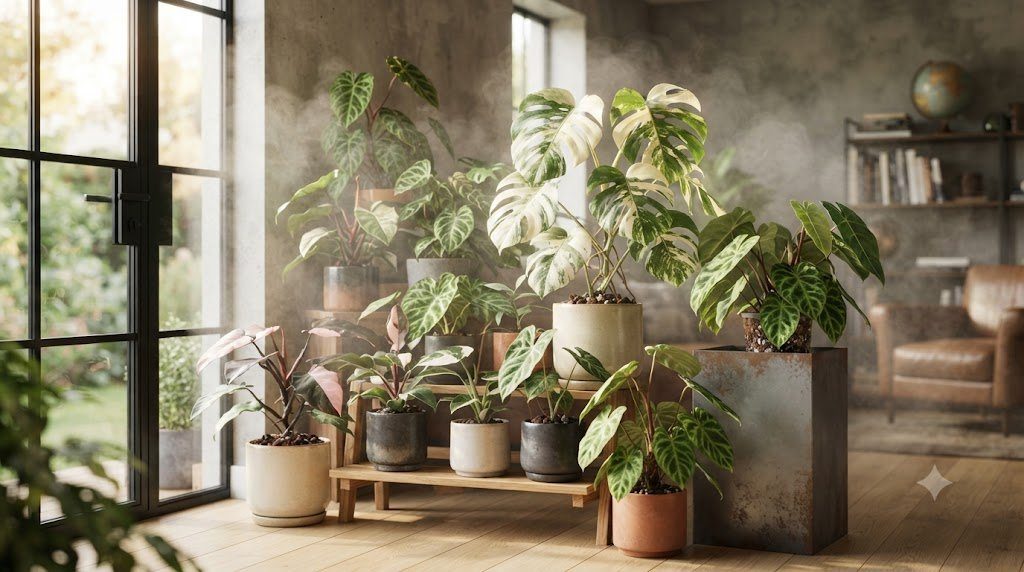
The family Araceae—commonly termed aroids, encompassing prized indoor genera such as Monstera, Philodendron, Anthurium, Alocasia, Epipremnum, and Rhaphidophora—has fundamentally reshaped modern interior horticulture. Indigenous to the dense, multi-layered tropical rainforests of Central and South America and Southeast Asia, these plants evolved primarily as hemiepiphytic climbers, lithophytes, or understory herbaceous perennials. Translating their natural ecological niche into indoor residential environments requires dismantling traditional houseplant myths. Growing champion-grade aroids demands high-porosity chunky substrates, precision water management that respects the perched water table, and atmospheric humidity regulation that minimizes lethal Vapor Pressure Deficits (VPD).
The Hemiepiphytic Niche: Root Morphology and Gas Exchange
In their native rainforest habitats, hemiepiphytic aroids (such as Monstera deliciosa or Philodendron verrucosum) germinate either in high canopy tree crotches or on the forest floor, rapidly producing specialized adventitious aerial roots that anchor to tree bark and climb toward higher solar radiation. These aerial roots transition morphologically as they descend into subterranean soil, developing an outer spongy layer of dead cells known as the velamen radicum (analogous to epiphytic orchids) or thick corky periderm layers.
Respiratory Oxygen Demand and Root Anoxia
Because tropical aroid roots evolved to breathe in humid, atmospheric tree crevices and leaf litter debris rather than dense, compacted mineral dirt, their root cellular mitochondria possess an exceptionally high metabolic demand for atmospheric oxygen ($O_2$). When planted in standard dense peat-based commercial potting soils that retain excessive water, the microscopic pores between soil particles become continuously flooded. Deprived of oxygen, root cells transition from aerobic respiration to anaerobic fermentation within 24 to 48 hours, producing toxic ethanol and lactic acid that cause root cell lysis. This physiological asphyxiation—commonly mischaracterized simply as ‘root rot’—is immediately exploited by opportunistic oomycete pathogens such as Pythium ultimum and Phytophthora.
Physics of the Perched Water Table in Containerized Culture
A fundamental physical reality governing all containerized houseplants is the Perched Water Table (PWT). In any container filled with a porous medium, gravitational force pulls water downward, while matric (capillary) forces pull water upward and hold it within microscopic pores. At the bottom of the container, these forces reach an equilibrium, creating a completely saturated layer of soil where all air has been displaced by water.
| Substrate Medium Type | Air-Filled Porosity (%) | Water Retention Capacity (%) | Perched Water Table Height | Root Rot Risk Level |
|---|---|---|---|---|
| Standard Peat Potting Soil | 8% – 12% | 65% – 75% | High (3.0 – 4.5 inches) | Severe (Frequent anaerobic death) |
| Pure Sphagnum Peat Moss | 5% – 10% | 70% – 80% | Very High (4.0 – 5.0 inches) | Extremely Severe |
| Engineered Chunky Aroid Mix | 35% – 45% | 35% – 45% | Negligible (< 0.75 inches) | Extremely Low (Optimal root health) |
| Pure Tree Fern Fiber | 30% – 40% | 45% – 55% | Low (1.0 – 1.5 inches) | Very Low (Excellent for Anthuriums) |
Vapor Pressure Deficit (VPD) and Atmospheric Humidity
Tropical rainforest understories maintain ambient relative humidity levels consistently between 75% and 95%. Conversely, indoor residential environments—especially during winter heating months—frequently drop to arid levels of 20% to 35% relative humidity. This steep moisture gradient creates a high Vapor Pressure Deficit (VPD)—the difference between the vapor pressure inside the saturated plant leaf tissue and the dry surrounding room air.
Transpirational Stress and Stomatal Closure
Under high VPD conditions (excessively dry air), water evaporates out of leaf stomata at an unsustainable rate. To prevent fatal cellular desiccation, the plant’s guard cells synthesize abscisic acid, triggering stomatal closure. However, closed stomata prevent the intake of carbon dioxide ($CO_2$), halting photosynthesis entirely. Furthermore, extreme transpirational pull causes cell death at leaf margins and delicate emerging leaf tips, resulting in unsightly brown, crispy leaf edges, failure of leaves to unfurl from cataphylls, and stunted, distorted growth.
Structural Epiphytic Supports: The Science of Living Moss Poles
Hemiepiphytic climbing aroids exhibit morphological heteroblasty—a dramatic change in leaf size, shape, and structural complexity (such as fenestrations and pinnate lobing in Monstera) as the plant ascends a vertical host. When allowed to trail or sprawl unsupported, plants enter a juvenile vegetative state, producing thin, weak internodes and diminutive, un-fenestrated foliage.
To stimulate mature fenestrated growth, growers must provide a moisture-retentive, breathable vertical support, such as a D-shaped plastic-backed sphagnum moss pole. When aerial roots penetrate moist long-fiber sphagnum moss, they develop extensive feeder root systems directly inside the pole, taking up water and dissolved nutrients directly at the node. This hydration and mineral abundance signals hormonal cascades that trigger mature leaf expansion and thick stem calipers.
Mineral Nutrition and Fertilizer Salts Leaching
Aroids are sensitive to high soluble salt levels in municipal tap water and concentrated synthetic fertilizers. Fluoride, chlorine, and excess sodium ions cause necrotic leaf tip burn in delicate genera like Calathea and Anthurium. Fertilize during active vegetative growth using a balanced, urea-free liquid fertilizer (such as a 12-4-8 or 9-3-6 formulation) diluted to one-quarter strength with every watering (‘weakly, weekly’). Thoroughly flush the container with pure water once a month to leach accumulated mineral salts from the substrate pores.
The Chemistry of Irrigation Water: Reverse Osmosis, EC, and pH Buffering
In high-end tropical houseplant cultivation, the chemical profile of municipal tap water is frequently the hidden limiting factor that prevents plants from achieving exhibition quality. Tap water is formulated for human consumption and plumbing preservation, containing chemical additives and dissolved minerals that damage delicate tropical root systems:
- Chlorine and Chloramines: Used as municipal municipal disinfectants. While free chlorine off-gasses after 24 hours of standing in open containers, modern water treatment facilities utilize chloramine (chlorine bonded to ammonia), which is non-volatile and persists indefinitely. Chloramines oxidize delicate root hairs and kill beneficial substrate microbiology.
- Total Dissolved Solids (TDS) and Electrical Conductivity (EC): Hard tap water loaded with dissolved calcium carbonate, magnesium, and sodium carries high Electrical Conductivity (EC > 0.6 mS/cm). Over repeated waterings, these dissolved minerals accumulate around root tips, raising osmotic pressure and making it physically impossible for plant roots to draw in water—a physiological condition termed ‘chemical drought’.
- Optimal Irrigation Water Solution: Utilize Reverse Osmosis (RO), distilled, or clean collected rainwater with an EC below 0.05 mS/cm. Re-mineralize pure water using a complete calcium-magnesium (Cal-Mag) supplement formulated for low-EC water, adjusting final pH to 5.8–6.3.
| Aroid Genus & Growth Form | Optimal Root Substrate | Target Relative Humidity | Tolerance to Low Light (PPFD) | Sensitivity to Tap Water Minerals |
|---|---|---|---|---|
| Monstera deliciosa (Climber) | Chunky bark, pumice, charcoal mix | 50% – 65% RH | High (Can tolerate down to 40 $\mu mol$) | Low (Extremely resilient) |
| Philodendron verrucosum (Hemi-epiphyte) | Pure long-fiber sphagnum / tree fern | 70% – 85% RH | Moderate (Prefers 80 – 120 $\mu mol$) | High (Prone to leaf margin scorch) |
| Anthurium clarinervium (Lithophyte) | Coarse orchid bark, pumice, perlite | 65% – 80% RH | Moderate (100 – 150 $\mu mol$) | Very High (Demands low TDS water) |
| Alocasia macrorrhizos (Herbaceous) | Aroid mix with 20% peat / worm castings | 60% – 75% RH | Low (Demands high light 150 – 250 $\mu mol$) | High (Prone to edema and salt burn) |
Physiological Edema: Cellular Rupturing and Transpiration Failure
A common diagnostic mistake among houseplant owners is confusing physiological edema with bacterial or fungal leaf spot. Edema manifests as small, translucent, water-soaked blisters or corky bumps on the undersides of leaves, particularly in Ficus lyrata, Peperomia, and Alocasia. Edema occurs when roots absorb water rapidly from warm, wet substrate while cool, humid air slows down transpiration from leaf stomata. Water pressure builds up inside internal leaf cells until cell walls literally burst and collapse. When the damaged tissue dries, it forms unsightly brown, scab-like corky lesions. Mitigate edema by improving room air circulation using oscillating fans and allowing potting media to dry slightly between thorough waterings.
Semi-Hydroponics (Passive Hydro) with LECA and Pon
An increasingly popular alternative to traditional bark mixes is transitioning aroids into semi-hydroponics using inorganic substrates such as Lightweight Expanded Clay Aggregate (LECA) or mineral zeolites (Lechuza Pon). In semi-hydro culture, the pot features a permanent 1-inch bottom nutrient water reservoir. Porous clay pebbles draw water upward via capillary action, delivering continuous moisture while maintaining 50%+ air porosity around roots. Semi-hydro eliminates organic decomposition, eradicates soil-dwelling fungus gnats completely, and allows precise monitoring of root health through clear pots.
Foliar Transpiration Dynamics and Stomatal Conductance
Tropical aroid leaves feature thousands of microscopic stomatal pores that regulate gas exchange and transpirational cooling. Stomatal aperture is controlled dynamically by osmotic turgor pressure within specialized guard cells. When atmospheric relative humidity is high (65% to 80%), stomata remain wide open, maximizing carbon dioxide ($CO_2$) assimilation for rapid photosynthesis while pulling dissolved mineral cations upward through xylem vessels.
However, when indoor residential air becomes dry (relative humidity plunging below 35%), the intense Vapor Pressure Deficit triggers rapid synthesis of abscisic acid, forcing guard cells to close stomata to prevent dehydration. Consequently, internal leaf temperatures rise, photosynthetic carbohydrate production ceases, and active vegetative growth stalls entirely. Maintaining proper humidity is not a cosmetic luxury; it is the fundamental biological switch that governs indoor plant metabolism.
| Aroid Genus | Ideal Ambient Humidity (%) | Critical VPD Threshold (kPa) | Stomatal Sensitivity Rating | Edema Susceptibility |
|---|---|---|---|---|
| Monstera (deliciosa / adansonii) | 50% – 65% RH | 0.8 – 1.2 kPa | Moderate (Tolerates moderate dry air) | Low (Thick waxy cuticle) |
| Philodendron (Velvet-leaf species) | 70% – 85% RH | 0.4 – 0.7 kPa | Extremely High (Crisps rapidly in dry air) | Moderate |
| Anthurium (Cardiochlamys / Clarinervium) | 65% – 80% RH | 0.5 – 0.8 kPa | Very High (Requires steady moisture) | Low to Moderate |
| Alocasia (Amazonica / Micholitziana) | 60% – 75% RH | 0.6 – 1.0 kPa | High (Prone to spider mite attacks when dry) | Very High (Frequent cellular rupture) |
Root Oxygen Diffusion Rates and Substrate Degradation Cycles
Even the finest organic aroid potting mixes naturally decompose over time. Composted pine bark and coco chips break down into fine particles, progressively filling macroscopic aeration pores and raising the perched water table. Every 12 to 18 months, growers must perform a complete substrate reset: gently remove spent decomposed media from root balls, inspect for necrotic root tips, and repot into fresh, chunky, high-porosity mix to restore optimal root oxygen diffusion rates.
Cabinet Greenhouses and Automated Microclimate Engineering
For high-value tropical aroids that demand unwavering 75%+ relative humidity and steady 72°F temperatures, converting glass display cabinets (such as IKEA Fabrikor or Milsbo) into smart indoor greenhouses is the modern gold standard. Seal door gaps with weatherstripping, install magnetic full-spectrum LED grow light bars, and mount high-efficiency computer cooling fans to maintain continuous gentle internal air circulation. Automated digital humidity controllers cycle ultrasonic foggers to maintain precise Vapor Pressure Deficits, preventing mold while driving massive, velvety foliage growth.
Foliar Micronutrient Nutrition: Seaweed and Humic Acid Sprays
Tropical aroid leaves feature specialized cuticular waxes that limit absorption of large synthetic fertilizer molecules. However, cold-water kelp meal extracts (Ascophyllum nodosum) and fulvic acid sprays applied at dawn penetrate stomatal cavities effortlessly. Kelp delivers natural cytokinins and auxins that promote thick, durable foliage laminae, enhance cell wall rigidity, and prevent leaf tip necrosis in delicate anthuriums and philodendrons.
Interior Botanical Protocol: The Complete Houseplant Health Maintenance Guide
Maintaining an exceptional collection of indoor tropical houseplants requires replicating the gentle, humid, high-oxygen conditions of equatorial rainforest understories within the modern residential home. Moving beyond basic watering routines to understand indoor environmental physics unlocks lush, vibrant, exhibition-grade foliage.
The Systematic Indoor Plant Wellness Protocol
Incorporate this weekly botanical care routine to ensure optimal vigor across your indoor foliage collection:
- Substrate Core Moisture Auditing: Insert a wooden chopstick or digital moisture probe deep into the center of the root ball. Water thoroughly only when the upper 30% to 50% of the substrate has dried, ensuring ample drainage flushes through bottom holes.
- Foliar Dust and Stomatal Cleansing: Wipe both sides of foliage gently with a soft, damp microfiber cloth every two weeks. Dust accumulation acts as an optical filter, blocking up to 30% of incoming light photons and clogging stomatal pores.
- Light Intensity and Photoperiod Recalibration: Audit light levels at leaf surfaces using a calibrated PAR meter. Adjust LED fixture hanging heights as plants grow upward to maintain target PPFD levels without heat scorching.
- Pest Quarantine and Loupe Scouting: Examine new leaf crevices, petiole sheaths, and leaf undersides under 10x magnification. Early detection of isolated spider mites or thrips allows rapid mechanical eradication before infestations spread.
- Vapor Pressure Deficit Optimization: Maintain indoor relative humidity between 55% and 70% using cool-mist ultrasonic humidifiers. Avoid placing plants directly in the path of forced-air heating registers or cold air-conditioning drafts.
Adhering to these physiological guidelines empowers indoor plant enthusiasts to cultivate thriving, fenestrated, and structurally magnificent specimens that elevate interior living spaces into verdant indoor sanctuaries.