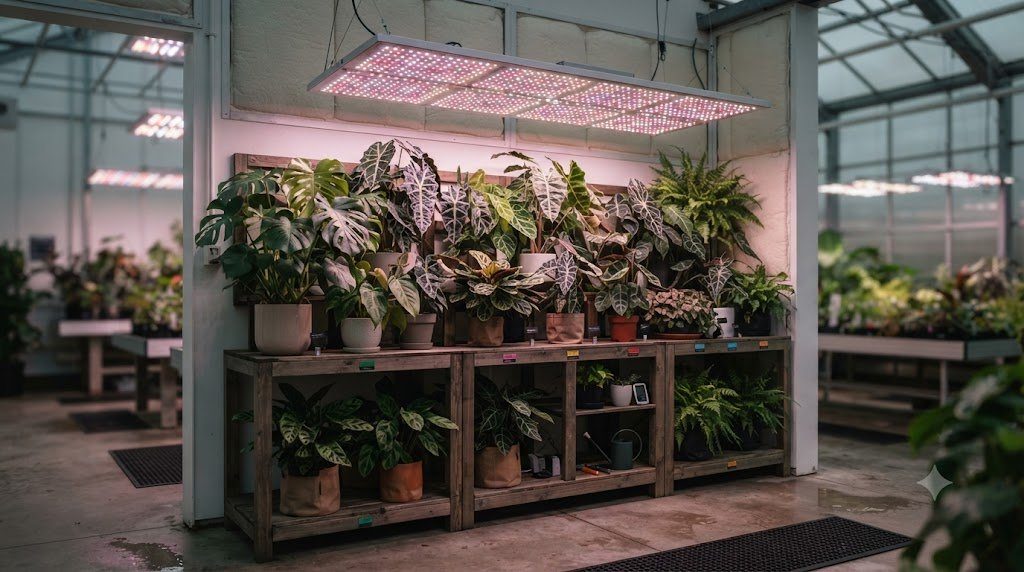
Light is the fundamental metabolic currency of plant life. Every carbohydrate molecule driving leaf cell expansion, root elongation, vascular transport, and chemical defense is synthesized exclusively through photosynthesis driven by intercepted photons. In residential indoor plant cultivation, insufficient lighting is overwhelmingly the primary underlying cause of plant mortality, leaf drop, weak leggy internodes, and root rot. Understanding the biophysics of artificial and natural indoor illumination—measuring Photosynthetically Active Radiation (PAR), Daily Light Integral (DLI), and spectral quality—transforms houseplant care from guesswork into an exact, predictable science.
Photometric Units vs. Plant Photobiology: The Lux and Lumen Trap
A pervasive error among indoor gardeners is evaluating plant light levels using human eye metrics such as lumens and lux (or imperial foot-candles). Human photopic vision is tuned specifically to yellow-green light wavelengths (peaking around 555 nanometers), because our eyes evolved to navigate daylight efficiently. Consequently, a light meter measuring lux gives enormous weight to yellow-green photons that plants largely reflect, while severely discounting blue and red photons that drive primary photosynthesis.
Photosynthetically Active Radiation (PAR) and Quantum Photon Flux
Plant photobiology relies on Photosynthetically Active Radiation (PAR)—the spectral band of solar radiation between 400 and 700 nanometers that plant photosynthetic pigments (principally Chlorophyll $a$, Chlorophyll $b$, and carotenoids) can absorb to drive the light-dependent reactions of photosynthesis. PAR is measured as Photosynthetic Photon Flux Density (PPFD), expressed in micromoles of photons per square meter per second ($\mu mol/m^2/s$).
The Inverse Square Law and Window Distance Attenuation
The physical propagation of light through an interior room obeys the Inverse Square Law of Illuminance: light intensity is inversely proportional to the square of the distance from the light source ($I \propto 1/d^2$). While this formula applies directly to point-source artificial fixtures, natural window illumination follows a steep exponential attenuation curve due to wall shading and glazing filtration:
| Distance From Window (South Exposure) | Average Foot-Candles | Average PPFD ($\mu mol/m^2/s$) | Suitable Plant Species | Metabolic Status |
|---|---|---|---|---|
| Direct Windowsill (0 Feet) | 1,500 – 3,500 FC | 250 – 650 | Succulents, Ficus lyrata, Citrus | Maximum Photosynthesis & Growth |
| 3 Feet Away From Glass | 300 – 600 FC | 50 – 110 | Monstera, Philodendron, Anthurium | Vigorous Vegetative Expansion |
| 6 Feet Away From Glass | 100 – 200 FC | 15 – 35 | Epipremnum (Pothos), Sansevieria | Slow Maintenance / Survival Mode |
| 10+ Feet (Interior Room Center) | 20 – 50 FC | 3 – 8 | Plastic / Artificial Plants only | Starvation / Leaf Abscission & Death |
Spectral Quality: Chlorophyll Absorption and Phytochrome Signaling
Photosynthetic pigments do not utilize all wavelengths equally:
- Blue Wavelengths (430 – 470 nm): High-energy photons absorbed strongly by chlorophylls and cryptochrome photoreceptors. Blue light suppresses internodal elongation, stimulating tight, compact growth, thick leaf laminae, and active stomatal opening.
- Red Wavelengths (640 – 680 nm): Matches the peak absorption spectrum of Chlorophyll $a$ and $b$, providing the primary thermodynamic energy for carbohydrate synthesis.
- Far-Red Wavelengths (700 – 740 nm): Governs the Phytochrome Photoreversible System. The ratio of Red to Far-Red light ($R:FR$) informs the plant whether it is growing in open sunlight or beneath a dense canopy. A low $R:FR$ ratio triggers the ‘shade avoidance response’—causing plants to stretch into weak, leggy stems.
Selecting Artificial Horticultural Grow Lighting
Modern horticultural illumination has been revolutionized by high-efficiency Light Emitting Diodes (LEDs). When selecting artificial grow lights for indoor houseplant collections, look for:
- Full-Spectrum White LEDs (3500K – 4000K Color Temperature): Provide a continuous, visually pleasing daylight spectrum containing a balanced blend of blue, green, and red photons with high Color Rendering Index (CRI > 90), rendering plants in vivid natural color without purple glare.
- High Electrical Efficiency (Efficacy > 2.2 $\mu mol/Joule$): Ensures maximum photon output per watt of consumed electricity while producing minimal waste heat that could scorch foliage.
- Optical Beam Angle Considerations: Utilize spotlights (36° to 60° beam angles) for isolated architectural specimen trees, and broad-distribution bar lights (120° beam angle) for multi-tiered plant shelving units.
Photoperiod Management and Circadian Rhythm Synchronization
Plants require predictable circadian rhythms to regulate metabolic enzymatic processes. Maintain indoor foliage grow lights on automated digital timers programmed for 12 to 14 continuous hours of illumination daily, followed by 10 to 12 hours of total darkness. Darkness is metabolically mandatory: during the dark period, plants engage in cellular respiration, translocating stored photosynthates from leaf chloroplasts to developing root tips and growing shoot meristems.
Calculating the Daily Light Integral (DLI) for Indoor Collections
While Photosynthetic Photon Flux Density (PPFD) measures the instantaneous intensity of light photons raining down on a leaf surface per second, the true metabolic determinant of plant growth is the cumulative total volume of photons absorbed throughout an entire 24-hour cycle—the Daily Light Integral (DLI), measured in moles of photons per square meter per day ($mol/m^2/day$).
DLI Thresholds Across Plant Physiological Categories
Every indoor plant species possesses minimum maintenance, vegetative expansion, and saturation DLI thresholds:
| Plant Category / Representative Species | Minimum Maintenance DLI | Optimal Growth DLI | Light Saturation DLI | Recommended Photoperiod |
|---|---|---|---|---|
| Low-Light Foliage (Sansevieria, Zamioculcas) | 1.5 – 2.5 mol/m²/day | 3.0 – 5.0 mol/m²/day | 8.0 mol/m²/day | 10 – 12 Hours daily |
| Medium Tropical Foliage (Monstera, Philodendron) | 3.5 – 5.0 mol/m²/day | 6.0 – 10.0 mol/m²/day | 14.0 mol/m²/day | 12 – 14 Hours daily |
| High-Light Specimen Trees (Ficus lyrata, Citrus) | 6.0 – 8.0 mol/m²/day | 12.0 – 18.0 mol/m²/day | 25.0 mol/m²/day | 14 – 16 Hours daily |
| Desert Succulents & Cacti (Echeveria, Euphorbia) | 8.0 – 10.0 mol/m²/day | 16.0 – 24.0 mol/m²/day | 35.0 mol/m²/day | 14 – 16 Hours daily |
Photomorphogenesis: The Role of Cryptochromes and Phytochromes
Beyond supplying thermodynamic energy for photosynthesis, light serves as an essential informational signal that orchestrates plant architecture through specialized photoreceptor proteins:
- Phytochromes ($P_r$ and $P_{fr}$): Detect red (660 nm) and far-red (730 nm) light ratios. When a plant receives high red light, inactive $P_r$ converts into biologically active $P_{fr}$, signaling that the plant is bathed in direct sunlight. Active $P_{fr}$ suppresses stem elongation, stimulates leaf expansion, and promotes branching. Under far-red light (the filtered shadow beneath other leaves), $P_{fr}$ reverts to $P_r$, triggering rapid, weak stem stretching.
- Cryptochromes and Phototropins: Blue light photoreceptors that govern phototropism (bending toward light) and chloroplast movement within cells. Under excessive solar radiation, phototropins signal chloroplasts to migrate to side cell walls to prevent light-induced chlorophyll photo-oxidation.
Thermal Management and Driver Efficiency in Modern LED Fixtures
While high-efficiency LEDs produce significantly less heat than legacy High-Pressure Sodium (HPS) or metal halide lamps, they still convert approximately 50% of electrical energy into thermal heat. Crucially, LEDs emit heat conductively through the back of the diode board rather than projecting infrared radiation downward onto plants. Ensure artificial grow lights feature substantial aluminum heat sinks or active cooling fans to dissipate heat away from the ceiling, preventing ambient room temperatures from exceeding 85°F.
Photosynthetic Quantum Yield Curves and the Emerson Effect
Understanding horticultural lighting efficiency requires examining the McCree Action Spectrum and the Emerson Enhancement Effect. In 1972, Dr. K.J. McCree demonstrated that photon absorption and photosynthetic quantum yield are not identical: while chlorophyll absorbs blue light efficiently, blue photons are absorbed in outer leaf layers, whereas red and green photons penetrate deeper into interior mesophyll cell layers to drive core photosynthesis.
The Emerson Enhancement Effect reveals that exposing plants simultaneously to Red light (660 nm) and Far-Red light (730 nm) yields a rate of photosynthesis significantly higher than the mathematical sum of the two lights applied separately! Far-Red photons excite Photosystem I (PSI), relieving metabolic bottlenecks and accelerating electron transport through Photosystem II (PSII). Modern commercial LED grow lights incorporate targeted Far-Red diodes to exploit this biological quantum synergy.
| Spectral Wavelength Band | Dominant Color | Primary Photoreceptor | Morphological & Physiological Impact | Optimal Spectrum Share (%) |
|---|---|---|---|---|
| 400 – 450 nm | Deep Blue / Violet | Cryptochromes & Phototropins | Suppresses stretching; stimulates stomatal opening | 15% – 20% of total PPFD |
| 500 – 580 nm | Green / Yellow | Internal mesophyll chlorophyll | Deep canopy penetration; human visual clarity | 20% – 30% of total PPFD |
| 640 – 680 nm | Deep Red (660nm) | Chlorophyll $a$ and $b$ peak | Primary thermodynamic engine for carbon fixation | 45% – 55% of total PPFD |
| 700 – 740 nm | Far-Red (730nm) | Phytochrome $P_{fr} ightarrow P_r$ |
Drives Emerson effect; governs shade avoidance | 5% – 8% of total PPFD |
Measuring Light Accurately: PAR Quantum Sensors vs. Smartphone Apps
Many indoor hobbyists attempt to measure grow light intensity using smartphone camera light meter apps. However, smartphone camera sensors contain infrared cutoff filters and lack cosine-corrected optical diffusers, producing measurement errors exceeding 40% to 60%! Accurate horticultural light auditing requires a calibrated solid-state Quantum PAR Meter (such as Apogee Instruments) equipped with a cosine-corrected optical sensor that measures true Photosynthetic Photon Flux Density ($\mu mol/m^2/s$) accurately across all artificial LED spectrums.
Photoperiodic Flowering Regulation: Short-Day vs. Long-Day Foliage
Beyond supplying photosynthetic energy, lighting duration dictates developmental transitions through photoperiodism. Plants measure the length of uninterrupted darkness using phytochrome photoreceptors:
- Short-Day Plants (Poinsettias, Holiday Cacti): Require long, uninterrupted nights (typically 14 hours of continuous total darkness for 6 to 8 weeks) to initiate flower buds. A single flash of light during the dark cycle disrupts phytochrome signaling, resetting the hormonal clock and halting flowering!
- Day-Neutral Plants (Most Tropical Foliage Aroids): Vegetative foliage growth is day-neutral, responding to total cumulative photons (DLI) rather than specific day-length triggers.
Thermal Dissipation Engineering: Heat Sinks and Diode Longevity
High-power LED chips generate localized junction temperatures at the microscopic semiconductor silicon die. If junction temperatures exceed 175°F (80°C), diode efficiency drops precipitously, light output (lumens/PPFD) degrades permanently, and the phosphor coating burns. Quality horticultural LED fixtures utilize thick extruded aluminum heat sinks with deep cooling fins, passively dissipating thermal energy without noisy mechanical fans, ensuring a service life exceeding 50,000 continuous operating hours.
Digital Light Programming: Automated Sunrise and Sunset Simulators
In natural outdoor environments, sunlight does not click on instantly at full intensity. Abruptly switching high-intensity LED grow lights on can shock plant photoreceptors, causing brief photoprotective stomatal closure. Advanced horticultural light controllers utilize programmable digital ramp timers that gradually increase photon intensity from 0% to 100% over 30 minutes at dawn, and reverse the process at dusk. This gradual ramp simulates natural diurnal solar transitions, smoothing transpirational demand and optimizing indoor photosynthetic efficiency.
Interior Botanical Protocol: The Complete Houseplant Health Maintenance Guide
Maintaining an exceptional collection of indoor tropical houseplants requires replicating the gentle, humid, high-oxygen conditions of equatorial rainforest understories within the modern residential home. Moving beyond basic watering routines to understand indoor environmental physics unlocks lush, vibrant, exhibition-grade foliage.
The Systematic Indoor Plant Wellness Protocol
Incorporate this weekly botanical care routine to ensure optimal vigor across your indoor foliage collection:
- Substrate Core Moisture Auditing: Insert a wooden chopstick or digital moisture probe deep into the center of the root ball. Water thoroughly only when the upper 30% to 50% of the substrate has dried, ensuring ample drainage flushes through bottom holes.
- Foliar Dust and Stomatal Cleansing: Wipe both sides of foliage gently with a soft, damp microfiber cloth every two weeks. Dust accumulation acts as an optical filter, blocking up to 30% of incoming light photons and clogging stomatal pores.
- Light Intensity and Photoperiod Recalibration: Audit light levels at leaf surfaces using a calibrated PAR meter. Adjust LED fixture hanging heights as plants grow upward to maintain target PPFD levels without heat scorching.
- Pest Quarantine and Loupe Scouting: Examine new leaf crevices, petiole sheaths, and leaf undersides under 10x magnification. Early detection of isolated spider mites or thrips allows rapid mechanical eradication before infestations spread.
- Vapor Pressure Deficit Optimization: Maintain indoor relative humidity between 55% and 70% using cool-mist ultrasonic humidifiers. Avoid placing plants directly in the path of forced-air heating registers or cold air-conditioning drafts.
Adhering to these physiological guidelines empowers indoor plant enthusiasts to cultivate thriving, fenestrated, and structurally magnificent specimens that elevate interior living spaces into verdant indoor sanctuaries.