The enclosed environment of a residential home represents an artificial microclimate characterized by static air, stable warm temperatures, absence of driving rainfall, and total isolation from native predatory insects. While these conditions facilitate year-round tropical plant growth, they simultaneously establish an ecological paradise for opportunistic phytophagous insect pests. Without natural predators to check their reproduction, a single gravid female pest introduced via a new nursery plant can multiply exponentially into an uncontrollable infestation within weeks. Eradicating indoor pests requires a systematic understanding of pest life cycles, biological modes of action, systemic chemical dynamics, and strict quarantine protocols.
Thrips (Thysanoptera): Biology of the Ultimate Indoor Scourge
Among all indoor houseplant pests, thrips—principally the Western Flower Thrips (Frankliniella occidentalis) and Greenhouse Thrips (Heliothrips haemorrhoidalis)—are the most destructive and intractable. Thrips are minute, slender insects (1 to 2 mm in length) equipped with specialized asymmetrical mouthparts featuring a single piercing mandible that rasps open outer plant epidermal cells, allowing the insect to suck out intracellular contents.
Endophytic Oviposition and the Soil Pupation Cycle
What makes thrips so extraordinarily resilient to standard contact spray treatments is their complex multi-stage developmental biology. Female thrips possess a serrated ovipositor that cuts microscopic slits directly inside the plant’s internal leaf tissue, inserting eggs deep beneath the protective cuticle where contact insecticides cannot touch them. After hatching and feeding through two larval instars, thrips enter the ‘prepupal’ and ‘pupal’ stages, during which many species drop from the foliage into the subterranean potting substrate to pupate, sheltered from foliar sprays.
Comparative Taxonomy and Lifecycle Mechanics of Major Indoor Pests
Accurate identification of the target organism is the absolute prerequisite for selecting an effective biological or chemical control agent:
| Pest Organism | Primary Feeding Niche | Key Diagnostic Symptoms | Optimal Biological Predator | Target Chemical Mechanism |
|---|---|---|---|---|
| Thrips (Frankliniella) | Intracellular sap / Epidermis | Silvery patches with black frass dots | Amblyseius swirskii, Orius bugs | Spinosad, Systemic Imidacloprid / Acetamiprid |
| Two-Spotted Spider Mites (Tetranychus urticae) | Cellular chlorophyll contents | Fine stippling, yellowing, silken webbing | Phytoseiulus persimilis, Neoseiulus californicus | Abamectin, Horticultural oils, Sulfur dust |
| Armored & Soft Scale (Coccoidea) | Vascular phloem sap | Waxy brown domes along stems, sticky honeydew | Lacewing larvae, Cryptolaemus | Horticultural oil suffocation, Systemic neonicotinoids |
| Fungus Gnats (Sciaridae) | Soil fungal hyphae & feeder roots | Adult gnats flying around substrate surface | Beneficial nematodes (S. feltiae), Hypoaspis miles | Bacillus thuringiensis israelensis (Bti) |
Spider Mite (Acari: Tetranychidae) Population Explosions
Two-Spotted Spider Mites are microscopic arachnids that flourish in hot, arid residential conditions (relative humidity below 40%). Under warm conditions (80°F / 27°C), a spider mite can progress from egg to reproductive adult in just seven days, with a single female laying over one hundred eggs. Mites puncture plant cells to extract vital chlorophyll, creating thousands of tiny yellow or white speckles (‘stippling’) across foliage. In advanced stages, mites spin fine silken webs over growing tips to protect colonies from predators and facilitate wind dispersal.
Miticide Resistance and Sulfur Dust Vaporization
Spider mites possess an extraordinary genetic capacity to develop rapid resistance to synthetic chemical miticides within two to three generations. For heavy infestations, pure wettable sulfur or horticultural oil sprays provide highly effective physical modes of action that pests cannot develop resistance against. Sulfur disrupts fungal and mite respiratory electron transport chains while fine horticultural oils physically coat and suffocate mite spiracles.
Fungus Gnat Management: Biological Eradication of Sciarid Flies
Fungus gnats (family Sciaridae) are small, black, mosquito-like flies commonly observed fluttering around houseplants. While adults are harmless to foliage, their subterranean translucent white larvae feed voraciously on decomposing soil organic matter and delicate plant root hairs, introducing root rot pathogens (Pythium). Eradicating fungus gnats requires a dual-stage biological protocol:
- Larval Biological Eradication with Bti: Apply Bacillus thuringiensis subspecies israelensis (Bti) directly into potting soil with every watering for three consecutive weeks. Bti produces crystal protein toxins that dissolve exclusively in the alkaline midgut of fly larvae, causing rapid mortality without affecting plants or pets.
- Adult Trapping with Yellow Sticky Cards: Position yellow sticky cards horizontally right at the substrate soil line to capture adult flying gnats, breaking the reproductive egg-laying cycle.
The Comprehensive Plant Quarantine and Intake Protocol
Preventing an infestation is infinitely easier than treating one in an established indoor plant collection. Implement a mandatory 30-day quarantine protocol for every new plant entering the home: isolate the plant in a separate room, inspect foliage under magnification, spray thoroughly with an organic insecticidal soap or neem derivative, and apply a preventative drench of Bti before introducing the specimen into the main plant room.
Systemic Insecticide Pharmacology: Neonicotinoids vs. Contact Botanicals
When severe indoor infestations of thrips, armored scale, or mealybugs threaten an entire plant collection, contact botanical sprays (such as neem oil or insecticidal soaps) frequently fail because they cannot reach pests hidden inside closed leaf sheaths, root zones, or stem crevices. In these critical scenarios, understanding the pharmacology of systemic insecticides is essential.
Mode of Action of Imidacloprid and Acetamiprid
Systemic insecticides—principally neonicotinoids like Imidacloprid and Acetamiprid—are absorbed by plant roots following a soil drench. Once inside, the active ingredient translocates acropetally (upward) through the plant’s vascular xylem vessels, distributing throughout all stem and leaf tissues. When piercing-sucking insects ingest plant sap, the compound irreversibly binds to nicotinic acetylcholine receptors in the insect’s central nervous system, causing paralysis and mortality within 24 to 48 hours.
| Insecticide / Miticide Class | Target Pest Spectrum | Systemic vs. Contact | Residual Efficacy Period | Mammalian / Indoor Safety Rating |
|---|---|---|---|---|
| Imidacloprid (Neonicotinoid) | Thrips, Scale, Mealybugs, Aphids | Fully Systemic (Via root uptake) | 4 – 8 Weeks residual protection | Moderate (Safe once dry; toxic to bees) |
| Spinosad (Microbial Ferment) | Thrips, Caterpillars, Leafminers | Translaminar (Absorbs into leaf) | 7 – 10 Days | High (OMRI-listed organic) |
| Abamectin (Avermectin Miticide) | Spider Mites, Broad Mites | Translaminar (Absorbs into foliage) | 14 – 21 Days | Moderate (Use personal protective gear) |
| Potassium Salts of Fatty Acids (Soap) | Soft-bodied aphids, juvenile mealybugs | Strictly Contact (No residual) | 0 Days (Kills on contact only) | Extremely High (Pet & human safe) |
Biological Control Release Mechanics in Indoor Environments
For dedicated organic growers and indoor cabinet collections, releasing live commercial beneficial predatory insects offers permanent biological pest suppression without chemicals:
- Amblyseius swirskii Predatory Mites: Voracious generalist predators that consume thrips larvae, whitefly eggs, and two-spotted spider mites. Available in slow-release paper breeding sachets hung directly on plant petioles, releasing hundreds of predatory mites weekly for four consecutive weeks.
- Phytoseiulus persimilis Specialist Spider Mite Hunters: Obligate predators that feed exclusively on two-spotted spider mites. In high-humidity environments (RH > 60%), P. persimilis reproduces faster than spider mites, completely annihilating dense colonies and their silken webbing.
Sanitation Chemistry: 70% Isopropyl Alcohol Spot Treatment
For minor localized outbreaks of mealybugs (Pseudococcidae) or soft scale, dip a cotton swab directly into 70% isopropyl alcohol and touch the individual insects. The alcohol instantly dissolves the insect’s protective white waxy coating (lanolin) and dehydrates its cell membranes, killing the pest on contact without requiring broad foliar spraying. Test alcohol on a single leaf first to verify that delicate foliage does not experience chemical phytotoxicity.
Economic Threshold Action Levels for Indoor Collections
In commercial agriculture, an ‘economic threshold’ is the pest density at which chemical treatment costs less than the predicted crop yield loss. In high-value indoor ornamental collections, however, the economic threshold is essentially near-zero tolerance: a single unmitigated pest can scar a rare, multi-hundred-dollar specimen plant permanently.
Implement a graduated three-tier action response based on scouting severity:
- Tier 1: Preventative / Solitary Detection (1-2 Pests Scouted): Immediate physical isolation of the plant. Mechanical removal using 70% isopropyl alcohol swabs. Release generalist predatory mites (Amblyseius swirskii).
- Tier 2: Moderate Infestation (Multiple Leaves Symptomatic): Full physical foliar spray using potassium salts of fatty acids (insecticidal soap) combined with spinosad. Repeat applications every 5 to 7 days for three consecutive cycles to intercept newly hatched eggs.
- Tier 3: Severe Systemic Crisis (Pests Spreading to Neighboring Plants): Treat with systemic insecticides (imidacloprid soil drench) coupled with aggressive pruning of heavily colonized leaves. Bag and dispose of infested foliage immediately.
| Target Indoor Pest | Primary Scouting Micro-Location | Early Diagnostic Hallmark | Recommended Bio-Control Predator | Threshold Action Level |
|---|---|---|---|---|
| Thrips (Western Flower) | Undersides of new emerging leaves | Silvery windowpanes + tar-black frass droplets | Amblyseius swirskii / Orius bugs | 1 Single insect observed |
| Spider Mites (Two-Spotted) | Leaf undersides along veins; crevices | Microscopic yellow stippling; fine webbing | Phytoseiulus persimilis | 2-3 Stippled leaves per plant |
| Mealybugs (Citrophilus) | Petiole axils, sheath folds, root crowns | White cottony waxy clusters | Cryptolaemus montrouzieri (Ladybird) | 1 Single cottony egg sac |
| Fungus Gnats (Bradysia) | Upper 1 inch of damp potting soil | Adults flying around pot rims | Nematodes (Steinernema feltiae) + Bti | 5 Adults trapped on sticky card |
Mechanical High-Pressure Foliar Washing Protocols
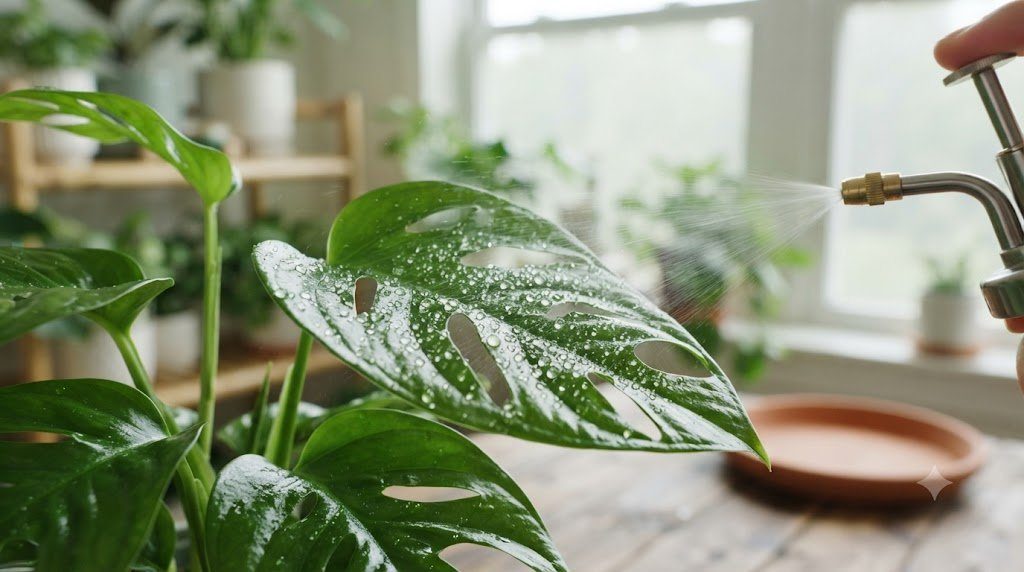
One of the most effective non-chemical interventions for eliminating spider mites, aphids, and juvenile scale is taking plants to the shower or outdoor wash station and blasting foliage with a high-pressure water jet. Focus the spray upward at a 45-degree angle to wash the undersides of leaves and leaf axils. The physical kinetic force of the water dislodges and crushes adult insects, drowns nymphs, and washes away sticky honeydew and dust without chemical resistance.
Sanitation Protocol for Plant Influx: The Dip Tank Quarantine
The most vulnerable moment for any established houseplant collection is the arrival of a new nursery specimen. Relying on simple visual inspection is inadequate, as microscopic spider mite eggs and endophytic thrips eggs are invisible to the naked eye. Implement a mandatory Submersion Dip Protocol:
Fill a clean bucket with room-temperature water treated with 2 tablespoons of organic insecticidal soap and 1 ounce of cold-pressed horticultural oil per gallon. Invert the new potted plant (holding a piece of plastic wrap securely over the soil) and submerge the entire foliage and stem canopy completely under the liquid for 60 seconds. The solution penetrates every microscopic leaf fold and stomatal crevice, coating and suffocating all hitchhiking pests before the plant ever enters your living space.
Quarantine Room Air Filtration: HEPA and Carbon Scrubbers
Adult thrips and sciarid fungus gnats are capable of airborne flight, carried across rooms on home air-conditioning drafts. In dedicated quarantine areas, install a continuous air filtration unit equipped with a high-efficiency particulate air (HEPA) filter and an activated carbon scrubber. The HEPA filter captures microscopic airborne fungal spores (powdery mildew and botrytis) and flying insect pests, preventing cross-contamination into primary living rooms.
Interior Botanical Protocol: The Complete Houseplant Health Maintenance Guide
Maintaining an exceptional collection of indoor tropical houseplants requires replicating the gentle, humid, high-oxygen conditions of equatorial rainforest understories within the modern residential home. Moving beyond basic watering routines to understand indoor environmental physics unlocks lush, vibrant, exhibition-grade foliage.
The Systematic Indoor Plant Wellness Protocol
Incorporate this weekly botanical care routine to ensure optimal vigor across your indoor foliage collection:
- Substrate Core Moisture Auditing: Insert a wooden chopstick or digital moisture probe deep into the center of the root ball. Water thoroughly only when the upper 30% to 50% of the substrate has dried, ensuring ample drainage flushes through bottom holes.
- Foliar Dust and Stomatal Cleansing: Wipe both sides of foliage gently with a soft, damp microfiber cloth every two weeks. Dust accumulation acts as an optical filter, blocking up to 30% of incoming light photons and clogging stomatal pores.
- Light Intensity and Photoperiod Recalibration: Audit light levels at leaf surfaces using a calibrated PAR meter. Adjust LED fixture hanging heights as plants grow upward to maintain target PPFD levels without heat scorching.
- Pest Quarantine and Loupe Scouting: Examine new leaf crevices, petiole sheaths, and leaf undersides under 10x magnification. Early detection of isolated spider mites or thrips allows rapid mechanical eradication before infestations spread.
- Vapor Pressure Deficit Optimization: Maintain indoor relative humidity between 55% and 70% using cool-mist ultrasonic humidifiers. Avoid placing plants directly in the path of forced-air heating registers or cold air-conditioning drafts.
Adhering to these physiological guidelines empowers indoor plant enthusiasts to cultivate thriving, fenestrated, and structurally magnificent specimens that elevate interior living spaces into verdant indoor sanctuaries.