Plant propagation is the magical yet deeply scientific discipline of taking living somatic tissue from a mature parent plant and stimulating it to regenerate entirely new root, shoot, and vascular systems. In indoor tropical horticulture, vegetative (asexual) propagation preserves the exact genetic identity and variegation patterns of prized cultivars that cannot be replicated through seed. Mastering the cellular mechanics of adventitious root differentiation, meristematic node activation, auxinic rooting hormone cascades, water rooting physics, and air-layering transforms a home grower into an accomplished botanical propagator.
Anatomy of the Node: Meristematic Pluripotency and Auxin Distribution
The biological foundation of asexual propagation resides in the node—the distinct morphological junction along a plant stem where leaves, petiole sheaths, and auxiliary buds originate. The tissue between nodes is the internode.
Axillary Meristem Activation and Basipetal Auxin Transport
Within each node lies a cluster of undifferentiated, totipotent meristematic cells known as the axillary bud (or ‘eye’). Under normal circumstances, the apical shoot tip of the plant continuously synthesizes the plant hormone auxin (principally Indole-3-Acetic Acid / IAA). Auxin moves downward through vascular tissues via polar basipetal transport, creating a hormonal suppression known as apical dominance that keeps dormant axillary buds from growing. When a propagator cuts the stem, removing the apical tip, auxin concentrations at the node drop precipitously, while upward-moving cytokinins from the root system trigger rapid cell division, causing the dormant axillary bud to burst into active vegetative shoot growth.
Adventitious Root Induction and Hormonal Chemistry
Adventitious roots are roots that develop from non-root tissue, such as stems or leaves. Their development progresses through four distinct anatomical phases: dedifferentiation of vascular cambium cells, formation of root primordia initials, internal vascular connection establishment, and mechanical emergence through outer stem bark.
| Rooting Medium / Technique | Aeration Porosity (%) | Water Holding Capacity | Root Architecture Quality | Rot Mortality Risk |
|---|---|---|---|---|
| Liquid Water Rooting (Hydro) | 0% (Dissolved $O_2$ only) | 100% | Fragile, water-adapted roots with few hairs | Moderate (Anaerobic stagnation) |
| Perlite / Vermiculite (Semi-Hydro) | 30% – 40% | 45% – 55% | Stout, well-branched root systems | Low (Excellent passive aeration) |
| Long-Fiber Sphagnum Moss | 25% – 35% | 65% – 75% | Extremely dense root hair proliferation | Very Low (Natural antimicrobial properties) |
| Stratified Coarse Pumice / LECA | 40% – 50% | 30% – 40% | Thick, highly durable primary roots | Extremely Low (Optimal drainage) |
The Water Rooting Paradox: Aquatic vs. Terrestrial Root Morphology
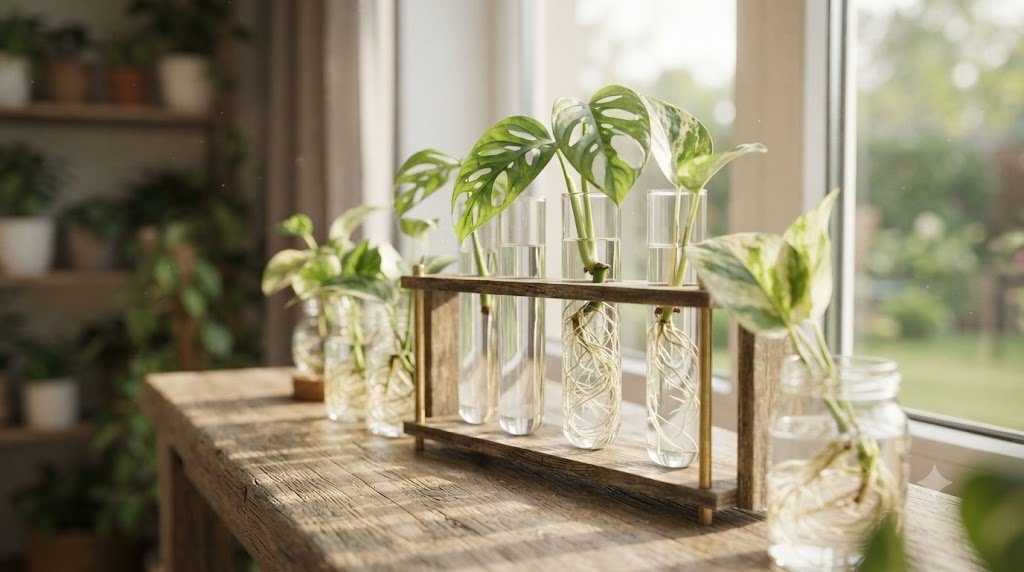
Rooting cuttings in a jar of clean water is extraordinarily popular due to its simplicity and the visual satisfaction of watching white root initials emerge. However, roots formed in liquid water develop distinct physiological adaptations: they form thin, brittle cell walls with large intracellular aerenchyma air channels designed to function in oxygen-depleted aquatic environments, while developing almost zero microscopic root hairs.
The Transplant Shock Transition
When an aquatic-rooted cutting is abruptly transplanted into a solid, abrasive potting soil mix, these delicate water roots are easily crushed by soil particles and desiccate rapidly because they lack protective outer suberin layers and root hairs. To minimize transplant shock, transition water-rooted cuttings into a damp, high-humidity sphagnum moss or perlite blend for two weeks before final potting, or ensure soil remains evenly moist during initial root acclimation.
Air-Layering Mechanics for Giant Specimen Preservation
Air-layering is the most advanced and risk-free propagation methodology, particularly for large, expensive specimen plants such as giant Monstera deliciosa, Ficus lyrata (Fiddle Leaf Fig), or rubber trees (Ficus elastica):
- Zero Energy Stress on the Cutting: Unlike severed stem cuttings that must survive on internal stored carbohydrates while desperately growing roots, air-layering induces root formation while the stem remains physically connected to the mother plant’s root and vascular system.
- The Girdling / Wounding Technique: Make an upward diagonal cut (one-third into the stem) beneath a node, or strip a narrow ring of outer bark to disrupt downward phloem transport. This causes photosynthesized carbohydrates and auxin to accumulate right at the wound site.
- Moss Ball Encapsulation: Apply Indole-3-Butyric Acid (IBA) rooting hormone to the wound. Pack a fist-sized ball of damp long-fiber sphagnum moss around the node and wrap tightly with clear plastic wrap or a rooting pod secured with zip-ties. Within 4 to 8 weeks, a dense ball of thick terrestrial roots fills the moss, allowing the propagator to sever the cutting cleanly and pot it without a single day of transplant shock!
Variegation Stability and Chimeric Cellular Architecture
When propagating prized variegated houseplants (such as ‘Albo’ or ‘Thai Constellation’ monsteras), propagators must understand plant chimera genetics. Variegation is caused by somatic mutations in specific cell layers of the shoot apical meristem. To ensure daughter cuttings maintain stable variegation, the cut must be positioned so that the axillary bud emerges directly through the green-and-white variegated stripe on the stem axis. If an axillary bud forms entirely within green tissue, the cutting reverts to solid green; if formed entirely within white tissue, it yields an albino shoot that starves from lack of chlorophyll.
Cellular Totipotency and Plant Tissue Culture (Micropropagation)
At the cutting edge of modern botanical propagation is plant tissue culture (micropropagation). In traditional asexual propagation, a grower takes a multi-node cutting containing thousands of somatic cells. In tissue culture, however, an entire mature plant is cloned from a microscopic cluster of meristematic cells (an explant) just 0.5 to 1.0 mm in size, suspended in an aseptic, nutrient-rich agar gel medium.
The Murashige and Skoog (MS) Medium and Phytohormone Ratios
Tissue culture operates on the legendary Murashige and Skoog (MS) nutrient formulation, which provides sucrose, mineral salts, and vitamins. The morphological development of the explant is controlled mathematically by adjusting the ratio between two master plant hormones:
- High Auxin to Cytokinin Ratio: Stimulates rapid adventitious root organogenesis and callus tissue formation.
- High Cytokinin to Auxin Ratio: Suppresses root formation and stimulates explosive multiplication of vegetative auxiliary shoots, generating dozens of identical clonal plantlets from a single node.
- Balanced 1:1 Auxin to Cytokinin Ratio: Promotes undifferentiated cell division, producing a mass of pluripotential cells known as a callus.
| Propagation Methodology | Multiplication Rate (Clones/Yr) | Genetic Variegation Stability | Technical Complexity | Pathogen Sanitation Level |
|---|---|---|---|---|
| Stem / Node Cuttings | 1:5 – 1:10 per plant | High (Maintains chimera patterns) | Low (Home windowsill) | Variable (Carries parent viruses) |
| Air-Layering | 1:1 – 1:2 per plant | 100% Identical to mature branch | Moderate | Carries parent pathogens |
| Aseptic Tissue Culture | 1:10,000+ per explant | Risk of somaclonal variation / reversion | Extremely High (Laminar flow hood) | 100% Sterile (Pathogen-free certified) |
| Division of Rhizomes / Tubers | 1:3 – 1:6 per season | 100% Stable | Low | Moderate |
Rooting Hormone Chemistry: Indole-3-Butyric Acid (IBA) Formulations
Commercial rooting compounds utilize synthetic auxins, predominantly Indole-3-Butyric Acid (IBA) and 1-Naphthaleneacetic Acid (NAA). Unlike natural endogenous auxin (IAA), which breaks down rapidly when exposed to light and oxygen, IBA remains chemically stable within plant stem tissue for days, continuously signaling vascular cambium cells to differentiate into root primordia. For tropical houseplant softwood cuttings, utilize a 0.1% to 0.2% (1,000 to 2,000 ppm) IBA powder or liquid dip. Avoid excessive hormone concentrations, which can cause chemical burning of the cut stem base and inhibit root elongation.
Aseptic Technique and Preventing Rot in Cutting Vessels
The single greatest cause of cutting mortality during water or moss propagation is bacterial soft rot caused by contaminated tools. Always sterilize cutting blades using heat or a 10% bleach solution between cuts. When propagating in water, incorporate 1 to 2 drops of 3% household hydrogen peroxide ($H_2O_2$) per cup of water once weekly. Hydrogen peroxide delivers a continuous micro-dose of dissolved oxygen while oxidizing pathogenic bacterial cell walls, keeping propagation water crystalline and rot-free.
Adventitious Root Cell Wall Differentiation and Suberin Chemistry
The anatomical transition of stem vascular tissue into an adventitious root is a marvel of cellular reprogramming. When auxins accumulate at a severed node, parenchyma cells adjacent to the vascular cambium undergo dedifferentiation, becoming active meristematic initials. As these cells divide, they form a root cap and push outward through the stem cortex and epidermis.
As the new root emerges into the surrounding medium, the outer epidermal layer undergoes suberization—depositing suberin (a complex, hydrophobic biopolyester) into root cell walls. Suberin acts as an impermeable barrier that prevents water loss, protects roots from soil pathogens, and regulates mineral uptake. In water-rooted cuttings, suberin deposition is severely inhibited due to continuous liquid immersion, explaining why water roots are so susceptible to desiccation when transplanted into dry potting mix.
| Propagation Vessel / Substrate | Suberin Deposition Rate | Root Hair Density (hairs/mm²) | Aeration Porosity | Average Rooting Time (Days) |
|---|---|---|---|---|
| Aerated Water Bubbler | Very Low (Underdeveloped cuticle) | 5 – 15 (Sparse) | 0% (Dissolved $O_2$ only) | 14 – 21 Days |
| Damp Coarse Perlite (Semi-Hydro) | High (Normal terrestrial suberin) | 80 – 140 (Dense) | 35% – 45% | 12 – 18 Days |
| Long-Fiber Sphagnum Moss | Very High (Thick suberin layer) | 120 – 200 (Exceptionally dense) | 25% – 35% | 10 – 15 Days |
| Sterile Peat-Perlite Plug | High | 90 – 150 | 20% – 30% | 14 – 20 Days |
Chimeric Variegation Genetics and Sectorial Somatic Reversion
Prized variegated cultivars (such as Monstera deliciosa ‘Albo Variegata’) are periclinal chimeras—plants composed of two genetically distinct cell layers in the shoot apical meristem: an outer layer containing mutant cells lacking chlorophyll, and an inner layer with normal green chloroplasts. When taking stem cuttings, propagators must examine the ‘growth strip’ running through the axillary eye. If a node cut is taken from a section of stem that has reverted to solid green, the emerging shoot will be 100% green. If taken from a fully white section, the shoot will be pure white, doomed to die from lack of photosynthesis. Selecting a balanced 50/50 marbled node ensures stable, long-term chimeric variegation.
Hormone Formulations: Powder Talc vs. Liquid Alcohol Solutions
Selecting the delivery carrier for rooting hormones significantly influences adventitious root initiation speed:
- Talc-Based Powder Hormones: Dry talc carriers adhere to moist stem wounds. They provide slow, steady hormone absorption, ideal for easy-to-root tropical aroids like Pothos and Monsteras. Tap off excess powder to avoid chemical burns.
- Liquid Alcohol Concentrates (Dip ‘N Grow): Synthetic auxins (IBA and NAA) dissolved in alcohol penetrate stem cambium instantly via capillary suction. Liquid formulations allow growers to calibrate hormone concentration precisely (e.g., 1:10 dilution for softwood cuttings, 1:5 for woody ficus stems), delivering superior rooting velocity in difficult-to-root woody species.
Humidity Domes and Transpirational Deficit Management
Severed cuttings lack roots to absorb water, yet continue to lose moisture through leaf stomata. Enclose newly stuck cuttings in a clear propagation dome maintained at 85% to 95% relative humidity. High ambient humidity reduces the transpirational vapor pressure gradient to near zero, keeping leaves turgid and photosynthetic until adventitious roots anchor into the substrate.
Thermal Heat Mats and Root Meristem Kinetic Energy
Root cellular division is temperature-dependent. Placing propagation trays over waterproof electric seedling heat mats calibrated to 75°F to 78°F (24°C to 26°C) warms root zones while ambient air remains cooler (68°F). This warm bottom heat stimulates rapid enzymatic activity and vascular cambium cell division at the node, accelerating root initiation by 40% to 50% compared to unheated room temperature propagation.
Interior Botanical Protocol: The Complete Houseplant Health Maintenance Guide
Maintaining an exceptional collection of indoor tropical houseplants requires replicating the gentle, humid, high-oxygen conditions of equatorial rainforest understories within the modern residential home. Moving beyond basic watering routines to understand indoor environmental physics unlocks lush, vibrant, exhibition-grade foliage.
The Systematic Indoor Plant Wellness Protocol
Incorporate this weekly botanical care routine to ensure optimal vigor across your indoor foliage collection:
- Substrate Core Moisture Auditing: Insert a wooden chopstick or digital moisture probe deep into the center of the root ball. Water thoroughly only when the upper 30% to 50% of the substrate has dried, ensuring ample drainage flushes through bottom holes.
- Foliar Dust and Stomatal Cleansing: Wipe both sides of foliage gently with a soft, damp microfiber cloth every two weeks. Dust accumulation acts as an optical filter, blocking up to 30% of incoming light photons and clogging stomatal pores.
- Light Intensity and Photoperiod Recalibration: Audit light levels at leaf surfaces using a calibrated PAR meter. Adjust LED fixture hanging heights as plants grow upward to maintain target PPFD levels without heat scorching.
- Pest Quarantine and Loupe Scouting: Examine new leaf crevices, petiole sheaths, and leaf undersides under 10x magnification. Early detection of isolated spider mites or thrips allows rapid mechanical eradication before infestations spread.
- Vapor Pressure Deficit Optimization: Maintain indoor relative humidity between 55% and 70% using cool-mist ultrasonic humidifiers. Avoid placing plants directly in the path of forced-air heating registers or cold air-conditioning drafts.
Adhering to these physiological guidelines empowers indoor plant enthusiasts to cultivate thriving, fenestrated, and structurally magnificent specimens that elevate interior living spaces into verdant indoor sanctuaries.