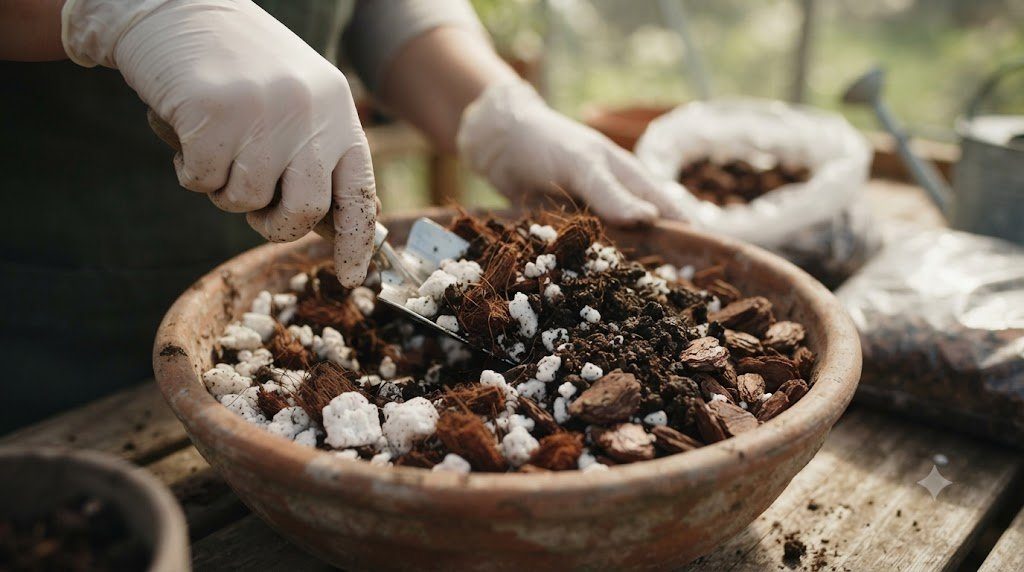
Container gardening is fundamentally an exercise in artificial rhizosphere engineering. In an open agricultural field, plant roots enjoy an essentially infinite vertical soil column where gravitational drainage, capillary tension, and biological earthworm activity maintain natural equilibrium. However, when soil is confined within the rigid, impermeable boundaries of a container, standard physics breaks down. Attempting to grow containerized plants in native garden topsoil invariably leads to catastrophic root suffocation, severe compaction, and stunted growth. Engineering high-performance container potting media requires a rigorous understanding of bulk density, total porosity, air-filled porosity, matric suction, and substrate particle geometry.
The Physics of Container Hydraulics: Why Garden Dirt Fails in Pots
The fatal flaw of placing native garden soil or clay loam into a container is the total disruption of vertical capillary pull. In an in-ground bed, deep subsoil horizons exert continuous downward matric suction that draws gravitational water away from upper root horizons. In a container, however, the soil column abruptly ends at the bottom drainage holes, creating an interface with the atmosphere where capillary suction drops to zero.
The Perched Water Table (PWT) and Container Geometry
Because capillary suction ceases at the container floor, water cannot exit the drainage holes until gravitational pressure overcomes the matric holding tension of the potting particles. This physical stalemate forms a 100% water-saturated layer at the bottom of the pot known as the Perched Water Table (PWT). Crucially, the height of the perched water table depends entirely on the particle size of the potting medium, not on the height or width of the container. In a fine-textured soil with microscopic pores, the PWT may stand four inches tall. If placed in a five-inch-deep pot, 80% of the root zone will remain permanently submerged in stagnant, anaerobic water!
Substrate Particle Mechanics: Balancing Air Porosity and Water Retention
A professional container potting mix must balance two opposing physical requirements: Container Capacity (maximum water held against gravity) and Air-Filled Porosity (AFP) (percentage of pore space occupied by air after drainage):
| Substrate Component | Particle Size Distribution | Total Porosity (%) | Air-Filled Porosity (%) | Decomposition Rate |
|---|---|---|---|---|
| Coarse Perlite (Size #3) | 3.0 – 5.0 mm granules | 80% – 90% | 45% – 55% | Extremely Stable (Inert volcanic glass) |
| Composted Pine Bark Fines | 2.0 – 8.0 mm flat flakes | 65% – 75% | 25% – 35% | Slow (High lignin / suberin content) |
| Coarse Horticultural Vermiculite | 2.0 – 4.0 mm expanded mica | 75% – 85% | 15% – 20% | Moderate (Compacts over 1-2 years) |
| Sphagnum Peat Moss | 0.5 – 2.0 mm fibrous particles | 85% – 92% | 8% – 14% | Slow (Acidic pH 3.5 – 4.5) |
| Washed Coco Coir Pith | 0.2 – 1.5 mm fine dust & fiber | 82% – 88% | 10% – 15% | Moderate (Neutral pH 5.8 – 6.5) |
The Classical 5-1-1 Gritty Substrate Formulation
Horticultural soil scientists developed the benchmark 5-1-1 Mix specifically to maximize gas exchange and eliminate perched water table saturation for long-season containerized crops, vegetables, and perennial shrubs:
- 5 Parts Composted Pine Bark Fines (1/8″ to 3/8″): Provides permanent physical aggregate structure, preventing compaction while retaining moisture along irregular bark crevices.
- 1 Part Sphagnum Peat Moss or Washed Coco Coir: Provides microscopic water-holding micropores and initial cation-exchange buffering.
- 1 Part Coarse Perlite (Size #3): Inert, expanded volcanic silicate that guarantees permanent macroscopic aeration pores that never degrade or collapse.
- Dolomitic Limestone ($CaCO_3 \cdot MgCO_3$): Added at 1 tablespoon per gallon of mix to neutralize the natural acidity of pine bark and peat, stabilizing pH at 6.0–6.5 while supplying essential calcium and magnesium.
Nutrient Dynamics: Cation Leaching and Controlled-Release Fertilizers
Because engineered container mixes feature large macroscopic pores and drain rapidly, soluble nutrients wash out with every thorough watering. Managing container nutrition requires a dual-track agronomic strategy:
- Controlled-Release Fertilizer (CRF) Prills: Incorporate polymer-coated N-P-K fertilizer prills into the potting mix during preparation. These semi-permeable capsules release a continuous micro-dose of nutrients driven by ambient soil temperature and osmotic pressure, ensuring plants receive baseline nutrition over 3 to 6 months.
- Liquid Fertigation Supplementation: Complement baseline CRFs with dilute, complete water-soluble fertilizers applied every 7 to 10 days during peak vegetative growth, ensuring adequate potassium and trace micronutrients (iron, manganese, zinc).
Reusing Potting Media: Sterilization and Soil Rejuvenation
High-quality potting mixes can be successfully reused for multiple seasons if properly conditioned. In autumn, dump spent container soil into a clean tarp, sift out old root balls, and inspect for soil-borne root pests. Rejuvenate the blend by incorporating 20% fresh pine bark fines, 10% fresh composted worm castings to re-inoculate beneficial microbiology, and a light dusting of dolomitic lime and organic bone meal before replanting.
Cation-Exchange Capacity (CEC) and Peat-Free Sustainable Substrates
For decades, commercial horticulture relied almost exclusively on mined Canadian and Baltic Sphagnum peat moss as the primary base for container potting mixes. However, growing ecological concerns regarding the destruction of ancient carbon-sequestering peat bogs has driven a global scientific shift toward peat-free container substrate engineering.
Coco Coir Pith vs. Peat Moss: Hydraulic and Chemical Contrasts
Washed coconut coir pith (the mesocarp husk of Cocos nucifera) is the premier renewable peat alternative, but it exhibits fundamentally different chemical characteristics that growers must manage:
- Natural pH Differences: Sphagnum peat is naturally highly acidic (pH 3.5 to 4.5), requiring substantial lime additions to reach crop viability. Coco coir exhibits a naturally circumneutral pH (5.8 to 6.5), eliminating the need for heavy lime buffering.
- The Potassium-Sodium Cation Problem in Coir: Coconut palms grow in coastal marine environments. Consequently, unwashed raw coco coir contains high concentrations of residual sodium ($Na^+$) and potassium ($K^+$) tightly bound to its cation exchange sites. If unbuffered coir is used, these exchange sites will aggressively pull calcium ($Ca^{2+}$) and magnesium ($Mg^{2+}$) out of the fertilizer solution, starving plants of calcium and causing severe blossom-end rot. Always utilize certified ‘triple-washed and calcium-buffered’ coco coir.
| Substrate Property | Mined Sphagnum Peat Moss | Buffered Coco Coir Pith | Composted Pine Bark Fines | Engineered Wood Fiber |
|---|---|---|---|---|
| Inherent pH | 3.5 – 4.5 (Highly Acidic) | 5.8 – 6.5 (Circumneutral) | 4.0 – 5.0 (Mildly Acidic) | 5.0 – 6.0 |
| Rewetting Hydrophobicity | Severe (Repels water when dry) | Zero (Rewets instantly) | Moderate | Low |
| Cation-Exchange Capacity | 100 – 180 meq/100g (High) | 60 – 100 meq/100g (Moderate) | 40 – 70 meq/100g | 15 – 30 meq/100g (Low) |
| Environmental Sustainability | Poor (Non-renewable peat bogs) | High (Agricultural byproduct) | High (Forestry coproduct) | Very High (Renewable pine) |
Wetting Agents and Overcoming Peat Hydrophobicity
When peat-based potting soils dry out completely, the organic particles synthesize a thin layer of hydrophobic paraffin wax, causing the soil to actively repel water. Water poured onto dry peat simply beads up, runs down the inner container walls, and drains out the bottom holes without wetting the root ball. Horticultural potting mixes incorporate non-ionic surfactant wetting agents (or natural yucca extract) that lower the surface tension of water, breaking the hydrophobic barrier and ensuring rapid, uniform capillary rehydration.
Container Aeration Physics: The Air-Pot and Fabric Bag Revolution
Traditional rigid plastic containers cause severe root circling, root spiraling, and compaction. Modern fabric aeration containers (such as Smart Pots) and dimpled plastic containers (Air-Pots) utilize air-pruning. When a root tip reaches the perforated outer wall, it is exposed to dry air, which naturally desiccates the root apical meristem. This pruning halts elongation and stimulates a burst of hundreds of fibrous lateral feeder roots throughout the entire interior substrate, increasing effective root absorption surface area by over 300%!
Bulk Density Mathematics and Total Porosity Formulas
In professional soil laboratories, container media performance is evaluated using standardized physical volume equations. Total Porosity ($S_t$) represents the percentage of the substrate volume occupied by pore spaces (both air and water):
Total Porosity ($S_t$) = (1 – (Bulk Density / Particle Density)) * 100
Where Bulk Density ($
ho_b$) is the dry mass divided by total volume, and Particle Density ($
ho_p$) of organic substrates is approximately 1.55 $g/cm^3$. An exceptional container potting mix maintains a Total Porosity between 75% and 85%, ensuring that even when saturated to Container Capacity, at least 20% to 30% of the volume remains filled with oxygenated air to support root respiration.
| Substrate Property / Metric | Standard Peat Potting Soil | Engineered 5-1-1 Bark Mix | Pure In-Ground Garden Clay | Recommended Target |
|---|---|---|---|---|
| Dry Bulk Density ($ ho_b$) |
0.15 – 0.25 g/cm³ | 0.35 – 0.45 g/cm³ | 1.30 – 1.60 g/cm³ | 0.25 – 0.40 g/cm³ |
| Total Porosity ($S_t$) | 82% – 88% | 72% – 78% | 38% – 48% | 70% – 85% |
| Air-Filled Porosity (AFP) | 8% – 12% (Suffocating) | 25% – 35% (Optimal) | 2% – 5% (Anaerobic mud) | > 20% |
| Container Capacity (Water) | 70% – 78% | 45% – 52% | 35% – 42% | 45% – 60% |
Managing the Leaching Fraction in Containerized Crops
Because container potting mixes are closed systems, soluble fertilizer salts continuously accumulate in the root zone as water evaporates. Managing container health requires applying a 15% to 20% Leaching Fraction during every watering: apply sufficient water so that 15% to 20% of the total volume drains out the bottom drainage holes into saucers. This drainage flow flushes accumulated sodium, chlorides, and excess mineral salts away from delicate root tips, preventing toxic osmotic salt build-up.
Particle Size Stratification and The Sieving Protocol
In advanced potting media formulation, the physical uniformity of particles is just as critical as the ingredients themselves. If coarse bark chunks (1/2-inch) are mixed with fine, powdery peat dust, the microscopic dust particles simply settle into the voids between the bark chunks, packing the pore space solid and destroying air-filled porosity!
The Two-Sieve Sorting Methodology
Professional soil artisans process pine bark and pumice through two wire mesh screens:
- The Top Screen (1/2-Inch Mesh): Discards excessively large wood chunks and sticks that take up excessive pot volume.
- The Bottom Screen (1/8-Inch Mesh): Screens out and discards all fine sawdust and silt particles. What remains is a perfectly graded aggregate (particles between 1/8″ and 1/2″) that guarantees permanent, non-collapsing macroscopic aeration channels.
Mineral Buffering and Cation Retention with Zeolites
Incorporating 10% natural clinoptilolite zeolite into container media adds exceptional cation-exchange capacity (CEC exceeding 150 cmol/kg). Zeolite possesses a microscopic honeycombed crystalline framework that traps positive ammonium ($NH_4^+$) and potassium ($K^+$) ions, protecting them from leaching rains while slowly releasing them to plant roots as needed.
Substrate Compaction Testing: The Cone Penetrometer Standard
Over a long growing season, organic potting components naturally decompose. Monitor container soil density by inserting a digital soil compaction penetrometer into the substrate core. If mechanical penetration resistance rises above 1.2 MPa, air-filled porosity has dropped below the critical 15% threshold, signaling the need for substrate repotting and aeration aggregate replenishment.
Small-Space Horticultural Standards and Container Fleet Management
Container gardening unlocks unlimited horticultural possibilities in small urban spaces, terraces, and patios. However, because container plants reside within confined, artificial root environments, success requires an uncompromising commitment to structural substrate physics, regular moisture monitoring, and precise nutrient replenishment.
The Container Fleet Master Maintenance Schedule
Execute this seasonal checklist to maximize yields and longevity across all containerized plantings:
- Substrate Porosity and Drainage Auditing: Inspect container drainage ports annually to ensure roots have not blocked water escape. Rejuvenate spent media with coarse perlite and composted pine bark fines to maintain air-filled porosity above 20%.
- Nutrient Salt Leaching Protocols: Every four to six weeks during active summer growth, perform a deep fresh-water flush, allowing 20% runoff to escape bottom drainage holes to purge accumulated fertilizer salts and prevent root tip burn.
- Container Root Pruning and Upsizing: For long-term perennial shrubs and fruit trees, perform surgical root pruning every two to three years in late winter, trimming outer circling roots before repotting in fresh media.
- Balcony Weight and Structural Safety Checks: Verify that heavy containers remain positioned over load-bearing building exterior walls and structural beams, keeping live weight loads well within engineered architectural tolerances.
- Winter Thermal Root Insulation: In cold-winter regions, move containers into unheated garages or bank heavy straw bales around pots before hard freezes, preventing sub-zero winds from penetrating container sidewalls and killing root systems.
Mastering container hydraulics and root zone management transforms even the smallest urban balcony into an incredibly productive, resilient, and beautiful high-density garden.