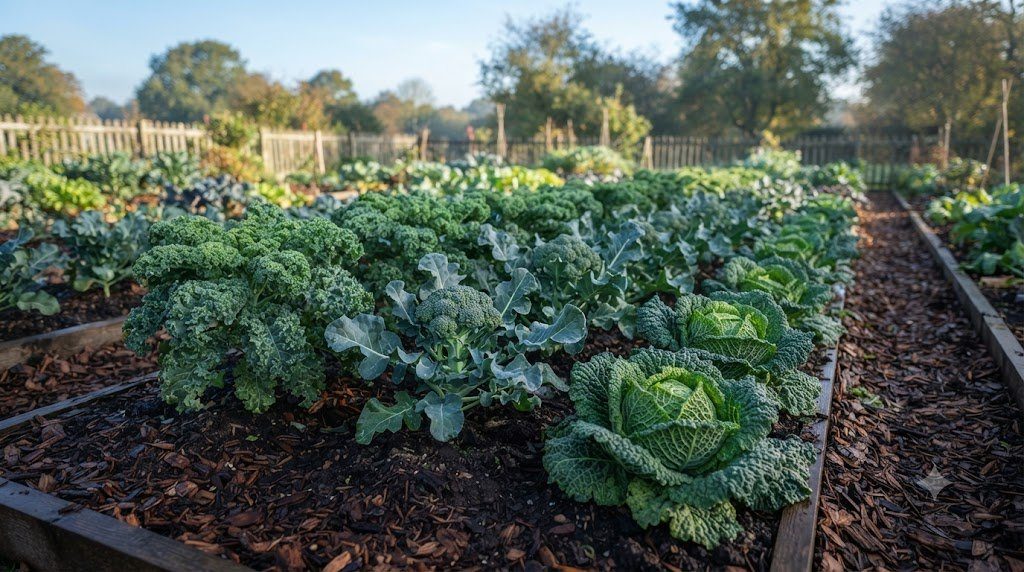
The family Brassicaceae—encompassing cabbage (Brassica oleracea var. capitata), broccoli (B. oleracea var. italica), kale (B. oleracea var. acephala), and cauliflower (B. oleracea var. botrytis)—represents some of the most nutritionally dense and cold-resilient crops in the vegetable kingdom. However, brassicas are also celebrated among horticulturists for their specialized biochemical profiles, heavy nutrient demands, high moisture requirements, and susceptibility to a formidable array of specialized insect herbivores and soil-borne pathogens. Achieving consistent, high-yield brassica production requires an agronomic approach integrating biological pest defenses, physical exclusionary barriers, soil pH modulation, and temperature-managed succession timing.
Glucosinolate Biochemistry and Insect Co-Evolution
All brassica species synthesize secondary sulfur-rich metabolites known as glucosinolates. Under normal circumstances, glucosinolates remain compartmentalized within plant cell vacuoles, while an endogenous hydrolytic enzyme, myrosinase, resides separately within specialized myrosin cells. When insect herbivores chew or rupture brassica plant tissue, cell membranes collapse, allowing myrosinase to hydrolyze glucosinolates into pungent, toxic isothiocyanates, nitriles, and thiocyanates—commonly recognized as the ‘mustard oil bomb’.
While this chemical defense mechanism successfully deters generalist insect herbivores, specialized brassica pests have co-evolved biochemical adaptations to neutralize or even exploit these compounds:
- Imported Cabbageworm (Pieris rapae): The larvae of the small white butterfly possess a specialized nitrile-specifier protein in their gut that diverts glucosinolate breakdown into harmless nitriles rather than toxic isothiocyanates, enabling rapid defoliation of cabbage and kale leaves.
- Cabbage Looper (Trichoplusia ni): Aggressive nocturnal caterpillars that chew large, ragged holes through inner head foliage, fouling market heads with dark frass pellets.
- Diamondback Moth (Plutella xylostella): Highly invasive small caterpillars that ‘windowpane’ the undersides of leaves, displaying notorious multi-chemical pesticide resistance.
- Flea Beetles (Phyllotreta cruciferae): Minute, jumping beetles that riddle young spring brassica cotyledons with thousands of tiny ‘shot holes’, severely stunting seedling vigor.
Microbial and Biological Insect Pest Management
When physical netting is impractical due to crop size or weeding access, organic biological controls offer targeted mortality without harming beneficial predatory insects:
| Biological Agent / Treatment | Target Pest Complex | Mode of Action | Optimal Application Timing | Pre-Harvest Interval |
|---|---|---|---|---|
| Bacillus thuringiensis kurstaki (Bt) | All Lepidopteran Caterpillars | Crystal endotoxin ruptures larval gut wall | Late afternoon / overcast days | 0 Days (Wash before consumption) |
| Spinosad (Saccharopolyspora ferment) | Thrips, Flea Beetles, Caterpillars | Nicotinic acetylcholine receptor neurotoxin | Early morning before bee activity | 1 Day |
| Kaolin Particle Clay (Surround WP) | Flea Beetles, Harlequin Bugs | Tactile tactile irritant & visual camouflage | Immediately post-transplant | 0 Days (Requires wash) |
| Parasitic Wasps (Cotesia glomerata) | Imported Cabbageworm Larvae | Endoparasitoid larvae consume host | Season-long nectar border support | N/A (Natural Biological Control) |
Soil Chemistry, pH Buffering, and Clubroot (Plasmodiophora brassicae)
Brassicas require fertile, high-organic-matter soil with consistent moisture retention and robust nitrogen fertility. However, the most insidious threat to brassica crops is Clubroot, an ancient soil-borne plasmodiophorid protist capable of persisting as dormant resting spores in soil for over twenty years.
Clubroot Pathogenesis and pH Modulation
Clubroot zoospores swim through water film in soil pores to infect brassica root hairs, stimulating runaway root cell hyperplasia and hypertrophy. Infected roots develop grotesque, club-like galls that choke off vascular xylem vessels, causing severe midday wilting, nutrient starvation, and crop failure. Plasmodiophora brassicae spore germination is severely inhibited at soil pH levels above 7.2. Agronomists managing clubroot-prone ground broadcast hydrated lime ($Ca(OH)_2$) or agricultural calcitic lime to elevate soil pH to 7.2–7.5, creating an alkaline chemical environment that suppresses spore germination while providing abundant calcium required for cell wall synthesis.
Nutrient Dynamics: Heavy Feeding, Molybdenum, and Boron Deficiencies
Brassicas rank among the heaviest feeders in the vegetable garden, requiring sustained nitrogen availability throughout vegetative frame development. A deficiency of nitrogen results in stunted purple-tinged lower leaves and premature ‘buttoning’ in broccoli and cauliflower—forming tiny, premature, unmarketable heads on undersized plants.
Furthermore, brassicas exhibit extreme sensitivity to trace micronutrient deficiencies:
- Whiptail (Molybdenum Deficiency): In acidic soils (pH < 6.0), molybdenum becomes chemically bound and unavailable. Molybdenum is an essential cofactor in the nitrate reductase enzyme. Without it, leaves fail to develop proper lamina, producing severely twisted, strap-like, deformed leaf ribs known as 'whiptail'.
- Hollow Stem (Boron Deficiency): Rapidly growing broccoli and cabbage heads starved of boron develop hollow, brown-stained central stems that invite bacterial soft rot (Pectobacterium carotovorum).
Cold Hardiness Mechanisms and Winter Harvesting
Mature brassicas—particularly curly kale, Tuscan Lacinato kale, collards, and savoy cabbages—display phenomenal sub-freezing hardiness, frequently surviving temperatures down to 10°F (-12°C) without protective row covers. Freezing temperatures trigger intracellular solute accumulation, elevating sugars and amino acids (such as proline) that dehydrate cellular protoplasts slightly to prevent internal ice crystallization, yielding exquisitely sweet, tender winter leaves.
Physiological Disorders: Buttoning, Blindness, and Heat Bolting
Brassicas are exquisitely sensitive cool-season crops whose developmental transitions between vegetative growth and floral initiation are governed by microclimatic temperature thresholds. When environmental stress occurs during early seedling development, brassicas exhibit distinct physiological disorders that ruin crop marketable yields:
- Premature ‘Buttoning’ in Broccoli and Cauliflower: Occurs when young seedlings (possessing 4 to 8 true leaves) are subjected to prolonged chilling temperatures (below 50°F / 10°C) for several consecutive days, or suffer severe root-bound stress in nursery plug trays. The physiological shock signals the plant to terminate vegetative development, producing a diminutive, premature curd the size of a quarter on a tiny, stunted plant.
- Blindness (Apical Meristem Death): Characterized by robust vegetative plants that fail to produce any central growing tip or head. Caused by mechanical insect damage to the microscopic apical bud by tarnished plant bugs, early flea beetles, or localized sub-freezing tissue damage during early spring frosts.
- Heat-Induced Bolting and Riciness: High temperatures exceeding 80°F during curding cause broccoli buds to loosen rapidly, branch prematurely, and open into yellow flowers, while cauliflower curds develop a fuzzy, velvety texture known as ‘riciness’.
| Brassica Crop Species | Optimal Curding Temp | Critical Chill Vernalization | Frost Tolerance Threshold | Key Mineral Requirement |
|---|---|---|---|---|
| Heading Cabbage (B. oleracea capitata) | 60°F – 68°F | Low (Prefers steady warmth) | Down to 15°F (-9°C) | High Nitrogen ($N$) & Sulfur ($S$) |
| Broccoli (B. oleracea italica) | 55°F – 65°F | Moderate (Avoid severe early cold) | Down to 20°F (-6°C) | High Boron ($B$) & Calcium ($Ca$) |
| Cauliflower (B. oleracea botrytis) | 58°F – 64°F | Extremely Sensitive to swings | Down to 25°F (-4°C) | High Molybdenum ($Mo$) |
| Lacinato / Tuscan Kale | 50°F – 65°F | None (Continuous harvest) | Down to 5°F (-15°C) | Balanced N-P-K Organic Feed |
Soil-Borne Disease Management: Black Rot and Fusarium Yellows
Beyond clubroot, brassicas battle serious vascular bacterial and fungal pathogens. Black Rot (Xanthomonas campestris pv. campestris) is considered the most destructive brassica disease worldwide. Bacteria enter leaves through hydathodes (specialized water-exuding pores at leaf margins) during humid, wet mornings. Symptoms appear as distinctive V-shaped yellow necrotic lesions with the wide point of the V along the leaf margin, pointing inward toward the leaf rib. Cross-sections of infected stems reveal characteristic blackened vascular rings. Preventative measures include purchasing hot-water-treated certified disease-free seed, practicing a minimum four-year brassica crop rotation, and avoiding overhead sprinkler irrigation.
Blanching Protocols for Pristine White Cauliflower
In traditional white cauliflower varieties, sunlight exposure stimulates chlorophyll synthesis in the developing curd, turning it creamy yellow, bitter, and sunburned. To maintain porcelain-white, sweet heads, growers perform blanching: when the immature curd reaches the size of a tennis ball (2 to 3 inches in diameter), gather the plant’s outer leaves together over the head and secure them with a rubber band, clothespin, or twine. This creates a shaded, sun-protected microclimate until harvest.
High-Tunnel Season Extension and Thermal Buffer Hydraulics
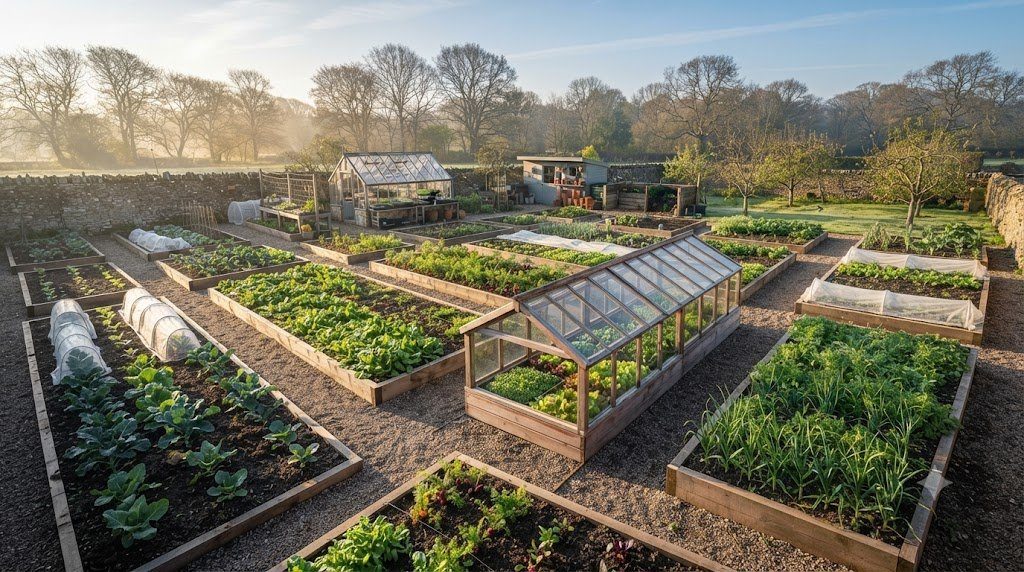
While brassicas are cold-tolerant, extended sub-freezing winter storms (temperatures plunging below 15°F / -9°C) can cause freeze-thaw cell rupturing, resulting in water-soaked, glassy foliage that collapses into rot. Commercial organic growers overcome winter freezes by deploying unheated high tunnels and protective caterpillar tunnels:
- Double-Layer Thermal Blanketing: In unheated high tunnels, suspended spun-bond polypropylene fabric row covers (1.2 to 1.5 oz/sq yd) create a microclimatic thermal blanket directly over brassica beds. This double-layer system traps geothermal soil heat, maintaining foliage temperatures 10°F to 14°F warmer than the exterior winter wind.
- Relative Humidity and Winter Botrytis: High tunnels during winter experience stagnant air and near-100% relative humidity. Without ventilation, condensation drips continuously onto heading cabbage and broccoli, inviting grey mold (Botrytis cinerea). Growers must roll up tunnel sidewalls on sunny winter mornings to purge moist air and dry leaf surfaces before nighttime freezing resumes.
| Winter Protection Level | Temperature Lift (°F) | Wind Chill Shielding | Primary Winter Pathogen Risk | Suitable Winter Brassica |
|---|---|---|---|---|
| Uncovered Open Ground Bed | 0°F (Direct ambient exposure) | Zero (Severe desiccation risk) | Freezing cell lysis & crown death | Only ultra-hardy kales (‘Winterbor’) |
| Floating Row Cover (0.9 oz) | +4°F to +6°F | High (Eliminates wind stripping) | Light frost damage during blizzards | Savoy cabbage, collards, Tuscan kale |
| Unheated Polyethylene Low Tunnel | +8°F to +12°F | Complete wind protection | High humidity condensation | Broccoli rabe, heading cabbage, kale |
| High Tunnel with Inner Blanket | +12°F to +18°F | Complete protection | Botrytis cinerea grey mold | Continuous winter harvest of all brassicas |
Sulfur Assimilation and Secondary Metabolic Glucosinolate Synthesis
Brassicas possess the highest sulfur ($S$) requirement of any vegetable family. Sulfur is assimilated through root uptake as sulfate ($SO_4^{2-}$) and incorporated into the amino acids cysteine and methionine, which serve as precursors for glucosinolate synthesis. When brassica soil is deficient in sulfur, plants exhibit uniform pale green chlorosis on young upper leaves (resembling nitrogen deficiency, but appearing on new growth first), while mature heads lack their characteristic pungent flavor and disease resistance. Applying agricultural gypsum ($CaSO_4$) at 10 to 15 pounds per 1,000 square feet supplies abundant bioavailable sulfate without altering soil pH.
Field Diagnostics: Aphid Parasitism and Mummification Chemistry
The Cabbage Aphid (Brevicoryne brassicae) is a specialized piercing-sucking pest that forms dense, grey, waxy colonies inside the tightly curled leaves of brassicas. In balanced organic ecosystems, cabbage aphids are naturally checked by the parasitic solitary wasp Diaeretiella rapae.
Female wasps deposit single microscopic eggs inside live aphids. As the wasp larva develops, it consumes the internal organs of the host, spinning a silken cocoon that transforms the dead aphid into a swollen, metallic bronze, papery shell known as an aphid mummy. When scouting brassica crops, look for high ratios of bronze mummies before spraying: applying broad-spectrum insecticides kills adult parasitic wasps, disrupting natural biological control.
Harvest Maturity Standards and Post-Harvest Hydro-Cooling
Harvest broccoli heads when the central cluster is tight, firm, and deep blue-green, before individual flower buds swell or show yellow petals. Cabbage heads should feel rock-hard when compressed firmly between palms. Immediately post-harvest, submerge harvested heads in ice-cold water (hydro-cooling at 34°F / 1°C) for 15 minutes to remove ambient field heat, preserving crunchiness and preventing rapid vitamin C degradation.
Bio-Fumigation and Glucosinolate Green Manures
When brassica crops finish production, incorporate spent stalks into an organic bio-fumigation protocol. Chop brassica residues finely with a high-speed flail mower and immediately till them into the soil, following with light overhead irrigation to seal the soil surface. Soil microbial breakdown of concentrated glucosinolates releases natural isothiocyanate gases that fumigate the soil, suppressing parasitic root-knot nematodes and soil-borne fungal spores ahead of following crops.
Comprehensive Agronomic Summary and Vegetable Bed Maintenance Schedule
Sustaining peak vegetable bed productivity across changing seasons requires executing a disciplined, proactive maintenance regimen. Successful vegetable cultivation is not an isolated set of weekend chores; it is an integrated agronomic system that links soil microbiology, water delivery, canopy airflow, and crop health into an enduring cycle of abundance.
Weekly Field Scouting and Diagnostic Checklist
Implement this 5-point weekly field inspection protocol across all active food beds:
- Under-Leaf Foliar Auditing: Inspect the undersides of lower leaves for early fungal conidia (concentric rings of early blight, powdery mildew pustules) and juvenile piercing-sucking insect colonies. Early physical removal of symptomatic leaves prevents broad-canopy outbreaks.
- Moisture Horizon Verification: Insert a calibrated tensiometer or dig down 4 inches into the root zone. Soil should feel cool and form a loose ball that crumbles under gentle finger pressure. Avoid overhead watering during evening hours to eliminate prolonged leaf wetness.
- Soil Surface Biological Inspection: Verify that organic mulch layers (clean wheat straw, shredded leaves) maintain a depth of 3 to 4 inches. Replenish bare soil patches immediately to prevent sun-baking and soil-borne fungal splash.
- Trellis Load and Fastener Inspection: Check support wires, clips, and stakes for structural stability as developing fruit mass expands. Reinforce weak branches before heavy summer thunderstorms arrive.
- Harvest Maturity Monitoring: Harvest edible crops at peak biological tenderness rather than letting them become overgrown and woody, stimulating plants to continue flowering and setting new produce.
By combining disciplined soil mineral balancing with vigilant preventative cultural practices, home growers transform standard garden plots into resilient, high-yield biological food systems that produce clean, nutrient-dense harvests year after year.