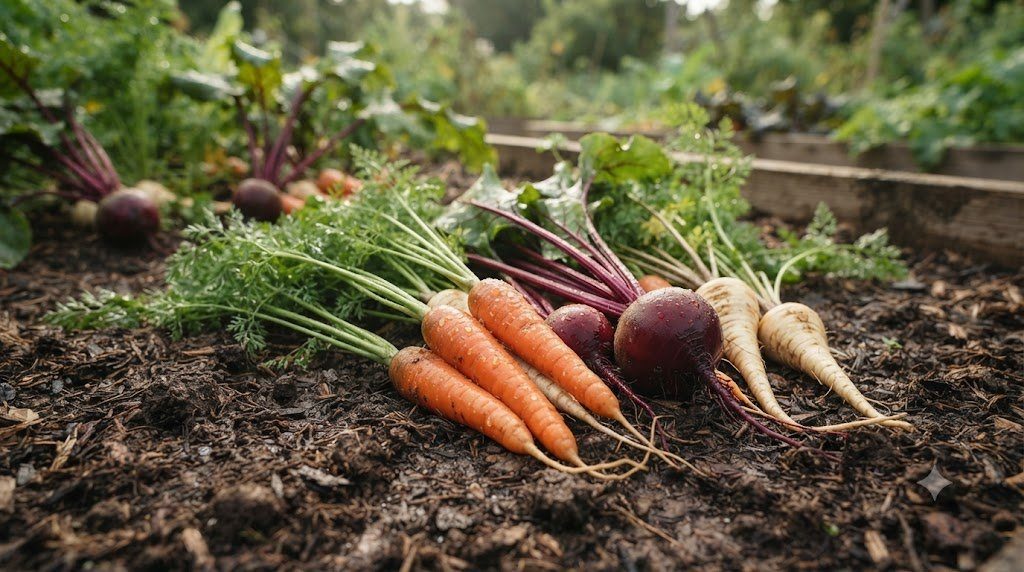
Root vegetables—principally carrots (Daucus carota), table beets (Beta vulgaris), and parsnips (Pastinaca sativa)—are foundational cool-season crops that transform subterranean soil biology into dense, mineral-rich culinary taproots. Unlike above-ground fruiting crops where structural flaws in soil architecture can often be partially offset by fertilization, root crops directly mirror the physical resistance, bulk density, mineral balance, and microbial dynamics of the subterranean soil profile. Producing straight, uniform, tender, and unblemished root harvests requires deep mechanical friability, disciplined germination moisture management, and decisive thinning regimes.
Subterranean Soil Physics: Bulk Density and Mechanical Impedance
The developing taproot of a carrot or parsnip elongates through cell division at the root apical meristem located at the descending root tip. As cell division pushes the delicate root cap downward through interstitial soil pores, any encounter with physical resistance—such as dense clay clods, unweathered gravel, hardpan compaction layers, or undecomposed woody debris—causes immediate meristem bifurcation or mechanical deviation. This physical impedance results in bifurcated (forked), twisted, stunted, or severely deformed roots.
Agronomically, soil compaction is measured through bulk density ($
ho_b$), expressed as dry soil mass divided by total soil volume ($g/cm^3$). Ideal root vegetable cultivation requires bulk densities below 1.25 $g/cm^3$. When bulk density exceeds 1.45 $g/cm^3$ in loamy soils or 1.60 $g/cm^3$ in sandy soils, mechanical impedance reaches critical thresholds where root penetration resistance exceeds 2.0 Megapascals (MPa), halting vertical root expansion and forcing undesirable horizontal branching.
Seed Germination Biophysics and Soil Crusting Mitigation
Carrot and parsnip seeds are botanically schizocarps—minute seeds encased in rigid pericarp shells possessing minimal endosperm energy reserves. Parsnip seeds exhibit exceptionally short viability windows, losing over 50% of germination potential within twelve months of harvest. Furthermore, carrot seeds require 10 to 18 days to germinate under typical spring soil temperatures (55°F to 65°F), during which the top quarter-inch of soil must remain continuously hydrated.
Soil Crusting and Emergence Mechanical Barriers
In soils containing silt or clay fractions, overhead rainfall followed by rapid solar drying forms a dense, cemented surface crust. The delicate carrot hypocotyl lacks the physical thrust required to fracture through a hardened crust, resulting in fatal subterranean emergence failure. Professional growers overcome this through specialized sowing substrates and microclimate blanketing:
| Germination Technique | Moisture Retention | Crusting Resistance | Germination Rate (%) | Labor Input |
|---|---|---|---|---|
| Native Soil Furrow Direct | Poor (Rapid surface desiccation) | Extremely Poor (Severe crusting) | 35% – 50% | Low initial / Poor stands |
| Sand / Vermiculite Furrow Cover | Moderate (Fast drainage) | High (No crust formation) | 70% – 85% | Moderate (Material hauling) |
| Wet Burlap / Lumber Plank Blanket | Exceptional (Zero evaporation) | Complete Immunity | 90% – 98% | Medium (Daily check & lift) |
| Radish Companion Sowing Indicator | Moderate | Moderate (Radish breaks crust) | 75% – 85% | Low (Harvest radish early) |
The Botany of Thinning: Monogerm vs. Multigerm Seed Structures
Thinning root vegetable seedlings is one of the most critical agronomic operations in the garden, yet it is frequently neglected by hesitant home gardeners. Unthinned root beds create fierce subterranean competition for light, water, and soil minerals, yielding pencil-thin, entangled, unmarketable roots.
Beet Seed Anatomy: The Multigerm Seed Cluster
A single beet ‘seed’ is actually an irregular, corky dried fruit cluster (botanically a glomerule) containing two to six individual true seeds fused together. Even when a gardener meticulously sows beet seeds two inches apart, three to five distinct seedlings will emerge from each single point of sowing. Hand-thinning is biologically mandatory once seedlings develop their first true leaves. Snip secondary and tertiary seedlings at ground level using micro-tip snips, leaving only the single strongest seedling per cluster, spaced three to four inches apart.
Parsnip and Carrot Spacing Geometry
For long-season parsnips, which require 110 to 130 days to reach maturity, final root spacing must reach four to five inches between plants in rows spaced twelve inches apart. Carrots require two-tier thinning: an initial thin to one inch at the two-leaf stage, followed by a secondary harvest thinning at pencil-thickness to establish final three-inch spacings for mature storage roots.
Mineral Nutrition: Nitrogen Control, Potassium, and Boron Dynamics
Root crops demand a specialized fertility profile diametrically opposed to leaf or fruiting vegetables. High levels of available soil nitrogen ($N$) are disastrous for taproot development:
- Excess Nitrogen Pathology: Abundant nitrate ($NO_3^-$) stimulates rampant, lush, dark green foliar tops at the direct expense of root carbohydrate storage. Furthermore, excess nitrogen causes lateral hairy root proliferation, internal root cavitation, and deep longitudinal splitting.
- Potassium ($K$) for Carbohydrate Translocation: Potassium plays an indispensable role in activating starch synthase enzymes and regulating stomatal osmoregulation. High potassium levels drive the translocation of photosynthesized sucrose from mature leaves into the descending taproot for storage.
- Boron ($B$) and Internal Black Heart in Beets: Beets and parsnips possess high micronutrient requirements for boron. Boron deficiency causes ‘internal black heart’ or ‘canker’ in beets—characterized by necrotic, blackened internal cambium rings and bitter flavor. Apply solubor or composted seaweed meal to beds showing boron deficiencies under high-pH calcareous conditions.
Cold Acclimation, Frost Sweetening, and Winter Overwintering
Parsnips, winter carrots, and storage beets undergo dramatic biochemical transformations following autumn frosts. As soil temperatures descend below 40°F, plants initiate cold acclimation protocols. In response to freezing temperatures, root cells actively convert complex, insoluble starches into simple, soluble sugars—principally sucrose, glucose, and fructose. These dissolved sugars lower the freezing point of intracellular water, acting as a biological antifreeze that protects cellular vacuole membranes from destructive ice crystal formation. This physiological response dramatically enhances culinary sweetness and eating quality.
Seed Priming and Fluid Drilling Agronomy
One of the most powerful professional agronomic techniques for overcoming sluggish and erratic carrot and parsnip germination is osmotic seed priming followed by fluid drilling. Naturally, Apiaceae seeds contain endogenous germination inhibitors in their seed coats and require prolonged hydration to activate embryonic metabolic enzymes.
Seed priming involves soaking seed batches in aerated water or a mild polyethylene glycol (PEG) osmotic solution for 48 hours at 68°F. This process initiates phase I and phase II of germination—repairing cellular membranes, activating mitochondrial respiration, and synthesizing DNA repair enzymes—without permitting actual radicle emergence. When primed seeds are sown, field emergence time is slashed from eighteen days down to just five to seven days, establishing uniform crop stands before surface soil crusts can develop.
Fluid Drilling Mechanics: Extrusion Sowing in Starch Gel
In fluid drilling, pre-germinated seeds displaying microscopic emerging radicles are suspended in a viscous, non-toxic cornstarch or methylcellulose aqueous gel. This seed-gel mixture is extruded smoothly through a syringe or specialized seed gun into the planting furrow. The hydrophilic gel provides an immediate, continuous moisture reservoir surrounding the newly emerged radicle, insulating it from dry surface soil particles and accelerating seedling anchorage.
| Sowing Methodology | Days to 50% Emergence | Stand Uniformity (%) | Crust Failure Vulnerability | Root Straightness Index |
|---|---|---|---|---|
| Dry Raw Seed Direct Sown | 14 – 21 Days | 50% – 65% | Severe (High seedling death) | Moderate (Variable depth emergence) |
| Hydro-Primed Seed (48 hr Soak) | 7 – 10 Days | 75% – 85% | Moderate | High |
| Fluid Drilled in Hydrophilic Gel | 4 – 6 Days | 90% – 98% | Extremely Low | Exceptional (Zero transplant shock) |
| Pelleted / Coated Seed | 10 – 14 Days | 80% – 88% | Moderate (Requires heavy water) | High |
Subterranean Pest Management: The Carrot Rust Fly (Psila rosae)
The most devastating subterranean pest of carrots and parsnips is the Carrot Rust Fly (Psila rosae). Adult flies emerge from overwintering soil pupae in spring and are attracted to the volatile essential oils (primarily trans-asarone and terpinolene) released by bruised carrot foliage during weeding or thinning operations. Females deposit eggs in soil cracks adjacent to carrot crowns.
Upon hatching, the yellowish larvae burrow downward and mine zigzagging tunnels through the taproot, leaving behind dark, rusty-brown, frass-filled necrotic cavities that invite soft-rot bacteria. Because adult rust flies are low-flying insects (rarely flying higher than 24 inches off the ground), enclosing beds with vertical 30-inch insect mesh fences or installing floating row covers immediately after sowing completely excludes the pest without requiring chemical insecticides.
Post-Harvest Root Storage Physiology and Winter Clamping
Storing winter carrots, storage beets, and parsnips for six to nine months of winter eating without loss of crispness requires arresting cellular respiration while preventing transpirational water loss. Root vegetables enter optimal storage dormancy at temperatures between 32°F and 34°F (0°C to 1°C) with 95% to 98% relative humidity. Harvested roots should be gently brushed (never washed, as washing removes the protective microbial skin flora), and foliar tops must be sliced cleanly one-quarter inch above the crown to prevent leaves from drawing moisture out of the root. Pack roots in stratified layers of damp sand, sawdust, or clean peat moss inside wooden crates stored in an unheated root cellar.
Soil Salinity, Electrical Conductivity (EC), and Root Tip Burn
Root vegetables are among the most salt-sensitive crops in the vegetable kingdom. While fruiting solanaceous crops can tolerate moderate soil salinity, carrots, table beets, and parsnips suffer acute osmotic stress at soil Electrical Conductivity (EC) levels exceeding 1.5 to 2.0 mS/cm. Excessive soil salinity—commonly caused by applying uncomposted poultry manure or synthetic chemical fertilizers—draws water osmotically away from descending taproots.
When descending root apical meristems encounter concentrated fertilizer bands, the delicate root cap cells suffer chemical burn and necrosis. The primary taproot aborts its vertical descent, forcing the plant to initiate multiple lateral root branches, resulting in grotesque ‘sprangled’ or hairy roots. Always apply soil amendments uniformly across beds months ahead of sowing, and utilize well-cured compost with low electrical conductivity.
| Root Crop Species | Salinity Threshold (EC mS/cm) | Soil Texture Preference | Optimum Soil Temperature (°F) | Depth to Hardpan Tolerance |
|---|---|---|---|---|
| Carrot (Daucus carota) | 1.0 – 1.5 mS/cm (Very Sensitive) | Sandy loam / Deep friable silt | 55°F – 65°F | Requires > 14 Inches deep friability |
| Table Beet (Beta vulgaris) | 2.5 – 3.5 mS/cm (Moderately Tolerant) | Loam / High organic silt | 50°F – 70°F | Requires > 10 Inches friability |
| Parsnip (Pastinaca sativa) | 1.2 – 1.8 mS/cm (Sensitive) | Deep stone-free sandy loam | 50°F – 60°F | Requires > 16 Inches deep friability |
| Turnip (Brassica rapa) | 2.0 – 3.0 mS/cm | Silt loam / Loamy sand | 45°F – 65°F | Requires > 8 Inches friability |
Mycorrhizal Glomalin and Soil Aggregate Stability in Root Beds
Producing perfectly straight root crops requires soil with high water-stable aggregation. Soil aggregation is driven by glomalin, a durable, insoluble glycoprotein exuded by arbuscular mycorrhizal fungi (AMF) and root hairs. Glomalin acts as biological cement that binds individual sand, silt, and clay particles into porous, crumbly granular aggregates that resist rainfall compaction while providing unobstructed microscopic passages for descending taproots. Practicing minimal soil disturbance and cover cropping with mycorrhizal oats maintains high glomalin levels, ensuring long-term bed friability.
Culinary Harvest Windows and Post-Frost Brix Testing
Determining the precise harvest window for root crops requires measuring internal soluble solids using an optical refractometer. Squeeze fresh sap from root tissue onto the refractometer prism to determine brix percentage. While early summer carrots average 6 to 8 degrees brix, autumn carrots exposed to multiple hard frosts (temperatures dipping below 28°F / -2°C) surge to 12 to 14 degrees brix, rivaling sweet apples in flavor.
When harvesting storage taproots, avoid pulling stems on dry soils, which can snap root shoulders. Always insert a flat-tined spading fork six inches away from the row, gently heaving the soil upward to break subterranean vacuum tension before lifting roots cleanly by hand.
Seasonal Agronomic Field Protocol: The 7-Point Taproot Checklist
To guarantee uniform, sweet, and market-grade root harvests season after season, execute this field protocol:
- Subsoil Compaction Test: Insert a 3/8-inch steel soil probe to 14 inches depth. If mechanical resistance exceeds 2.0 MPa, loosen beds deeply with a broadfork before sowing.
- Seedbed Fining: Rake the top 2 inches into a fine crumb structure free of clods, stones, and un-decomposed woody compost chunks.
- Moisture Blanket Maintenance: Cover newly sown furrows with wet burlap or dimensional lumber planks for 6 to 10 days until first emergence, checking moisture twice daily.
- Two-Phase Precision Thinning: Perform primary thinning to 1 inch at first true leaf emergence, followed by final 3-to-4-inch spacing when roots reach pencil thickness.
- Nitrogen Restriction: Avoid all synthetic nitrate fertilizers; rely exclusively on slow-release organic potash and composted seaweed for potassium enrichment.
- Carrot Rust Fly Exclusion: Install 0.8mm insect barrier netting immediately after sowing, anchoring all perimeter edges securely into the soil.
- Winter Storage Curing: Harvest mature roots in dry conditions, slice greens cleanly 1/4 inch above root shoulders, and pack unwashed in moist sand at 32°F to 34°F.