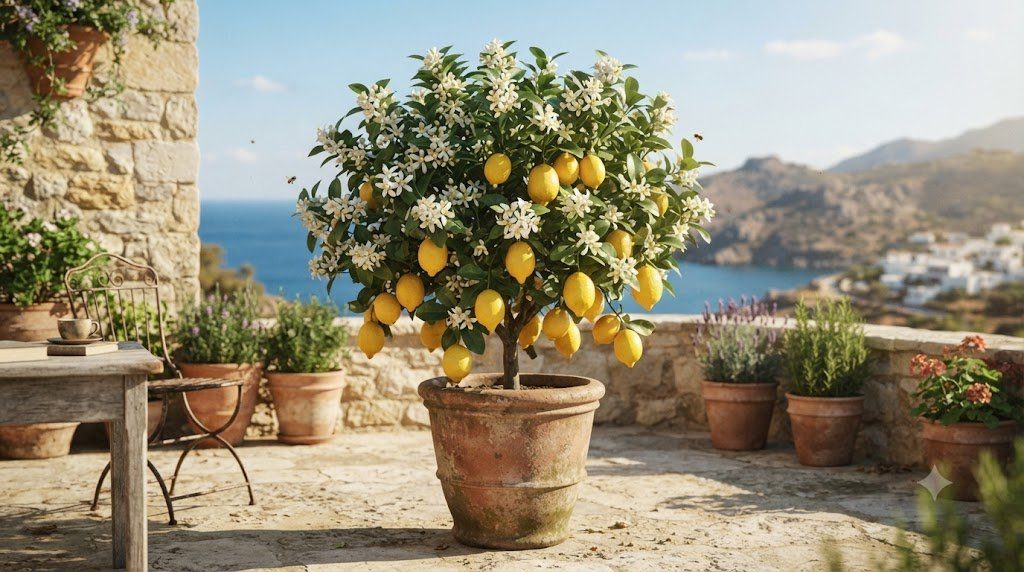
Cultivating productive fruit trees and citrus in containers is the ultimate convergence of pomology, bonsai root engineering, and container substrate science. Growing orchard fruit—such as Meyer lemons (Citrus x meyeri), Calamondins, dwarf figs (Ficus carica), columnar apples (Malus domestica), and dwarf peaches (Prunus persica)—in pots liberates gardeners from native soil limitations and empowers northern growers to harvest subtropical fruit by moving containers into sheltered microclimates during winter. However, trees are long-lived woody perennial organisms with aggressive, expanding root systems. Successfully maintaining productive containerized fruit trees for ten to twenty years demands precise dwarfing rootstock selection, disciplined biennial root pruning, and strategic dormancy management.
Dwarfing Rootstock Pomology: Genetic Stunting and Anchorage
In commercial fruit production, standard tree cultivars grafted onto seedling rootstocks easily reach mature heights of twenty to thirty feet with massive root systems that would become pot-bound and suffocate within eighteen months. Successful container culture depends on genetically dwarfing rootstocks:
Apple Rootstocks (M27 and M9)
The extreme-dwarf M27 rootstock restricts mature apple tree size to just 4 to 6 feet in height, inducing precocious fruiting in the second season while thriving in a 15-gallon container. The slightly more vigorous M9 rootstock produces an 8-foot tree with exceptional fruit size and productivity.
Citrus Rootstocks (Flying Dragon)
For citrus, the trifoliate orange cultivar ‘Flying Dragon’ (Poncirus trifoliata var. monstrosa) is the global benchmark dwarfing rootstock. It restricts scion vigor by 60% to 70%, produces high-solids fruit with intense sugars, and imparts substantial cold tolerance to root systems.
The Art and Science of Biennial Root Pruning
Eventually, even trees on dwarfing rootstocks fill the container volume with fibrous roots. If left untreated, the tree becomes root-bound: root mass displaces all soil, water channels down container edges without wetting root cores, and leaf canopy growth stalls. Every two to three years during late-winter dormancy, growers must perform surgical root pruning:
| Root Pruning Step | Timing / Season | Target Tissue / Removal Ratio | Primary Tool Required | Post-Operative Care |
|---|---|---|---|---|
| Tree Extraction & Soil Shaving | Late Winter (Pre-Bud Break) | Extract root ball; shave outer 2-3 inches | Serrated soil saw or Japanese hori-hori | Keep exposed roots continuously misted |
| Root Wedge Resection | Same day | Cut 3 to 4 pie-slice wedges from root ball | Sanitized bypass pruning shears | Eliminate any thick circling/girdling roots |
| Repotting in Fresh Substrate | Immediate | Pack fresh chunky bark mix into gap | Tamping stick (Eliminate air pockets) | Water thoroughly with mild seaweed extract |
| Canopy Balance Reduction | Immediately post-potting | Prune 20% – 25% of top vegetative branches | Sharp bypass loppers | Balances root water uptake capacity |
Citrus Nutritional Demands: Iron Chlorosis and Micronutrient Ratios
Citrus trees are evergreen, high-energy heavy feeders with specialized nutritional requirements. They demand an acidic substrate pH between 5.8 and 6.5. In alkaline potting mixes or under hard, calcium-rich municipal tap water, iron becomes chemically insoluble, triggering rapid interveinal iron chlorosis—where new leaves emerge bright yellow while leaf veins remain dark green.
Chelated Iron (Fe-EDDHA vs. Fe-EDTA)
When correcting citrus iron deficiencies, standard iron sulfate or iron EDTA chelates fail if substrate pH exceeds 6.5. Growers must apply high-stability Fe-EDDHA chelated iron, which remains fully bioavailable to roots across an extreme pH spectrum from 4.0 to 9.0, restoring deep emerald chlorophyll within two weeks.
Winter Protection and Thermal Mass Dynamics
In-ground tree roots are insulated by the vast thermal mass of the earth, rarely dropping below 32°F even when air temperatures plunge to 0°F. In a container, however, the root ball is exposed to ambient air temperatures from all sides. A tree whose branches survive 15°F (-9°C) in the ground will suffer fatal root freezing in a container at 24°F (-4°C)!
- Dormant Deciduous Trees (Apples, Pears, Figs): Move dormant containers into an unheated garage, shed, or root cellar where temperatures remain between 30°F and 45°F. The lack of light is completely harmless to leafless deciduous trees. Moisten the root ball lightly once a month to prevent root desiccation.
- Evergreen Subtropical Citrus: Move citrus indoors before the first autumn frost into a bright south-facing window complemented by a dedicated full-spectrum LED grow light. Maintain cool room temperatures (55°F to 65°F) to prevent ‘Winter Leaf Drop’—a physiological shock caused by hot dry room air heating foliage while cold roots in pots remain metabolically inactive and unable to deliver water.
Cold Hardiness Zones and Root Lethal Temperatures in Containers
In traditional pomology, a fruit tree’s hardiness is rated by its above-ground dormant wood. For instance, a Honeycrisp apple tree in the ground easily survives ambient winter temperatures of -25°F (-32°C). However, the root systems of woody deciduous trees are dramatically less cold-tolerant than their above-ground branches!
The Root Freezing Vulnerability Threshold
In nature, subterranean soil temperatures at a depth of 12 inches rarely descend below 28°F to 30°F, even under severe sub-zero blizzards, insulated by deep snow cover and geothermal heat. In a container, however, sub-freezing winds penetrate container sidewalls, rapidly dropping root core temperatures to match the ambient air. Apple and pear roots suffer fatal intracellular freeze-thaw cell necrosis at 12°F to 15°F (-10°C), while fig and citrus roots perish at 22°F to 24°F (-4°C)!
| Fruit Tree Species | Dormant Branch Hardiness | Container Root Lethal Temp | Winter Storage Protocol | Post-Winter Wakeup Timing |
|---|---|---|---|---|
| Meyer Lemon (Citrus x meyeri) | 28°F (-2°C) | 30°F (-1°C) | Move indoors to sunny LED grow room | Transition outdoors after last frost |
| Brown Turkey Fig (Ficus carica) | 10°F (-12°C) | 22°F (-5°C) | Unheated dark garage / basement (32°F-40°F) | Bring to sun 2 weeks pre-bud break |
| Columnar Apple on M27 Rootstock | -25°F (-32°C) | 12°F (-11°C) | Bury pot in garden mulch / unheated shed | Leave outdoors with insulated pot wrap |
| Dwarf Peach (Prunus persica) | -10°F (-23°C) | 18°F (-8°C) | Unheated attached garage | Monitor bloom chilling hour counts |
Chilling Hours: Breaking Dormancy in Deciduous Fruit Trees
Deciduous fruit trees (apples, pears, peaches, plums) require a genetically specified number of Chilling Hours—hours spent between 32°F and 45°F (0°C and 7°C) during winter—to break embryonic dormancy and bloom properly in spring. If a containerized peach tree with a 600-hour chill requirement is brought inside a warm 70°F living room in December, it will never bloom, or will bloom irregularly with severe leaf deformities. Keep dormant fruit trees in cool, unheated storage until their winter chill requirements are fully satisfied.
Hand-Pollination and Fruit Thinning for Giant Container Harvests
Because container trees are often kept indoors or in screened patio enclosures during early spring flowering when pollinating bees are absent, growers must perform hand-pollination using a soft camel-hair artist’s paintbrush, transferring pollen between anthers and stigmas. Furthermore, once fruit sets, perform aggressive fruit thinning: remove 70% of developing pea-sized fruitlets, leaving only one fruit every six inches of branch. Heavy over-cropping exhausts the tree’s limited carbohydrate reserves, causing branch breakage, tiny sour fruit, and biennial bearing (blooming only every other year).
Scion-Rootstock Graft Compatibility and Hydraulic Vascular Flow
In container fruit tree cultivation, the physical union between the scion (the fruit-producing upper branch) and the dwarfing rootstock must possess perfect cellular compatibility. Incompatible grafts develop cellular callusing anomalies that constrict vascular xylem vessels, starving the root system of photosynthetic carbohydrates and causing premature tree decline within three to five years.
Selecting certified virus-free rootstocks—such as ‘Flying Dragon’ for citrus and ‘M9’ or ‘Budagovsky 9’ for apples—ensures clean vascular bridging across the graft union. Inspect the graft union (the swollen bulge located 2 to 4 inches above the root flare) annually: remove any vegetative suckers that emerge from below the graft union, as these vigorous wild rootstock shoots will rapidly outgrow and starve the fruiting scion.
| Fruit Tree / Rootstock Combination | Mature Container Height | Years to First Crop | Winter Chill Requirement | Container Volume Required |
|---|---|---|---|---|
| Meyer Lemon on ‘Flying Dragon’ | 4 – 5 Feet | 1 – 2 Years (Precocious) | 0 Hours (Subtropical evergreen) | 15 – 20 Gallons |
| Honeycrisp Apple on M27 Dwarf | 5 – 6 Feet | 2 Years | 800 – 1,000 Chilling Hours | 15 – 25 Gallons |
| Brown Turkey Fig (Own Roots) | 5 – 7 Feet (Pruning managed) | 1 Year | 100 – 300 Hours | 20 – 30 Gallons |
| Bonanza Miniature Peach (Genetic Dwarf) | 4 – 5 Feet | 1 – 2 Years | 400 – 500 Hours | 15 – 20 Gallons |
Bonsai Canopy Pruning: The Open-Center Vase Architecture
To maximize fruit quality and sugar accumulation in containerized trees, train branches into an Open-Center Vase (Goblet) Architecture. Prune out the central leader, leaving three to four primary scaffold branches angled outward at 45 degrees. This hollow center allows unobstructed solar radiation and airflow to penetrate the interior canopy, accelerating fruit ripening, eliminating fungal mildew, and ensuring all fruit develops intense, uniform color.
Canopy Thinning and Leaf-to-Fruit Ratio Mathematics
In pomology, fruit development is driven by the Leaf-to-Fruit Ratio. In an open orchard, a mature apple or citrus tree maintains approximately 30 to 40 fully expanded sunlit leaves to support the growth and sugar synthesis of a single mature fruit.
In a container, where total canopy volume is restricted, allowing a tree to hold twenty fruitlets with only fifty leaves guarantees disaster: the fruit will remain sour, small, and woody, while the exhausted tree may suffer fatal leaf drop and enter alternate-year bearing dormancy. When fruitlets reach the size of a marble in late spring, ruthlessly thin the crop: remove 60% to 75% of developing fruitlets, leaving only 4 to 6 prime fruits per ten-gallon container. This yields magnificent, commercial-grade, sugar-packed fruit.
Micro-Drip Fertigation and Acid Injection for Container Citrus
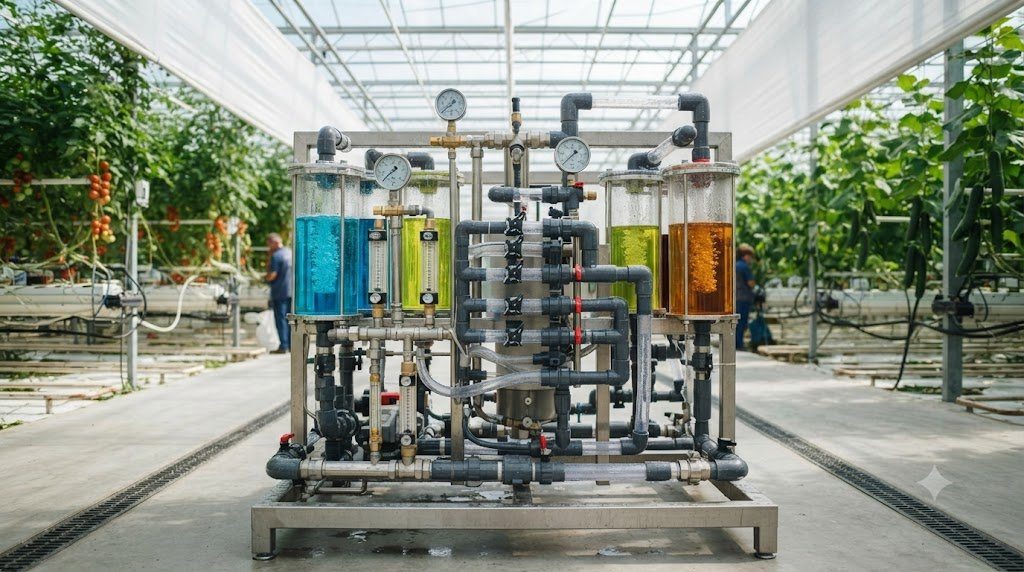
Citrus trees are notorious acid-lovers that decline rapidly when irrigated with hard, alkaline tap water (pH > 7.5). Over several months, alkaline carbonates neutralize substrate acidity, locking out iron, zinc, and manganese. Incorporate organic citric acid or horticultural vinegar into irrigation water to lower water pH to 6.0–6.5, keeping trace mineral chelates completely bioavailable to root hairs.
Zinc and Manganese Foliar Sprays for Subtropical Foliage
Beyond iron chlorosis, potted citrus frequently suffer from zinc and manganese deficiencies. Zinc deficiency causes ‘little leaf’ (diminutive, bunched, chlorotic leaf clusters), while manganese deficiency produces mottled yellowing with green bands along leaf midribs. Apply a monthly foliar spray of chelated zinc-manganese micronutrient solution directly to leaves during active flushes of spring growth to ensure vibrant chlorophyll development.
Small-Space Horticultural Standards and Container Fleet Management
Container gardening unlocks unlimited horticultural possibilities in small urban spaces, terraces, and patios. However, because container plants reside within confined, artificial root environments, success requires an uncompromising commitment to structural substrate physics, regular moisture monitoring, and precise nutrient replenishment.
The Container Fleet Master Maintenance Schedule
Execute this seasonal checklist to maximize yields and longevity across all containerized plantings:
- Substrate Porosity and Drainage Auditing: Inspect container drainage ports annually to ensure roots have not blocked water escape. Rejuvenate spent media with coarse perlite and composted pine bark fines to maintain air-filled porosity above 20%.
- Nutrient Salt Leaching Protocols: Every four to six weeks during active summer growth, perform a deep fresh-water flush, allowing 20% runoff to escape bottom drainage holes to purge accumulated fertilizer salts and prevent root tip burn.
- Container Root Pruning and Upsizing: For long-term perennial shrubs and fruit trees, perform surgical root pruning every two to three years in late winter, trimming outer circling roots before repotting in fresh media.
- Balcony Weight and Structural Safety Checks: Verify that heavy containers remain positioned over load-bearing building exterior walls and structural beams, keeping live weight loads well within engineered architectural tolerances.
- Winter Thermal Root Insulation: In cold-winter regions, move containers into unheated garages or bank heavy straw bales around pots before hard freezes, preventing sub-zero winds from penetrating container sidewalls and killing root systems.
Mastering container hydraulics and root zone management transforms even the smallest urban balcony into an incredibly productive, resilient, and beautiful high-density garden.