In the realm of container horticulture, erratic watering—the vicious cycle of soaking container soil to total anaerobic saturation followed by allowing it to bake into bone-dry, hydrophobic compaction—is the leading cause of poor plant vigor, blossom-end rot in tomatoes, stunted fruiting, and root death. Sub-Irrigated Planters (SIPs), commercially marketed as ‘self-watering containers’, solve this challenge through hydraulic physics. By decoupling the water delivery mechanism from human daily watering routines and leveraging continuous capillary action, SIPs maintain an optimal, unwavering air-to-water ratio within the plant root zone throughout the hottest days of summer.
The Biomechanical Architecture of a Sub-Irrigated Planter
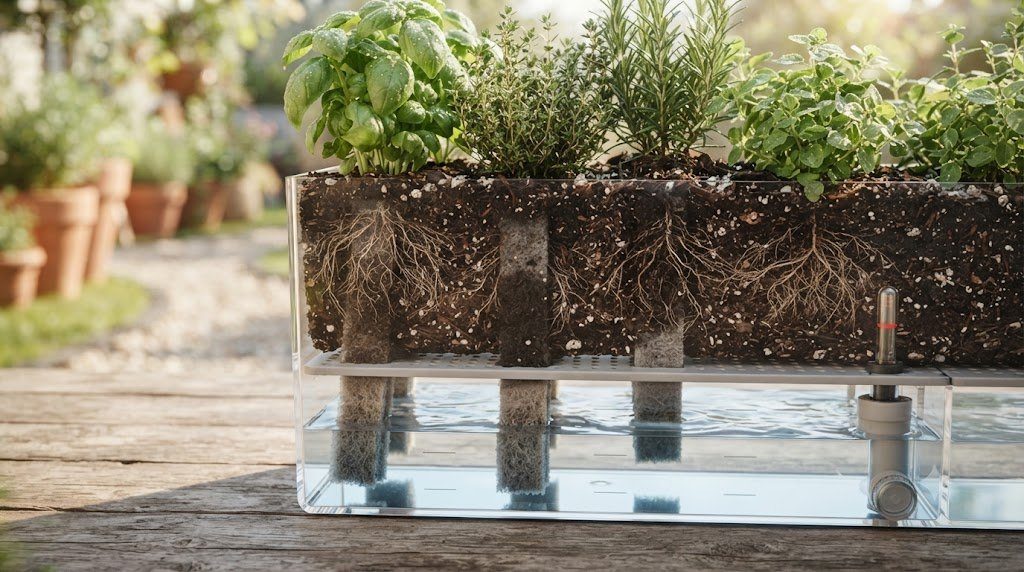
A Sub-Irrigated Planter is an engineered closed container system that separates the growing medium from a dedicated water storage reservoir situated directly beneath the soil floor. Unlike traditional bottom-watering trays where pots sit directly in open standing water (suffocating lower root horizons), an engineered SIP utilizes four distinct anatomical components:
The Reservoir Aeration Platform and Overflow Weep Hole
A rigid, perforated false bottom platform suspends the potting medium above the bottom water reservoir, creating a 1-to-2-inch air gap between the soil and the water surface. Critical to the entire system is the overflow weep hole drilled through the exterior container wall exactly at the level of the false bottom. This overflow port guarantees that excess water (from heavy rains or overfilling) immediately drains out, preventing the water level from ever rising into the soil column and suffocating plant roots.
The Wicking Chamber (The Capillary Engine)
To draw water upward against gravity from the reservoir into the dry upper soil, the platform features one or more sunken perforations or hollow perforated feet known as wicking chambers. These chambers extend down into the water reservoir and are packed tightly with soil medium. As water enters the wicking foot, capillary forces draw moisture upward through interstitial micropores, distributing moisture evenly across the entire soil profile via matric suction.
Comparative Hydraulic Performance: Top-Watering vs. SIP Systems
The operational contrast between conventional top-watering and closed sub-irrigation is dramatic:
| Hydraulic Metric | Conventional Top-Watered Container | Sub-Irrigated Planter (SIP) System | Agronomic Impact |
|---|---|---|---|
| Water-Use Efficiency (%) | 30% – 50% (High surface evaporation & runoff) | 85% – 95% (Zero drainage runoff waste) | Massive water conservation in arid climates |
| Soil Moisture Volatility | Extreme (Cycles between flooded & drought) | Virtually Zero (Continuous equilibrium) | Eliminates fruit cracking & blossom-end rot |
| Nutrient Leaching Losses | Severe (Liquid fertilizer flushes out drain) | Zero (Closed bottom preserves all nutrients) | Reduces fertilizer inputs by over 60% |
| Leaf Canopy Fungal Disease | Moderate to High (Water splash on leaves) | Extremely Low (Foliage remains 100% dry) | Dramatically suppresses early blight & mildew |
The Fertilizer Strip Technique: Preventing Salt Inversion
Because a Sub-Irrigated Planter experiences continuous upward water movement via capillary action, dissolving fertilizers in the water reservoir is an agronomic error that can burn root tips. Instead, SIP systems utilize the concentrated fertilizer strip method:
During initial container potting, the potting mix is thoroughly pre-moistened. Once the container is filled to within two inches of the rim, a shallow trench is excavated across the soil surface away from plant stems. A measured dose of balanced granular organic fertilizer (such as a 4-4-4 or 5-7-3 blend) along with agricultural dolomitic lime is buried in a narrow, concentrated band across the top of the bed. Water wicking upward dissolves the underside of this fertilizer strip, creating a gentle, steady diffusion gradient of nutrients that moves downward toward seeking roots.
Evaporation Barriers: The Power of the Mulch Cover
A core engineering element of high-yield SIP systems is the installation of an impermeable plastic or fabric mulch cover stretched tightly over the top of the container. This cover serves two vital functions: it completely halts surface soil moisture evaporation from beating summer sun, and it prevents heavy driving rains from saturating the topsoil and washing the concentrated fertilizer strip downward into the root zone.
Maintenance, Salt Flushing, and Overwintering Protocols
Over a long growing season, capillary action carries dissolved tap water minerals (calcium, carbonates, chlorides) upward, where they accumulate at the very top soil crust as a white mineral film. At the end of each season, remove the mulch cover, scrape off the top inch of salt-crusted soil, and flush the container with abundant water from above through the overflow hole to purge accumulated salts. Drain reservoirs completely before winter freezes to prevent expanding ice from rupturing container walls.
Capillary Rise Physics and the Washburn Porosity Equation
The operational efficiency of a Sub-Irrigated Planter (SIP) is governed by capillary rise physics, mathematically described by the Washburn and Jurin equations. Water rises through small porous channels due to adhesive forces between water molecules and substrate particle surfaces, balanced against downward gravitational pull:
Maximum Capillary Rise Height: h = (2 * $\gamma$ * cos $ heta$) / ($
ho$ * g * r)
Where $\gamma$ is water surface tension, $ heta$ is contact angle, $
ho$ is water density, $g$ is gravity, and $r$ is the effective pore radius. This mathematical relationship proves that as soil pore radius ($r$) increases (such as in coarse chunky gravel or wood bark), capillary rise height ($h$) collapses to near zero. Conversely, fine-textured peat and vermiculite channels support vertical capillary rise up to 12 to 14 inches above the water reservoir, ensuring that upper root horizons remain continuously hydrated without water pumps or mechanical moving parts.
| Substrate Blend in SIP Wicking Foot | Effective Capillary Rise (Inches) | Wicking Velocity | Root Aeration Score | Tomato Productivity Rating |
|---|---|---|---|---|
| 100% Coarse Orchid Bark (5-1-1) | < 1.5 Inches (Fails to wick) | Virtually Zero | 95% (Bone dry topsoil) | Disastrous / Crop Failure |
| 75% Peat/Coir + 25% Fine Perlite | 10 – 12 Inches (Ideal) | Rapid & Continuous | 80% (Optimal moisture curve) | Exceptional (Peak market yields) |
| 50% Heavy Clay Topsoil + 50% Sand | 6 – 8 Inches | Slow & Compacting | 20% (Anaerobic mud risk) | Poor / Root rot death |
| 50% Worm Castings + 50% Perlite | 8 – 10 Inches | Moderate | 70% | High (Excellent organic vigor) |
Preventing Anaerobic Stagnation and Mosquito Breeding in Reservoirs
Because SIP water reservoirs remain dark, moist, and enclosed, two potential management challenges require attention:
- Mosquito Oviposition Defense: Standing water in outdoor reservoirs can become a breeding ground for mosquitoes (Culex spp.). Ensure the fill pipe features a snug cap or fine mesh screen, and insert half of an organic Mosquito Dunk (containing Bacillus thuringiensis israelensis / Bti) into the water reservoir twice per season. Bti specifically kills mosquito larvae without affecting plant roots.
- Dissolved Oxygen Replenishment: Although the bottom water lacks oxygen, the 2-inch air gap beneath the false bottom provides continuous atmospheric aeration. Plant roots suspend themselves in the moist air gap (developing specialized ‘air roots’) while only the tips touch the water, preventing anaerobic rot.
Scaling Up: The Multi-SIP Manifold and Float Valve System
For large container gardens with twenty or more SIP containers, manually filling individual water fill pipes daily becomes tedious. Advanced growers connect multiple SIP reservoirs together using 0.5-inch flexible poly tubing fitted with bulkhead fittings. The entire network is connected to a primary rain barrel or hose tap equipped with an automated mechanical toilet-style float valve. When water levels drop by half an inch, the float valve opens automatically, keeping every container reservoir permanently topped off with zero human labor!
Reservoir Nutrient Osmotic Pressure and Electrical Conductivity (EC)
In closed Sub-Irrigated Planters, managing nutrient concentrations is an exact science. Because water is continuously drawn upward and evaporated from the soil surface while water is replenished from below, dissolved fertilizers added to the water reservoir will not drain away—they will continuously concentrate over time, raising the Electrical Conductivity (EC) of the root zone to toxic levels.
Agronomists managing high-performance SIP vegetables follow two strict operational rules: never add concentrated water-soluble fertilizers directly into the bottom water reservoir, and rely on top-banded slow-release organic fertilizer strips that release nutrients at a steady, biologically regulated pace as water wicks upward past the fertilizer band.
| Vegetable Crop in SIP | Water Consumption (Gal/Day) | Target Substrate EC (mS/cm) | Optimal Reservoir Volume | Fruit Cracking Vulnerability |
|---|---|---|---|---|
| Indeterminate Heirloom Tomato | 1.5 – 2.5 Gal/Day (Peak summer) | 1.8 – 2.5 mS/cm | 3 – 5 Gallons minimum | Zero (Equilibrium capillary flow) |
| Bell & Hot Peppers (Capsicum) | 0.8 – 1.2 Gal/Day | 1.5 – 2.0 mS/cm | 2 – 3 Gallons | Extremely Low |
| Japanese Long Eggplant | 1.2 – 1.8 Gal/Day | 1.6 – 2.2 mS/cm | 3 – 4 Gallons | Zero |
| Bush Cucumbers (Parthenocarpic) | 1.0 – 1.5 Gal/Day | 1.4 – 1.8 mS/cm | 2 – 3 Gallons | Zero |
Overcoming Mineral Salt Crust Accumulation in SIP Beds
Because capillary action in a Sub-Irrigated Planter flows exclusively upward, dissolved tap water minerals (calcium carbonate, magnesium sulfate) migrate toward the topsoil surface, evaporating and leaving behind a visible white mineral crust. At the start of each spring season, scrape off the top half-inch of crusted soil, discard it, top-dress with fresh worm castings and compost, and perform a deep top-flush through the overflow weep hole before planting new crops.
Microbiological Dynamics in Enclosed Wicking Reservoirs
An intriguing biological reality of Sub-Irrigated Planters is the distinct microbial stratification that develops across the vertical soil column:
- Upper Aerobic Horizon (Top 6 Inches): High in oxygen and rich in organic matter. Fungal mycelia and aerobic nitrogen-cycling bacteria flourish here, breaking down the concentrated organic fertilizer strip.
- Middle Transition Zone: Optimal moisture-air equilibrium where root hair density reaches its peak, absorbing water and mineral ions via continuous capillary mass flow.
- Submerged Reservoir Horizon: Anaerobic water storage. While roots should not remain submerged for prolonged periods, mycorrhizal fungi form protective hyphal sheaths around roots entering the wicking foot, buffering them against stagnant water pathogens.
Winterizing and Storage Protocols for Heavy-Duty SIP Units
In freezing winter regions, leaving water inside Sub-Irrigated Planters will cause freezing ice expansion that fractures plastic reservoirs and ruptures overflow fittings. In late autumn, extract remaining crops, remove the fill pipe cap, and tilt the container to drain all reservoir water completely through the overflow port. Store containers under cover or invert them to prevent snow from refilling the water cavity.
Gravity-Fed Rain Barrel Integration for Automated SIP Arrays
For gardeners operating multiple sub-irrigated containers, connect a 55-gallon rain barrel to a 1/2-inch mainline hose routed behind the planters. A low-pressure mechanical float valve installed in each container’s reservoir maintains a constant 2-inch water depth automatically. This gravity-driven closed loop requires zero electric pumps, providing weeks of automated irrigation independence during peak summer heatwaves.
Small-Space Horticultural Standards and Container Fleet Management
Container gardening unlocks unlimited horticultural possibilities in small urban spaces, terraces, and patios. However, because container plants reside within confined, artificial root environments, success requires an uncompromising commitment to structural substrate physics, regular moisture monitoring, and precise nutrient replenishment.
The Container Fleet Master Maintenance Schedule
Execute this seasonal checklist to maximize yields and longevity across all containerized plantings:
- Substrate Porosity and Drainage Auditing: Inspect container drainage ports annually to ensure roots have not blocked water escape. Rejuvenate spent media with coarse perlite and composted pine bark fines to maintain air-filled porosity above 20%.
- Nutrient Salt Leaching Protocols: Every four to six weeks during active summer growth, perform a deep fresh-water flush, allowing 20% runoff to escape bottom drainage holes to purge accumulated fertilizer salts and prevent root tip burn.
- Container Root Pruning and Upsizing: For long-term perennial shrubs and fruit trees, perform surgical root pruning every two to three years in late winter, trimming outer circling roots before repotting in fresh media.
- Balcony Weight and Structural Safety Checks: Verify that heavy containers remain positioned over load-bearing building exterior walls and structural beams, keeping live weight loads well within engineered architectural tolerances.
- Winter Thermal Root Insulation: In cold-winter regions, move containers into unheated garages or bank heavy straw bales around pots before hard freezes, preventing sub-zero winds from penetrating container sidewalls and killing root systems.
Mastering container hydraulics and root zone management transforms even the smallest urban balcony into an incredibly productive, resilient, and beautiful high-density garden.