Heirloom tomatoes (Solanum lycopersicum) represent the pinnacle of home vegetable gardening, celebrated for extraordinary flavor complexities, diverse genetic heritage, and delicate textural nuances that commercial hybrid varieties bred for long-distance shipping simply cannot replicate. However, cultivating historic heirloom open-pollinated varieties demands exacting agronomic discipline. Unlike modern disease-resistant hybrids possessing bred-in genetic resistance to Verticillium wilt (V), Fusarium wilt races 1, 2, and 3 (F), Nematodes (N), and Tobacco Mosaic Virus (T), heirloom cultivars rely almost entirely on precise cultural management, optimized soil mineral nutrition, rigorous canopy airflow engineering, and vigilant preventative disease suppression.
Taxonomic Classification and Indeterminate Growth Dynamics
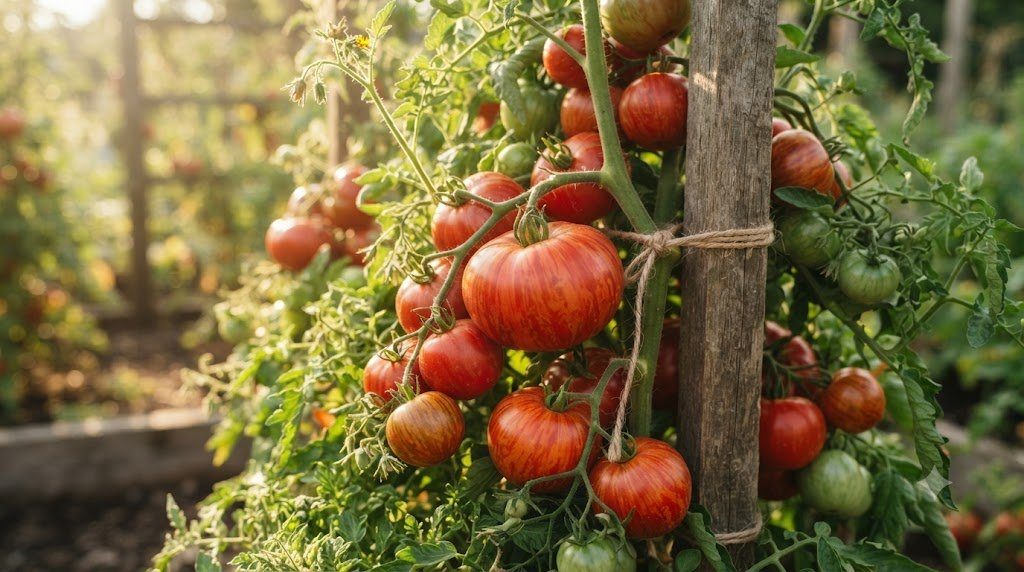
The overwhelming majority of prized heirloom tomato varieties—including ‘Brandywine’, ‘Cherokee Purple’, ‘Black Krim’, ‘Mortgage Lifter’, and ‘German Queen’—exhibit an indeterminate growth habit. Botanically, indeterminate tomatoes function as perennial vines grown as warm-season annuals. Terminal vegetative meristems continue vegetative cell division and elongate indefinitely until terminated by hard autumn frosts, continuously differentiating flower clusters and auxiliary shoots from leaf axils along the primary central leader.
This continuous vegetative vigor contrasts sharply with determinate bush varieties, which produce a genetically predetermined number of nodes before terminating in a terminal inflorescence, ripening fruit in a concentrated two-to-three-week window. In heirloom indeterminate systems, unpruned plants rapidly develop into sprawling, dense vegetative thickets. Without active horticultural intervention, this unchecked foliage canopy traps high-humidity boundary layers against damp soil, restricts interior photosynthetic radiation penetration, and creates an ideal microclimate for the rapid germination of fungal spores.
Axillary Sucker Differentiation and Meristem Energy Distribution
An axillary sucker is a secondary vegetative shoot arising at the 45-degree junction between a leaf petiole and the main stem. While suckers are genetically capable of flowering and setting fruit, permitting unchecked sucker proliferation severely dilutes the plant’s photoassimilate partitioning. Sugars synthesized during photosynthesis via the Calvin cycle become excessively diverted toward vegetative structural tissue development rather than fruit cell expansion and brix accumulation.
In professional indeterminate training systems, growers implement single-leader or two-leader pruning protocols. Lateral suckers are mechanically excised when they reach 2 to 4 inches in length, while tissue is still succulent, enabling clean snapping or precision sterilization-sheared cuts that callus rapidly without tearing underlying vascular cambium.
Structural Trellising and Vertical Support Engineering
Heavy-bearing heirloom vines easily exceed eight to twelve feet in length over a prolonged growing season, supporting substantial biomass loads exceeding thirty to forty pounds of foliage and mature fruit per specimen. Inadequate structural support results in lodging, stem kinking, localized vascular thrombosis, and soil contact that invites devastating soil-borne pathogens.
Comparative Evaluation of Tomato Trellising Systems
Selecting an appropriate vertical support system depends on bed layout, prevailing wind loads, and available garden infrastructure:
| Trellising Methodology | Structural Integrity | Canopy Airflow Rating | Labor Requirement | Recommended Heirloom Types |
|---|---|---|---|---|
| Florida Weave (Staking) | Moderate (Stakes every 2 plants) | High (Thin vertical plane) | Medium (Stringing every 8 inches) | Mid-size heirlooms (‘Pruden\’s Purple’) |
| Heavy-Gauge Welded Wire Cages | High (Reinforcing mesh cages) | Moderate (Circular containment) | Low (Occasional tucking) | Vigorous heirlooms (‘Black Krim’) |
| Vertical Overhead String Trellis | Very High (Rigid top conduit wire) | Exceptional (Single-leader training) | High (Weekly twisting & clipping) | Large beefsteaks (‘Brandywine’) |
| Standard Inverted Cone Cages | Extremely Low (Frequent collapse) | Poor (Dense foliage collapse) | Low initial / Disastrous late | Determinate patio varieties only |
Soil Chemistry, Mineral Ratios, and Calcium Physiology
Heirloom tomatoes are notorious heavy feeders that display acute sensitivity to soil mineral imbalances. Successful production requires an organic-rich, loamy soil profile maintaining a pH range between 6.2 and 6.8, where macro- and micronutrient bioavailability peaks. Cation-exchange capacity (CEC) values above 15 cmol/kg ensure adequate retention of positively charged nutrient ions against leaching rains.
Blossom-End Rot Etiology and Transpiration Mechanics
Blossom-end rot (BER) is a physiological disorder characterized by dark, sunken, leathery lesions at the distal blossom end of developing fruit. While historically attributed simply to soil calcium deficiency, modern plant physiology recognizes that BER is predominantly an issue of localized calcium transport dynamics within xylem vessels.
Calcium ($Ca^{2+}$) is an immobile nutrient within plant tissues; it moves exclusively through the transpirational stream via mass flow within the xylem, driven by water evaporation from leaf stomata. Calcium cannot be remobilized from older leaves to developing fruit via the phloem. Rapid vegetative leaf expansion during hot weather directs the vast majority of transpirational water toward mature foliage, starving expanding distal fruit tissue of critical calcium ions needed to cross-link pectin molecules in developing cell walls. Resulting cell membrane lysis leads to tissue collapse and the distinctive black lesion.
Fungal Pathogen Diagnostics and Preventative Management
Heirloom tomatoes are acutely susceptible to a spectrum of devastating fungal and oomycete foliar diseases that can completely defoliate a vigorous crop in under two weeks if left unmitigated.
Early Blight (Alternaria solani) Pathogenesis
Early blight manifests initially on lower, senescent foliage as small brown or black necrotic lesions displaying distinctive concentric rings, resembling an archery target or miniature topographical map. Lesions are frequently surrounded by chlorotic (yellow) halos caused by alternaric acid, a phytotoxin produced by the pathogen. Overwintering in soil debris, fungal conidia splash onto lower leaves during rainfall. As lower leaves succumb, the disease progresses vertically up the canopy.
Late Blight (Phytophthora infestans) Catastrophic Destruction
Late blight is an aggressive water mold pathogen responsible for historic agricultural collapses. Unlike early blight, which progresses systematically from the ground up, late blight can strike anywhere on the plant following cool, wet, humid weather (temperatures between 60°F and 75°F with relative humidity exceeding 90%). Symptoms appear as large, irregular, water-soaked pale green or dark brown lesions on leaves and stems, often developing a delicate white fuzzy sporulation on the underside of foliage during humid mornings. Entire fruit displays greasy, firm, copper-brown rot.
Integrated Biological and Cultural Defense Protocols
Protecting vulnerable heirloom vines requires an integrated multi-tier defense strategy:
- Bottom Foliage Stripping: Prune all leaves off the bottom 18 to 24 inches of the main stem once plants reach five feet tall. This eliminates ground splash contact and maximizes airflow across the soil surface.
- Thick Organic Mulching: Apply a clean 3-to-4-inch barrier of wheat straw, shredded leaves, or wood chips across the entire root zone to physically trap soil-borne fungal spores beneath the mulch layer.
- Bio-Fungicidal Inoculation: Apply preventative foliar sprays containing Bacillus amyloliquefaciens or Bacillus subtilis strains. These beneficial bacteria colonize leaf stomata and produce lipopeptide bio-surfactants that physically outcompete pathogenic fungal spores.
- Copper Hydroxide Barrier Sprays: Under severe regional late blight alerts, apply preventative OMRI-listed fixed copper sprays ahead of persistent multi-day rain events to establish an inorganic protective chemical barrier.
Grafting Heirloom Scions onto Vigorous Hybrid Rootstocks
One of the most revolutionary advances in commercial organic heirloom tomato cultivation is cleft and tube grafting. Heirloom open-pollinated cultivars possess unmatched organoleptic qualities but lack genetic resistance to aggressive soil-borne pathogens. By severing an heirloom seedling (the scion, such as ‘Brandywine’) and grafting it onto the decapitated stem of a specialized hybrid interspecific tomato rootstock (such as ‘Maxifort’, ‘Estamino’, or ‘SuperRoot’), growers combine world-class heirloom flavor with near-indestructible root defenses.
Hybrid rootstocks provide total genetic immunity against Fusarium oxysporum races 1, 2, and 3, Verticillium dahliae, root-knot nematodes (Meloidogyne spp.), and corky root rot (Pyrenochaeta lycopersici). Furthermore, these rootstocks possess expansive, deeply penetrating root architectures capable of absorbing water and nutrients with 40% higher efficiency than ungrafted root systems, elevating fruit yields by 30% to 50% across challenging growing seasons.
The Tube-Grafting Surgical Protocol and Healing Chamber Biophysics
Grafting must be conducted when scion and rootstock stem diameters match precisely (typically 1.5 to 2.5 mm, roughly 14 to 21 days post-germination). Using a sterilized double-edged razor blade, both stems are severed at a 45-degree angle. A specialized silicone grafting clip holds the cut surfaces in intimate contact, aligning the vascular cambium layers.
The grafted seedlings are immediately placed in a dark, high-humidity healing chamber maintained at 95% to 100% relative humidity and 72°F to 78°F for 72 hours. High humidity prevents transpirational leaf wilt while callusing occurs. Over days 4 through 7, light levels and ventilation are gradually introduced as newly differentiated vascular xylem vessels bridge the graft union.
| Grafting Parameter | Standard Heirloom (Ungrafted) | Grafted onto ‘Maxifort’ Rootstock | Agronomic Benefit |
|---|---|---|---|
| Fusarium Wilt Resistance | Susceptible (Races 1 & 2) | Immune (Races 1, 2, and 3) | Prevents mid-season vascular collapse |
| Root-Knot Nematode Defense | Highly Susceptible | Genetic Immunity (Mi gene) | Eliminates root galling in sandy soils |
| Water / Nutrient Uptake | Baseline Root Volume | +45% Larger Root Surface Area | Extreme drought and heat tolerance |
| Total Season Fruit Yield | 12 – 18 lbs per plant | 25 – 38 lbs per plant | Doubles productivity in identical bed space |
Post-Harvest Physiology: Ethylene, Chilling Injury, and Brix Accumulation
The exceptional flavor profile of heirloom tomatoes depends on a delicate biochemical balance of soluble sugars (glucose and fructose) and organic acids (citric and malic acids), harmonized with over four hundred volatile aromatic organic compounds. However, improper post-harvest handling can destroy this flavor complexity within hours.
The Chilling Injury Threshold (55°F / 13°C): Never store freshly harvested heirloom tomatoes in a refrigerator. Storing tomatoes at temperatures below 55°F induces irreversible chilling injury. Cold temperatures downregulate the transcription of genes responsible for synthesizing volatile flavor compounds (including cis-3-hexenal, beta-ionone, and 2-methylbutanal) while disrupting cellular pectin degradation, rendering the flesh mealy, dry, and flavorless. Store heirloom fruit at room temperature (65°F to 72°F) away from direct sunlight with stems facing downward to prevent moisture loss through the stem scar.
Seed Saving Genetics and Varietal Purity Preservation
Heirloom tomatoes are open-pollinated varieties whose seeds breed true to type, preserving cultural heritage for future generations. However, maintaining varietal genetic purity requires preventing cross-pollination. Modern cultivars with inserted stigmas are predominantly self-pollinating, but potato-leaf heirloom varieties (such as ‘Brandywine’) often feature exerted stigmas that extend beyond the anther cone, making them vulnerable to bumblebee cross-pollination. Maintain an isolation distance of minimum 20 to 50 feet between differing heirloom varieties, or install fine organza blossom bags over unopened flower clusters before anthesis to guarantee 100% pure seed line preservation.
Nutrient Feeding Schedules: N-P-K Stoichiometry Across Phenological Phases
Heirloom tomatoes exhibit dynamic shifts in mineral demand as they progress from juvenile vegetative growth to heavy reproductive fruit set. Applying a uniform fertilizer formulation throughout the plant’s life cycle results in severe physiological imbalances. Managing heirloom nutrition requires aligning fertilizer stoichiometry with three distinct phenological phases:
- Phase I: Vegetative Frame Development (Transplant to First Flower): Demands a balanced N-P-K ratio approximating 3-1-2 or 1-1-1. Modest nitrogen fuels stem caliper and leaf area index without triggering excessive vegetative lushness that delays floral initiation.
- Phase II: Anthesis and Fruit Set (First Flower to Marble-Sized Fruit): Nitrogen inputs must be reduced by 40%, while phosphorus ($P$) and micronutrients (principally boron and zinc) are elevated. Boron plays an indispensable role in pollen tube germination; a mild boron deficiency results in flower abscission and poor fruit set.
- Phase III: Fruit Bulking and Ripening (Expanding Fruit to Harvest): Demands a high-potassium feeding ratio (approximately 1-1-3 or 2-1-4). Potassium ($K^+$) is the primary osmotic engine driving sugar translocation and organic acid synthesis into expanding fruit cells. Supplementing with soluble potassium sulfate or organic kelp meal during this phase elevates brix levels, enhances lycopene synthesis, and prevents ‘yellow shoulder disorder’.
| Phenological Growth Stage | Target N-P-K Stoichiometry | Primary Mineral Driver | Foliar Deficit Symptom | Correction Protocol |
|---|---|---|---|---|
| Vegetative Frame (Weeks 1-4) | 3 – 1 – 2 | Nitrogen ($N$) & Calcium ($Ca$) | Pale green lower foliage, thin stems | Fish hydrolysate & alfalfa meal tea |
| Floral Anthesis (Weeks 5-7) | 1 – 2 – 2 | Phosphorus ($P$) & Boron ($B$) | Blossom drop, unpollinated flowers | Bone meal & kelp extract foliar spray |
| Fruit Expansion (Weeks 8-14) | 1 – 1 – 3 | Potassium ($K$) & Magnesium ($Mg$) | Interveinal chlorosis on lower leaves | Potassium sulfate & epsom salt drench |
| Late-Season Ripening (Weeks 15+) | 1 – 0.5 – 3.5 | Potassium ($K$) | Yellow shoulder, blotchy ripening | Sulfate of potash & water restriction |
Integrated Disease Scouting and Weather-Based Predictive Spraying
Rather than spraying preventative fungicides on an arbitrary weekly schedule, modern agronomy deploys weather-based disease forecasting models (such as the TOM-CAST system). TOM-CAST calculates Daily Disease Severity Values (DSVs) based on hours of continuous leaf wetness combined with average ambient air temperatures during wet periods. When accumulated DSVs exceed 15 to 20, the environmental risk for early blight and Septoria leaf spot reaches critical thresholds, signaling the exact day to apply protective bio-fungicides (such as copper hydroxide or Bacillus inoculants) before visible symptoms erupt across the field.